Images courtesy of Industrial Light & Magic.

Images courtesy of Industrial Light & Magic.
Magic can happen when the right group of people come together at the right time to work on the right project. That was true for the young visual effects crew working in a Van Nuys, California warehouse for the fledgling studio Industrial Light & Magic. The effects they created for the 1977 breakout film, Star Wars, made history. The film won six Academy awards in 1978 including Best Visual Effects, made hundreds of millions of dollars and set the stage for visual effects-driven blockbuster films to come.
As we commemorate ILM’s 50th anniversary, it’s fitting to celebrate an invention that made the visual effects in Star Wars possible. The dramatic opening scene and iconic space battles could not have happened without the Dykstraflex, the handmade, home-brewed motion control camera system the crew built for the film. Nothing quite like the Dykstraflex had existed before. ILM’s crew named the system after John Dykstra, the “Special Photographic Effects Supervisor” – aka Visual Effects Supervisor, and built it completely from scratch.
“It was a huge effort,” Dykstra says. “We had to make the assumption that all the interactive pieces, the motion control system, the speed, the scale of the models, would integrate and support one another based on the ability of the guys at ILM to collaborate, and their willingness to put the project in the fore rather than individual promotion.” In 1978, Dykstra, Electronics Designer Al Miller and Electronic Systems Designer Jerry Jeffress received the Academy’s “Scientific and Technical Award” to recognize their achievement. The plaque read: “To John C. Dykstra for the development of a facility uniquely oriented toward visual effects photography, and to Alvah J. Miller and Jerry Jeffress for the engineering of the Electronic Motion Control System used in concert for multiple exposure visual effects motion picture photography.
“I remember when the first Star Wars came out and I couldn’t figure out how the shots were done,” says John Knoll, Executive Creative Director at ILM, who was then a student and avid Cinefantastique reader. “There’s the famous shot of the TIE fighter diving down into the Death Star. It curves, drops, levels out and zooms down into the trench. I knew it wasn’t stop-motion because there’s motion blur, but it carried depth of field the whole way. I didn’t know how they did it.” They did it, of course, using the Dykstraflex, or D-Flex as ILMers often refer to the system. “The D-Flex was a real revolution,” Knoll says. “Before, there were often stylistic boundaries – live action would end and suddenly there would be a visual effect. The D-Flex was the first to break that boundary. The camera wasn’t restricted to shots with only simple moves and ones that had to be locked off. What we imagined could be executed. A whole world became doable.” Knoll joined ILM in 1986 and was a motion control camera operator using the D-Flex, its upgrades and revisions for three years before transitioning to the digital world.
THE SYSTEM
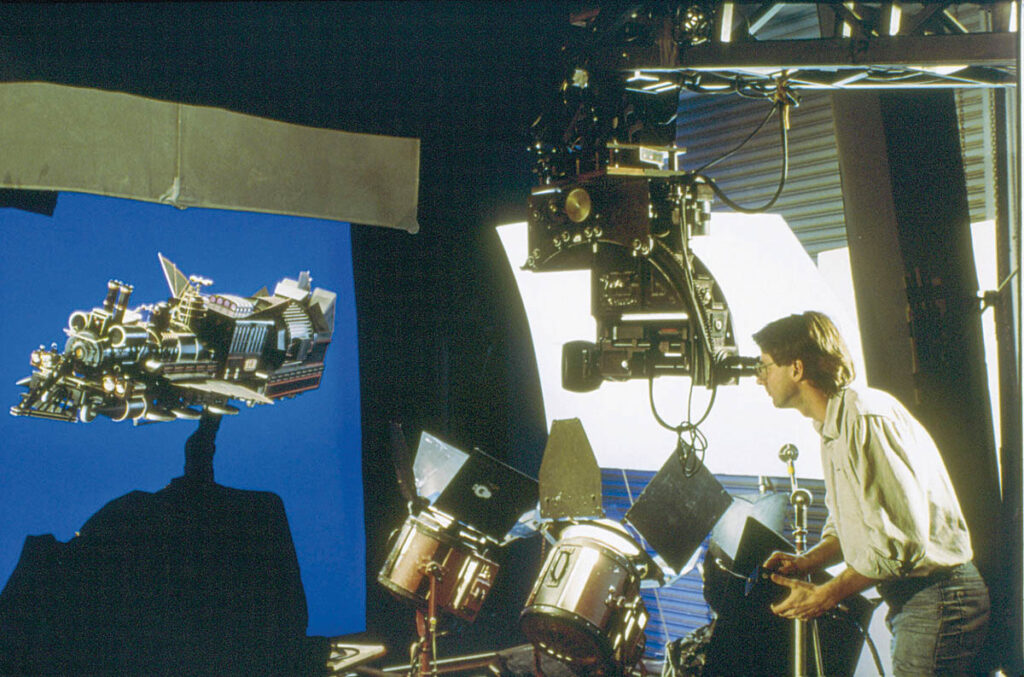
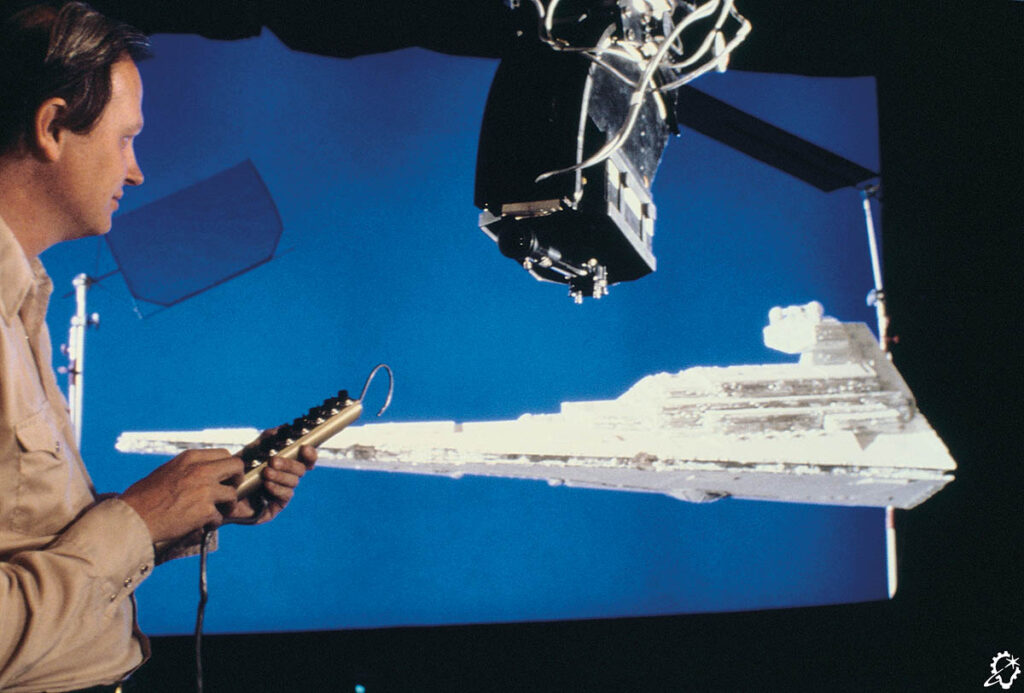
The 1,500-pound Dykstraflex system was built with stepper motors, a VistaVision camera on a boom, and typically a 40-foot track. Camera operators used joysticks or potentiometers to program camera moves that could be recorded and repeated precisely. Simultaneous control of different axes, such as roll, pan, tilt, swing, boom, traverse and track, meant spaceships could bank, dive, fly and curve. One pass might have an X-wing starfighter curve toward the viewer, a second might send a second ship curving away. Additional passes could add lighting and the star field. Each pass would be viewed in black and white on a Movieola and composited optically before being filmed in color and optically composited to create final shots. Although the system was revolutionary, John Dykstra and his merry band of artists and engineers didn’t invent the Dykstraflex out of a void. Visual effects crews and others had used motion control systems for years. “In the early days, visual effects for the most part relied on stop-motion animation,” Dykstra says. “With these incremental still frames, there is no motion blur. People understand if something has a jittery motion without motion blur that it’s not real.”
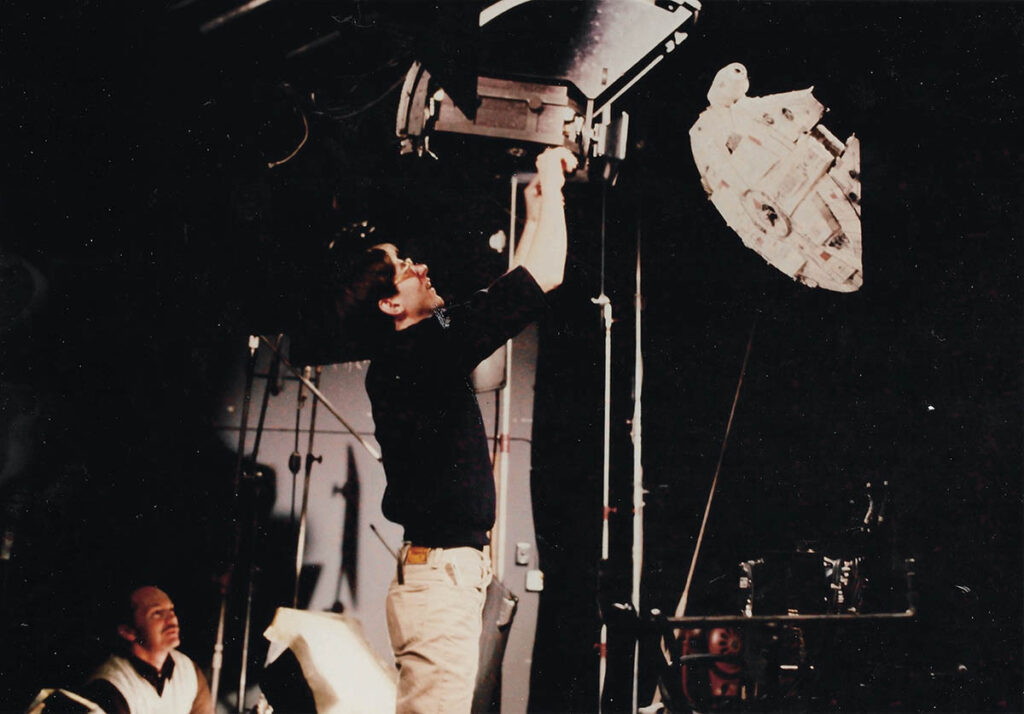
For Stanley Kubrick’s 2001: A Space Odyssey Douglas Trumbull, VES, and his team devised a motion control system that moved a camera down a track past a model, panning in a linear way, which kept detail and depth of field. Multiple synchronized passes recorded and composited together produced beautiful final shots with high quality, stately motion. But even using an upgrade for Silent Running, a camera operator couldn’t accelerate or decelerate the moving camera. Dykstra worked on Silent Running – his title was “Special Photographic Effects” – and that helped him land a job on a scientific project funded by the National Science Foundation at the University of California Berkeley’s Environmental Simulation Laboratory. Researchers there wanted to evaluate whether simulated environments could more accurately convey how people might experience a proposed plan than static models and drawings. The goal was to determine what made images believable.
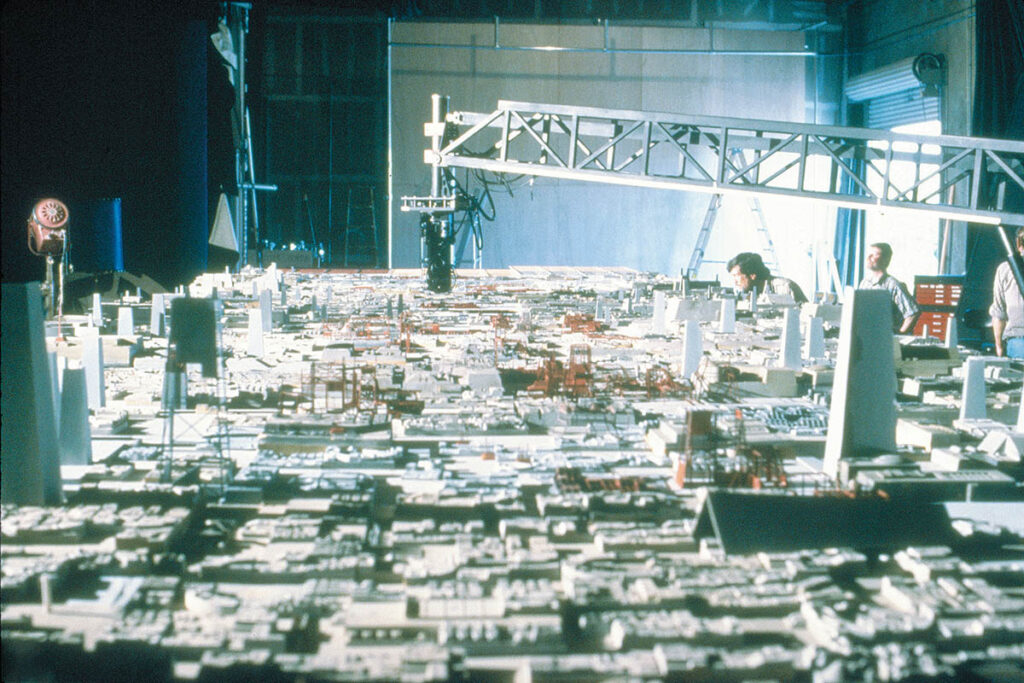
For the simulation, they built a detailed model of a suburb and populated it with landscaping, streetlights, cars, houses, even gas stations. Each inch represented 30 feet of streets and terrain. A moving gantry above the model had a 16mm camera hanging down and an optical system that provided an eye-level view. A PDP-11 computer controlled the rig, allowing a route to be precisely repeated. Of the 800 people who viewed the simulation, many refused to believe that models were used. And it was most effective when it simulated something never before seen by the viewers.
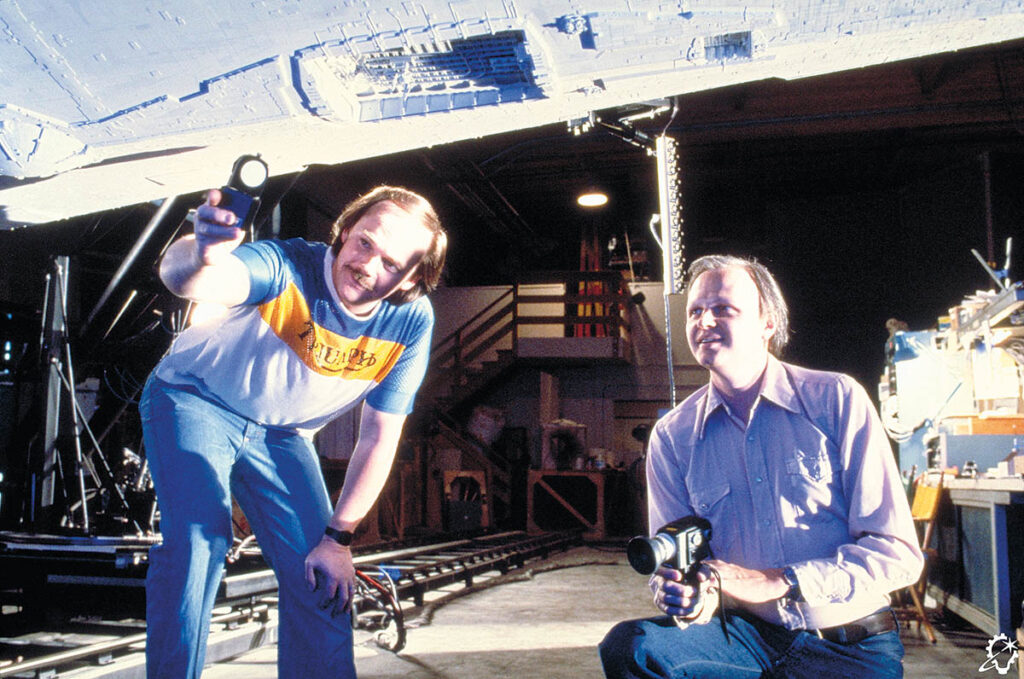
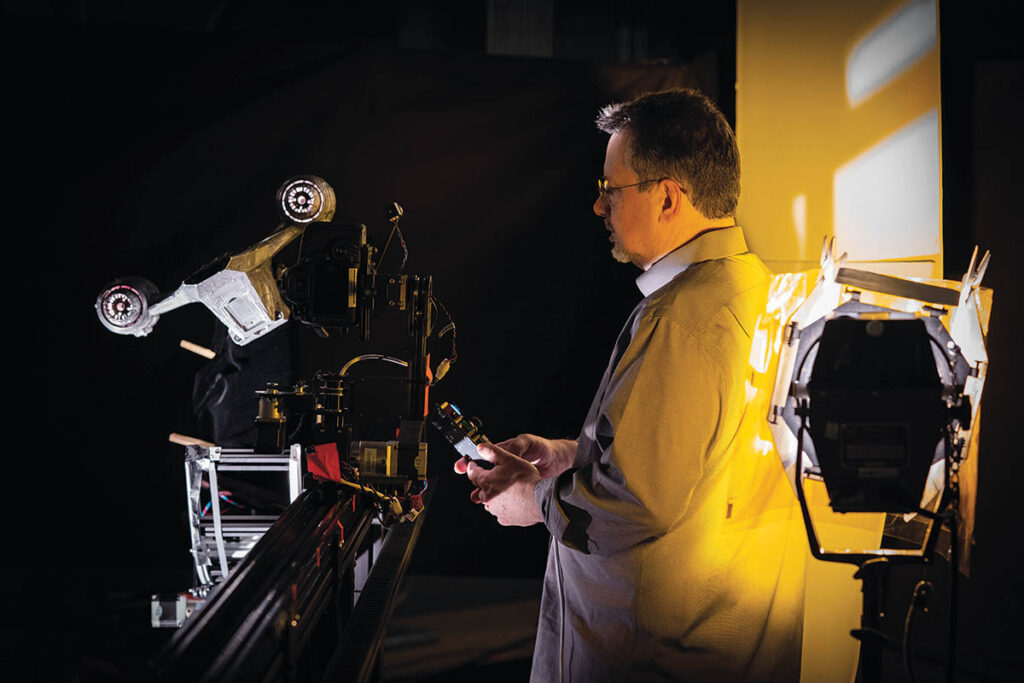
Dykstra’s next project would be Star Wars. George Lucas provided the opportunity, vision and need. Dykstra and the young crew he hired provided the MacGyver energy and willingness. “I think George wanted the audience to be a participant, to become engaged at a personal level, to have the engagement that 2001 was able to generate,” Dykstra says. “The whole premise of the movie screen being a portal into which you are drawn had a lot to do with George’s vision of having visuals that supported his reality. But one of the difficult things to do is to find out what the cues are.”
“People have subliminal survival systems,” Dykstra explains. “They’re able to evaluate speed, how much energy something traveling carries; whether that rock coming toward you has the same sense of mass and trajectory as in real life. Does it bring you out of your seat and into the movie?” That, he says, was the premise behind the dogfight battles that were intrinsic in the Star Wars movies; behind capturing the energy of handheld cameras in the middle of the action just like World War II movies, with ships flying by. “That was something I was totally involved in,” Dykstra says. “Creating that sense of momentum and personal involvement. That is what the Dykstraflex was involved in, to get all the subtle cues you have in real life.”
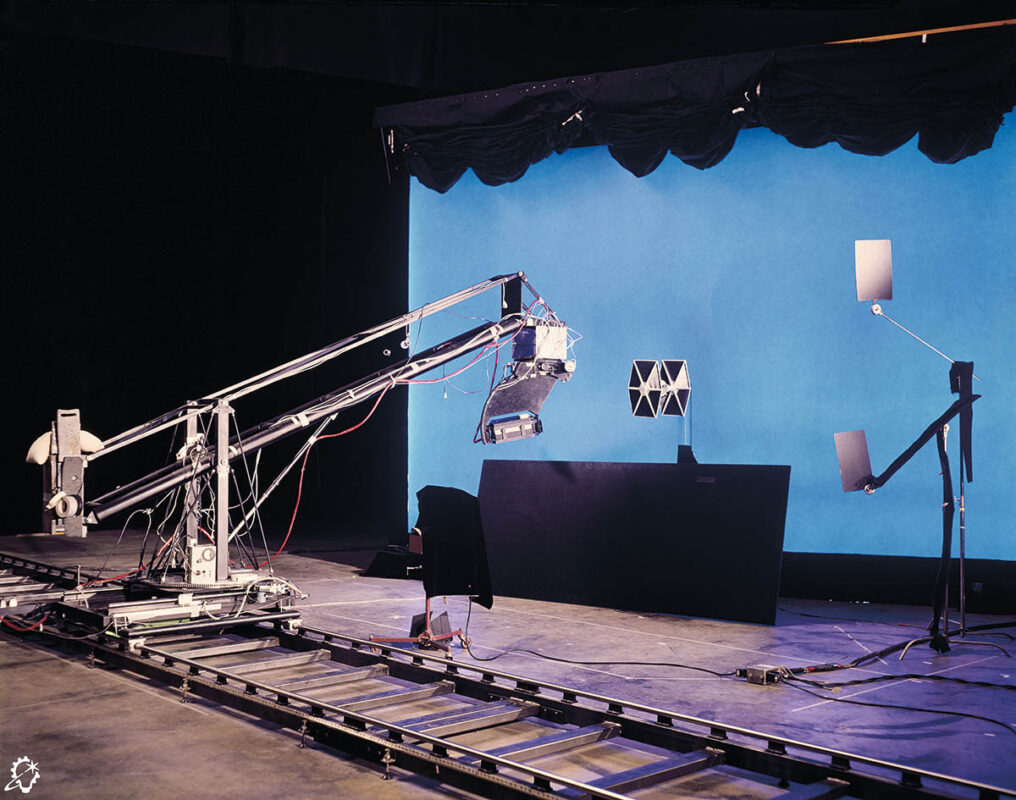
THE KEY
“The key was to figure out a way to integrate the motion of the camera in multiple axes and to have the camera in the same position more than one time,” Dykstra notes. “What we did was control the camera moves with a computer, which gave us the ability to synchronize several axes with the motion of the camera and repeat them. We could generate multiple elements with the same camera move.” Knoll states, “To put all that into a package that was cameraman-friendly, with a conventional-like camera crane that could shoot any move, was transformative.” First cameraman Richard Edlund, VES, and his camera operators could film one pass and the system would precisely replicate the motion for a second pass. A boom arm let the underslung camera move close to a model. The VistaVision camera gave them large-format film. But there was something more.
“I had precision accuracy of the camera in all axes of motion and could vary the speed,” Dykstra says. “To move with acceleration with the motion control system was something no other system could do. Then, to enhance that sense of speed change, we could move close to the miniatures.” That flexibility proved to be essential for Star Wars’ spaceship dogfights. In the television documentary Light and Magic, George Lucas says, “Movies are kinetic. It’s about movement. Forget the actors, forget the story. It’s all about movement.” No other system provided camera moves with acceleration and deceleration.
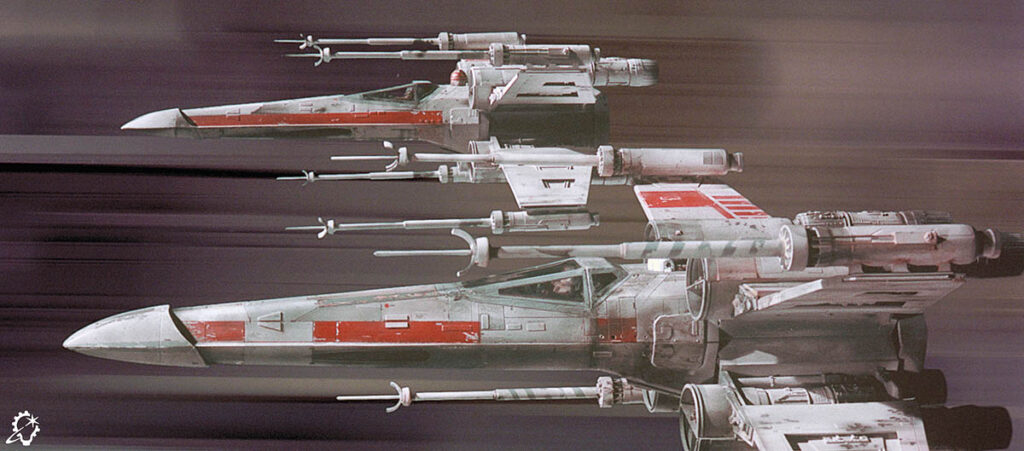
“John [Dykstra] must have recognized that we needed to be able to slow things down and speed them up, and he was absolutely right,” says Dennis Muren, VES, who was a second cameraman at ILM back in 1977 on A New Hope and went on to win eight Academy Awards for best visual effects at ILM before semi-retiring. “If you’re going to have a curve, one motion is going to need to slow down, and then you have to go back and put in the other motion of speeding up to get the curve.”
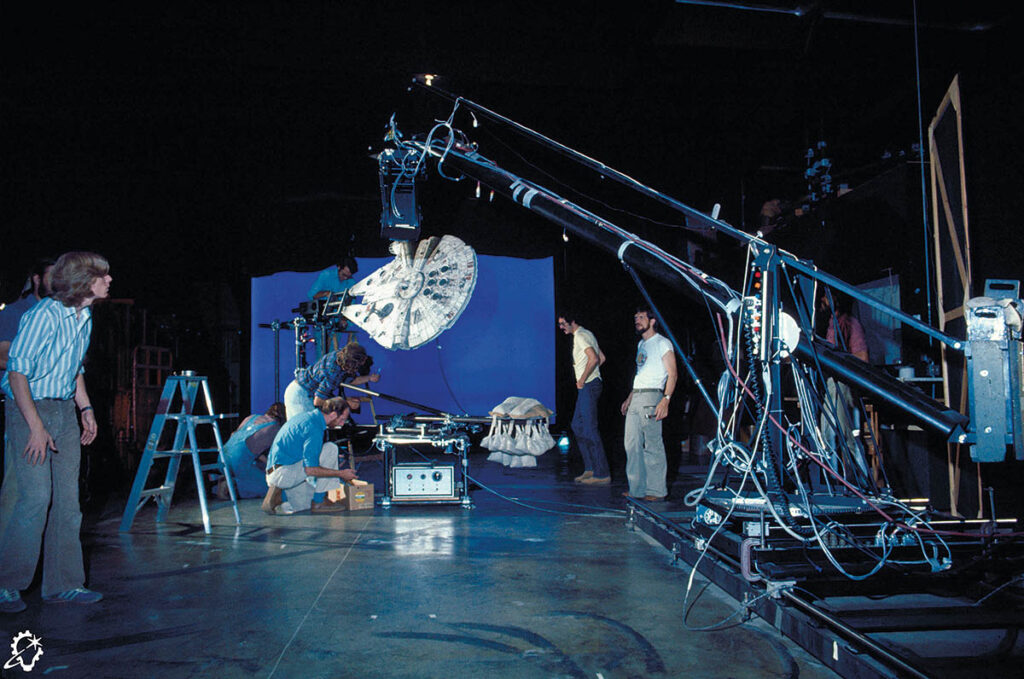
After New Hope, Muren moved north with ILM from Los Angeles to Marin County and was a cameraman on Close Encounters. “That system was all linear, nothing like the same situation at all; it was easy,” Muren says. “New Hope had been so hard I was just thinking about getting the shots done. It took a long time to figure out mechanically how to use the D-Flex. Each motor controlled one axis, so trying to do two things at once, like pan and tilt, was like working an Etch A Sketch. And you’re doing the layers all one at a time, so you can’t really see them together until you play it back. But, during that time I worked on Close Encounters, I thought about what I had learned on Star Wars. I thought about all the dynamics you can have in a three-dimensional space.” Muren envisioned these new shot designs knowing the Dykstraflex would give him the control he needed.
BEYOND A NEW HOPE
“If you can formulate three dimensions and fluidity in your mind, you can design shots that you’ve never seen before that are completely different from storyboards,” Muren says. “You may find a frame that’s like the storyboard, but the dynamics give it power. We used to take storyboards more literally,” he adds. “But you know, even previs today is done with cheating. If you have something go off in the distance, they’ll just scale it down. They think it’s the same thing, but it’s not. It’s not going to have the reality that the rest of the film has with actors walking around and living in that world.”
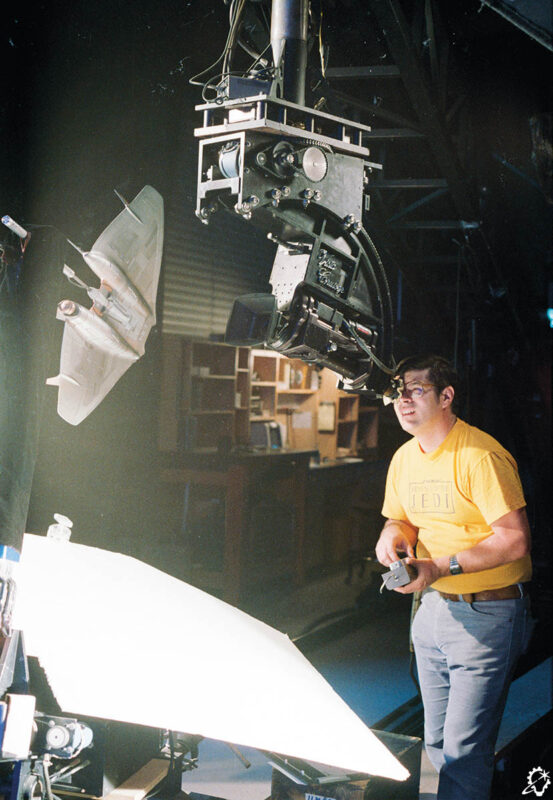
Muren tried out his new shot design ideas on Battlestar Galactica in 1978 using the Dykstraflex. He describes a storyboard with tiny Cylon ships off in the distance strafing the Galactica ship, shooting at it, getting farther and farther away. “I thought what if you start the Cylon close to the camera with the Galactica way down there,” he says. “You start going with the Cylon as it goes faster and farther, and it ends up reversed with the Galactica huge and the Cylon small. I realized recently that it’s a Vertigo shot. It was one long shot, but sadly they cut it into three shots for the film. That’s what the Dykstraflex gave me. The possibility. I could previsualize something in my head spatially with multiple objects moving at various speeds and put them in a way that it creates something dynamic at the level needed for a major motion picture – not just moving around, but with pacing – and then get it on film.”
After Galactica, Muren became Effects Director of Photography for The Empire Strikes Back and received an Oscar for best visual effects, as did VFX Supervisor Richard Edlund, who had moved to Northern California with ILM. They both earned Oscars again for Return of the Jedi.
“I would never have conceived a tool that complicated,” Muren says of the Dykstraflex. “And yet once you figured it out, you could do anything. I took shot design further because I had a tool that could do it. And, I applied what I learned to later films, even to Jurassic Park, even though there’s no motion control in Jurassic. I’m very glad John built the Dykstraflex and that George let him build this crazy thing. It gave us a level of wonder that would not otherwise have been there. It opened up something for me.”
It affected others, as well. Take animator Peter Daulton, for example. “I learned how to be a camera assistant and motion control camera operator on the D-Flex,” says Daulton, who worked at ILM from 1983 until 2019. “Those skills came in handy when I made the switch to CG in 1993 as an animator. The Dykstraflex made my dream career possible.” Daulton is now writing, producing, directing and filming short documentary films. The last thing he remembers shooting on the Dykstraflex was a miniature gothic mansion for Death Becomes Her. “Soon after that, I switched to computer graphics. As a motion control operator, I had learned how to smooth curves, to modify our curves. That was a step toward CG.”
“The D-Flex was pivotal in spawning a significant era in visual effects,” says Jim Morris, Pixar’s General Manager, who was at ILM from 1987 to 2005 as a producer, Executive in Charge of Production, then General Manager. “It was a piece of mechanical equipment able to do a job because it was connected to a computer, which made the repeatability possible. It was a transitional link between the photochemical and mechanical technologies used for years and the digital worlds now.”
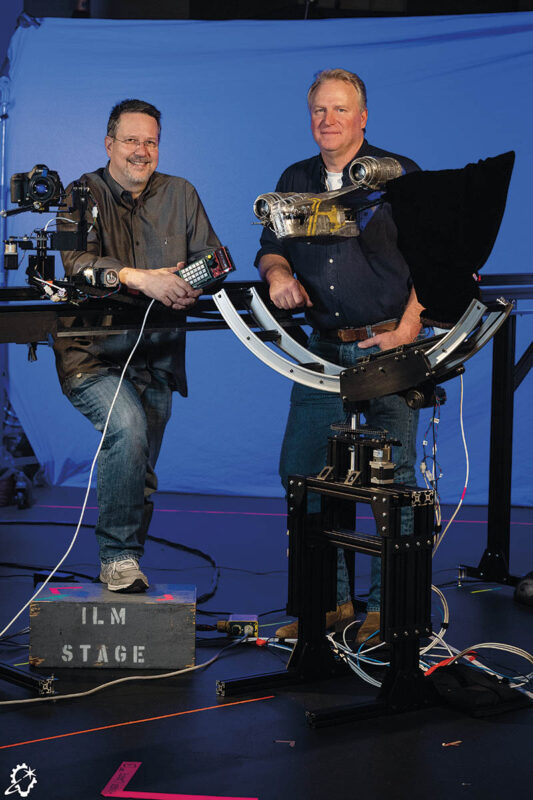
Motion control camerawork fell out of favor when miniatures tended to become more expensive than CG models, and when computer graphics became more flexible – a digital model could be used in an infinite number of concurrent shots, whereas a physical model could only be used to film a single shot at any given time. But recently, John Knoll returned to the world of motion control camerawork to create some shots for the television series Mandalorian. “[Producer, writer, director] Jon Favreau became interested in using miniatures,” Knoll says. “We showed him a couple of [CG] shots of the Razor Crest flying through space, and he said that something didn’t feel right. Shouldn’t it be more reflective? He thought we should build a model and shoot reference.” Knoll took it on as a challenge and built a motion control system in his garage, including all the electronics, that he used to film 16 shots of a model built by modelmakers John Goodson and Dan Patrascu. “Even though we used the miniature for only 16 shots, they made all the other shots look better,” he says. “We can get a look with a miniature physical object and lighting that’s surprisingly hard to do with computer graphics. We retooled the look of the CG model.”
It’s easy to think of the Dykstraflex as simply the system that gave George Lucas his WWII dog fights in space, although that’s accomplishment enough. But people using it achieved something deep and long lasting that changed visual effects beyond Star Wars. It opened ideas for shot design that undoubtedly helped Dennis Muren win eight Academy Awards for Best Visual Effects. It helped foster new careers for artists like Peter Daulton. It was a transitional link. And, a modern-day version of the Dykstraflex is being used today at ILM. It has given visual effects artists the possibility of images never seen before. And the revolution continues to this day.
“At their core, that’s what all these tools should be about,” Morris says. “They should extend our artistic reach, to be creative and make better stuff.” And then magic happens.
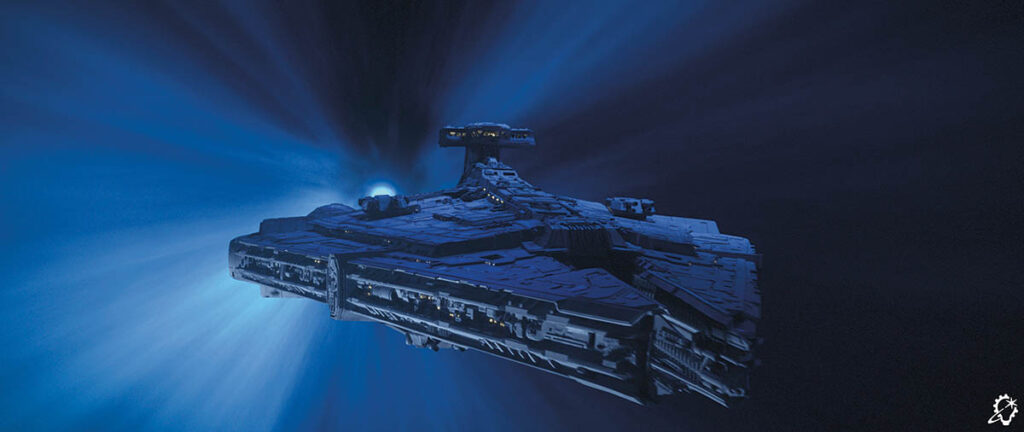
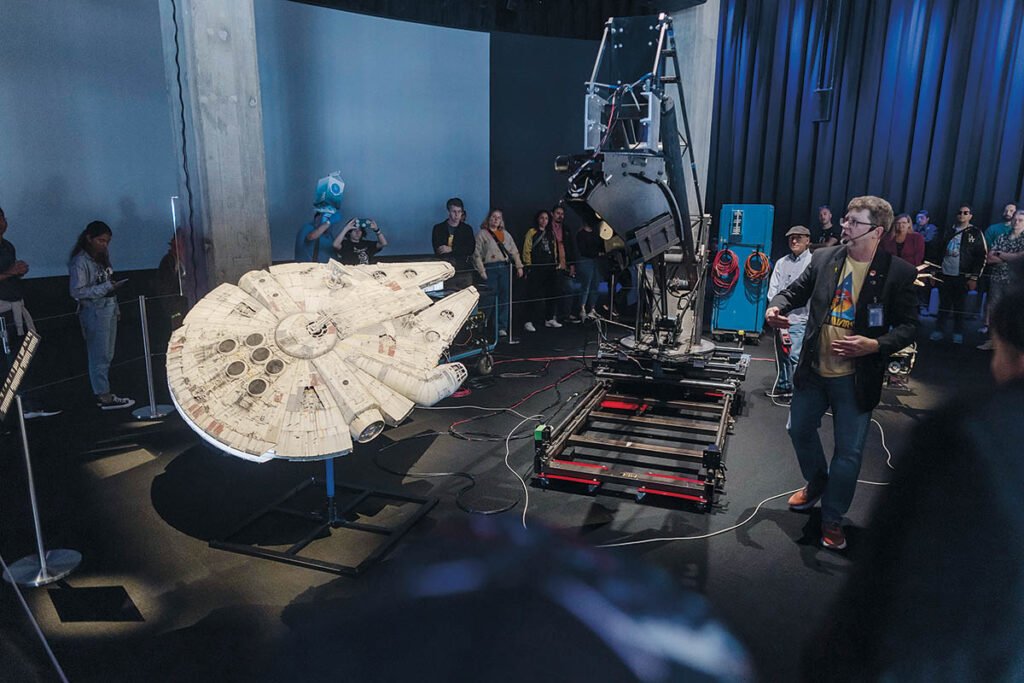
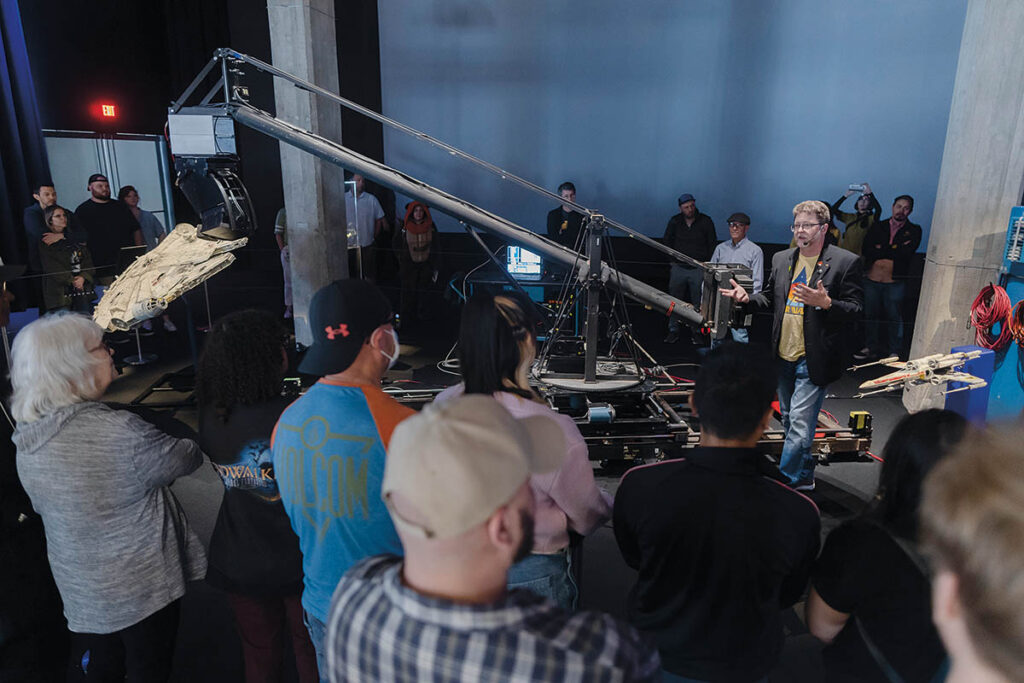
The D-Flex moved to Northern California with ILM in 1978, and camera operators continued using it and updated versions of it until around 1992, and it was set aside. People lucky enough to be in L.A. in 2024 had an opportunity to see the legendary camera system in action during an exhibition at the Academy Museum of Motion Pictures.
“The Dykstraflex is part of the Academy Collection and a revolutionary camera system that fundamentally changed how special effects were filmed in the original [Star Wars] trilogy and transformed cinematic visual effects worldwide,” says Museum Director and President Amy Homma.
Working in partnership with the Science and Technology Council at the Academy of Motion Picture Arts and Sciences, Academy Foundation Vice President and VFX Branch Governor Brooke Breton, VES, along with Visual Effects Producer and Historian Gene Kozicki, VES, helped spearhead the effort.
It took about six months to plan and one week to cobble together and install the Dykstraflex and a model of the Millennium Falcon. Scheduled to run from May 4 to July 8, the exhibition was so popular the museum extended it to July 28. Live demonstrations occurred throughout.
“The turnout exceeded our expectations,” Homma says. “Especially during weekend demonstrations in May. It was standing room only for each of our sessions, and we reached our maximum capacity in our gallery.” Special guests included Richard Edlund and John Dykstra, both of whom received Oscars for the Best Visual Effects in A New Hope, as did with Jon Erland, VES, and Alvah Miller, the electronics and electronic systems designers.