Images courtesy of Sucker Punch Productions and Sony Interactive Entertainment.

Images courtesy of Sucker Punch Productions and Sony Interactive Entertainment.
A mainstay of the creative team at Sucker Punch Productions ever since working on Sly 2: Band of Thieves (2004) as a texture artist, and subsequently becoming the environments lead on Ghost of Tsushima (2020), Joanna Wang got to explore the Edo period as an art director with Ghost of Yōtei (2025), which takes place 329 years after the samurai sensation. There were lessons learned from Ghost of Tsushima, which were applied to the revenge tale where the mercenary Atsu attempts to find and kill the Yōtei Six, responsible for the death of her family.
“From Ghost of Tsushima, we learned how powerful it is when nature tells the story,” notes Joanna Wang, Art Director at Sucker Punch Productions. “How color, light and weather can guide a player’s heart without a single word; that emotional honesty became our compass. With Ghost of Yōtei, we wanted to carry that soul forward. The same poetry, the same beauty in motion, but expressed through a colder, wilder, untamed land. Ezo has a different spirit. The wind feels stronger, the sky stretches wider and the weather is unpredictable. It’s raw land beyond the edge of Japan. That contrast is what makes Yōtei feel connected, yet new. Tsushima gave us the heartbeat; Yōtei gave us a new voice to speak with.”
World-building always begins with the same idea. “It’s not only about how the world looks, but what we want the player to feel,” Wang states. “Art, gameplay, culture and mood all have to work together. The environment should guide the player, support the story, respect the land, and still carry our emotional, artistic voice. This time, with Ghost of Yōtei, the approach evolved because the map itself is different. We divided the island into six distinct regions, each with its own look, emotion, and even gameplay rhythm. We designed each region with a sense of build-up, a shift in tone and atmosphere as players cross into new areas. The core methodology stayed the same, but the scale and structure of Yōtei pushed us to think more deeply about regional identity and how the world grows with the player’s journey.”
Guiding the visual language was a particular phrase coined by co-directors Nate Fox and Jason Connell. “I remember very early on, the phrase they used was ‘The edge of Japan,’” Wang remarks. “It instantly captures the feeling of wild, mysterious, untamed land with so many stories waiting to be told.” Dealing with the scale of Hokkaido was the most immediate challenge. “Those open fields that stretch forever, forests that swallow the light, and snow mountains that rise like giants on the horizon. It stretched both vertically and horizontally. It’s beautiful, but also incredibly intimidating. That scale pushed us in every direction. Gameplay had to adapt because encounters work differently when players can see danger from a mile away. Rendering had to adapt, since showing that much land, sky and shifting weather without breaking the game became a major technical hurdle. Art had to adapt too. We had to make those massive spaces feel intentional and emotional, not empty. It wasn’t easy, but that’s what made it exciting. Those challenges shaped Yōtei into something bold and new.”
Locations were scouted in Japan, such as national parks, remote wild areas and Matsumae Castle. “We even spent time with an Ainu family, foraging, cooking, learning how they honor nature and seeing how they design fabric,” Wang recalls. “We visited their museum to better understand their history. The team brought back tons of photos and videos for reference, but honestly, the most important thing we brought back is memory. What we saw, what we heard, what we felt, even what we tasted in Hokkaido. The way wind moves through bamboo grass, the texture of old tree bark, the sound of birds echoing across open fields. Those sensory moments stayed with us and became the emotional foundation of our world. Also, same as we did for Ghost of Tsushima, we worked closely with Japanese cultural advisors every step of the way. They guided us, corrected us and helped ensure our interpretation stayed respectful and authentic. All of that: those experiences, those feelings and that collaboration shaped the heart of the world you see in the game.”
Narrative, mood, emotion and gameplay feed into one another. “The narrative, mood and emotion set the tone for how the world should feel – lonely, hopeful, dangerous, peaceful – and that feeling becomes the backbone of our world-building,” Wang explains. “Gameplay then shapes the rhythm, where tension builds, where players can breathe, where the world needs to open up or tighten in. But it also works the other way. For example, memory swap changes the environment and can quietly nudge the narrative in a new direction just by one push of a button. For us, none of these pieces stand alone. Mood shapes the world, gameplay shapes the flow, and the world answers back with new ideas. That push and pull is what makes the world feel alive, and why everything feels connected when you step into Yōtei.”
An important aspect of gaming is creating environments that players want to explore. “For me, the real trick is curiosity through contrast,” Wang remarks. “Giving the world small moments that tug at you. A single red tree burning on a distant hill, a strange rock silhouette that feels like an animal, or a weathered gate standing alone at the edge of a forest; little things that make you wonder, ‘What’s over there?’ And then the world gently guides you. The wind kicks in and hints you toward your next destination. A patch of white flowers that give your horse a boost. A bird suddenly appears, inviting you to follow and discover something hidden. When the world feels alive like that, full of tiny invitations and quiet mysteries, players explore, not because they’re told to but because their heart pulls them forward.”
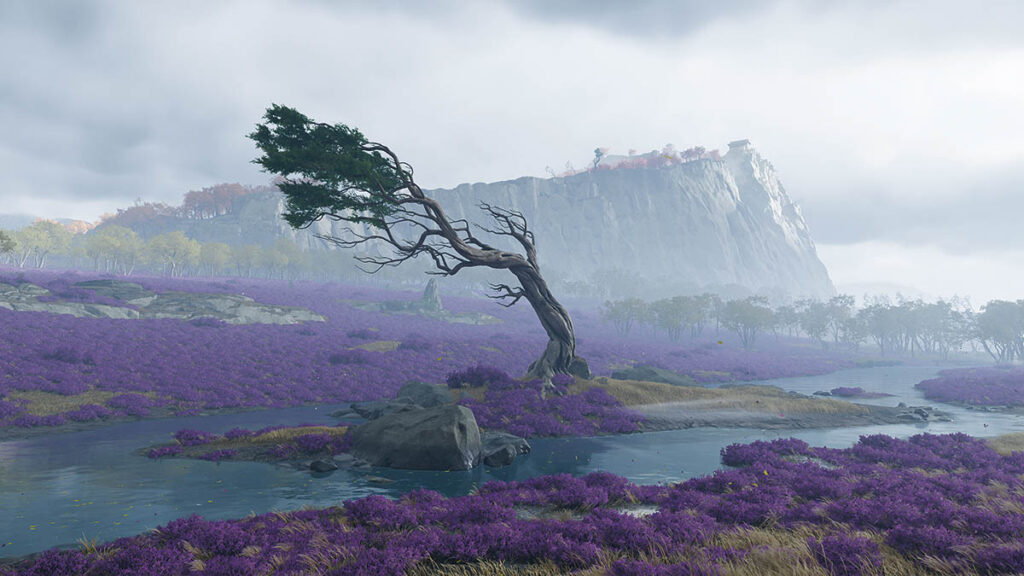
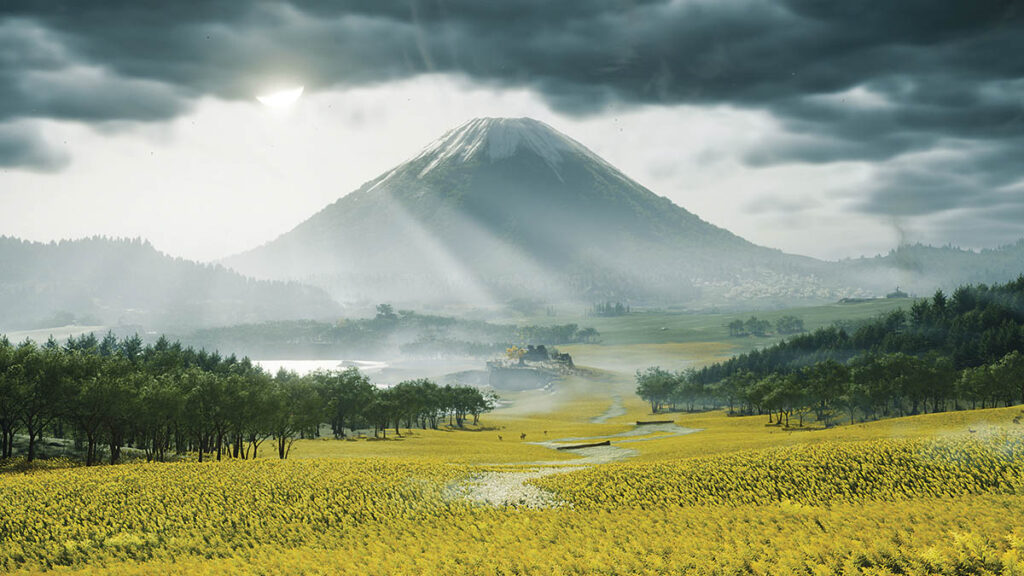
Six major regions are explored. “The Yōtei Grasslands is where Atsu’s story begins, so it needed warmth, memorable places and the constant presence of Mount Yōtei,” Wang states. “We added memory swaps throughout the area to make you feel this is the place she lived 16 years ago – familiar, comforting, but touched by loss. The challenge was to make it inviting for new players while carrying that emotional weight.” Tokachi Range is one of the most open vast areas of the game. “Endless grass fields stretching toward distant snow peaks. The challenge was scale and readability. We balance the size, shape of landmarks and POI [points of interest]. The pagoda stands behind a foggy bamboo forest, a wind-shaped tree in the middle of the hill, and a sharp vertical mountain cliff that leads you to one of most beautiful shrines. We try to keep it open and natural without letting it feel empty or directionless.”
Teshio Ridge, in the far north, is harsh, mysterious and breathtakingly beautiful. “Enemies can disappear into the white and ambush you from the snow, and the terrain hides countless secrets,” Wang remarks. “We built layered puzzles through caves, frozen passages and hidden pockets of landscape, making exploration feel risky and rewarding in this unforgiving world.” The Nayoro Wilds are home to the Ainu, an indigenous ethnic group residing in northern Japan. “We worked closely with Ainu cultural advisors, understanding traditions and making sure the environment is respectful and felt authentic without losing our artistic voice.”
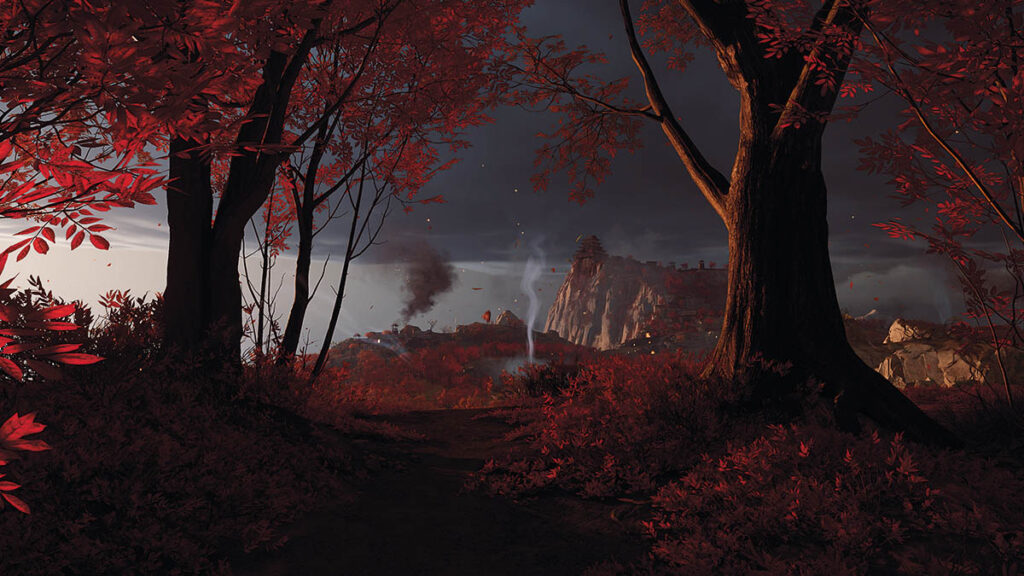
Ishikari Plain was the first valley to be worked on. “We had lots of iteration,” Wang reveals. “It took a good amount of effort finding the right balance on theme, shape, color and content density. In the end, we began with Hokkaido’s vibrant autumn colors, then shaped the region around the Oni and fire theme. Orange-red trees add to the mood while a steep hilltop castle dominates the entire space. Burned forests and ruined towns add strong environmental storytelling.” The Oshima Coast is the most established area due to the presence of the Matsumae base. “Its layout needed to feel structured and lived in. Inspired by the real Matsumae Castle, it features towns, farmland and fortified spaces tied closely to the narrative. It’s also where some of the biggest battles unfold, giving the region a sense of history, tension and movement.”
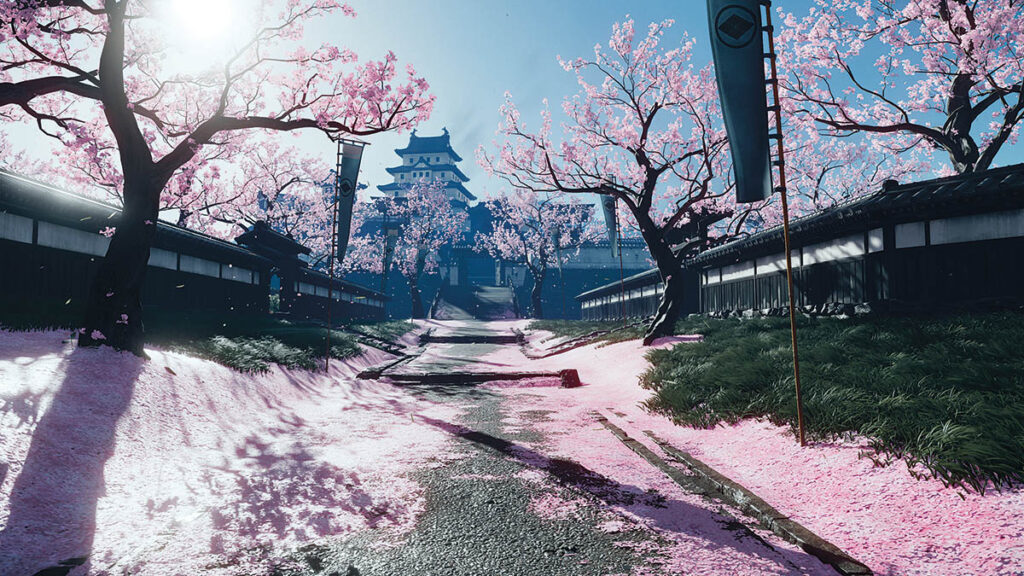
Each region has its own landmark and signature moment. “Mount Yōtei is the big one,” Wang notes. “It sits right in the heart of the map. This massive, isolated volcano mountain that you can see from other regions. Its scale plays completely differently from the rest of the world – towering, quiet and always watching you. It became a visual landmark of the entire game. Another key landmark is Matsumae Castle. With its white walls, dark rooflines and the cherry blossoms framing the structure, it brings a strong cultural presence and a sense of history to the world. There are many more, but those two are perfect examples of how each region gets its own identity, something iconic, memorable and emotionally tied to that part of Yōtei.”
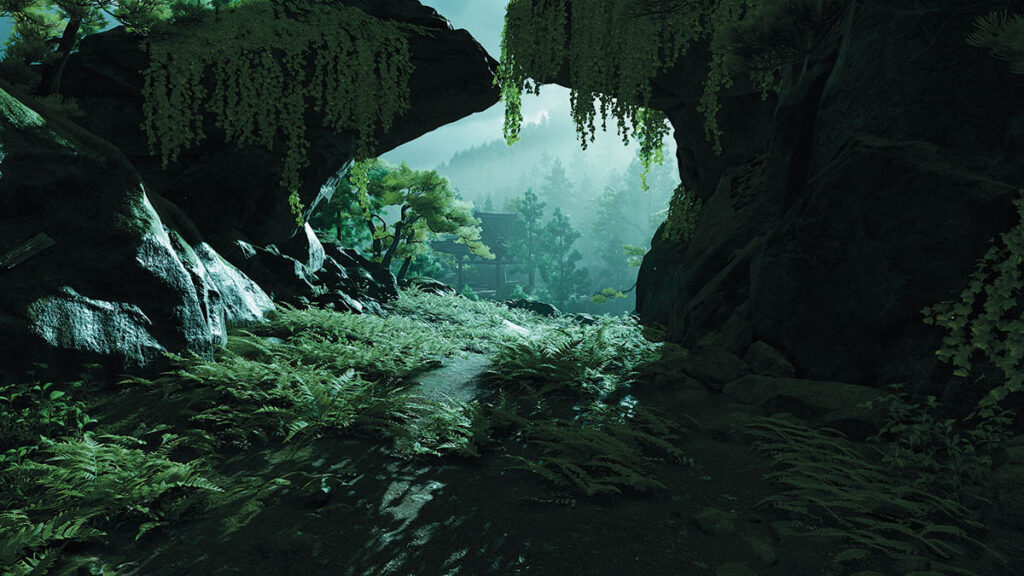
Shrines are an integral part of the spiritual life in Japan. “With a map as big and rich as Yōtei, the shrines were our chance to show players the world from a different perspective,” Wang explains. “We treated each shrine like a little stage, a pocket of the world with its own personality. Maybe it’s perched on a mountaintop with the whole valley unfolding beneath you, or tucked by a misty lake where everything feels soft and quiet, or on the coastal rock where wind hits hard and waves crash beneath your feet. We wanted players to pause, take a breath and just feel each place. Also, every shrine needed its own journey, a traversal challenge that fit its vibe. Some build upward, some stretch sideways, some tease you with a view before making you work for it. The fun part was letting the landscape lead us, finding those special spots where the world already felt magical, then designing a shrine that brings that magic to life.”
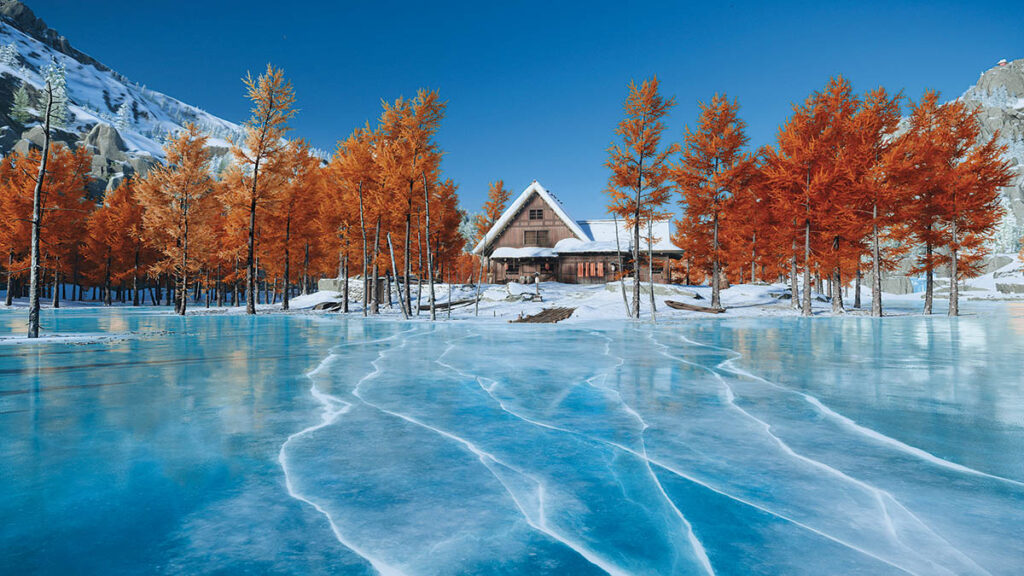
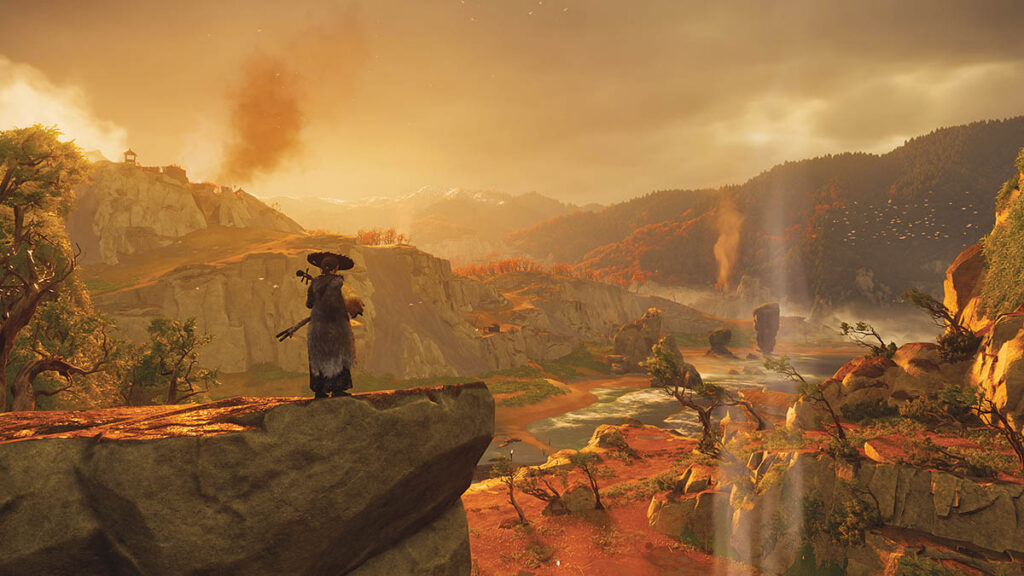
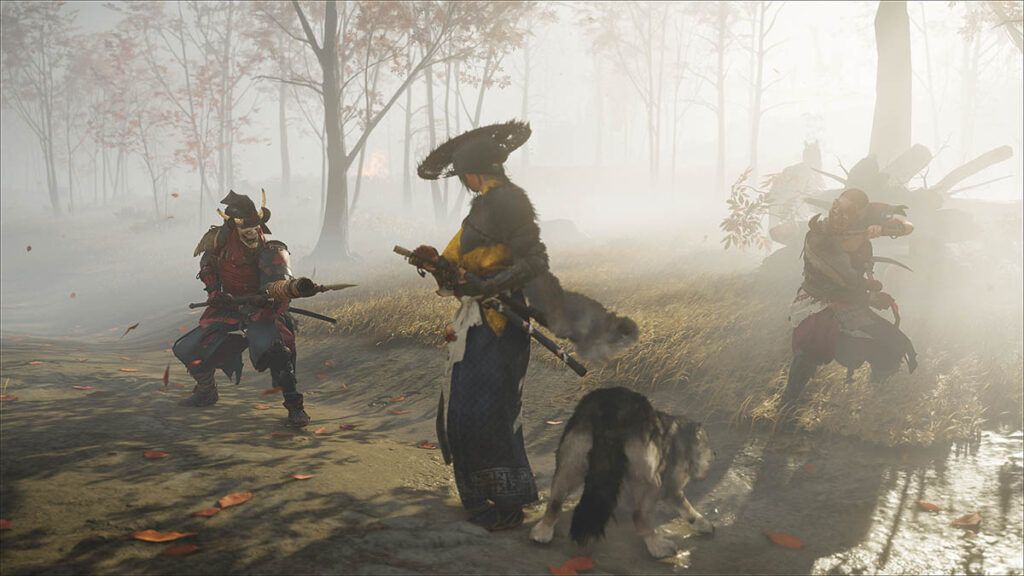
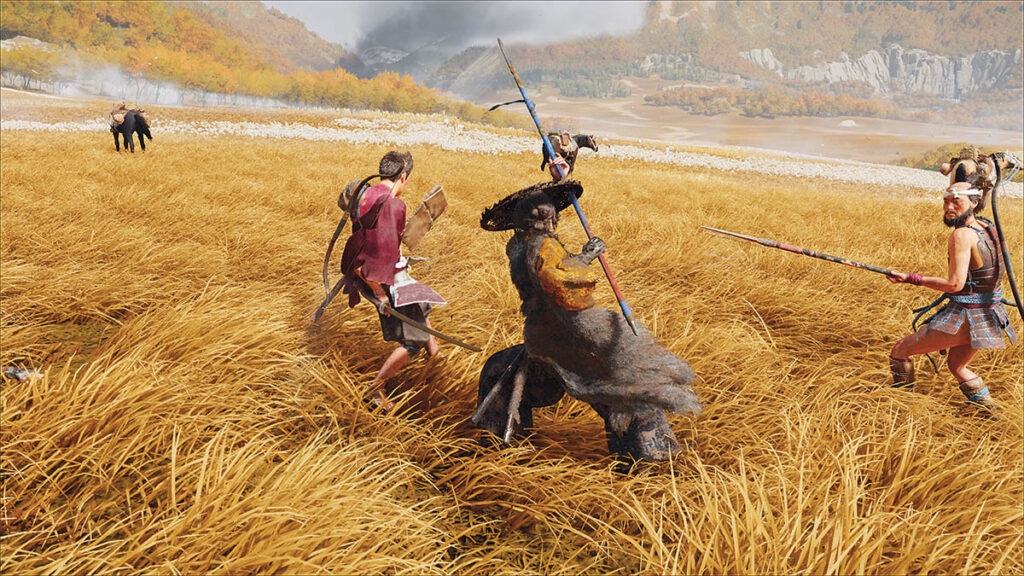
In order to emotionally engage players, the visuals had to feel like a living painting. “To get there, we leaned heavily into shape, color and motion,” Wang states. “Clear silhouettes that read instantly. Bold color palettes that set the mood the moment you enter a space. And natural-motion-made wind sweeping through grass, snow drifting off branches, mist rolling across the hills and birds singing through the sky. All of these layers stack together to bring the world to life.” Visuals are not meant to be distracting. Wang adds, “At the same time, we’re constantly simplifying, stripping away anything that doesn’t matter, from big picture layout to small detailed texture level. The important things can stand out – your path, your goal and the emotional beat of the moment. When it all comes together, the world stops feeling like a level and starts feeling like a living painting.”
Seasonal changes in nature guided the color palette. “Each region has its own moment in the year,” Wang explains. “Spring in the south of Oshima Coast with soft pink cherry blossoms. Summer’s lush greens sweeping across the Yōtei Grasslands. Autumn turns the Tokachi Range and Ishikari Plain into waves of gold and deep red. And finally, the far north of Teshio Ridge wrapped in pure white snow. Second, color became a way to elevate the narrative tone. The Oni lean into intense reds and warm, destructive hues while the Kitsune carry cooler tones, pale blues, quiet whites, even the soft shimmer of blue fox fire. The palette shifts not just with the land, but with the emotion of the story. On top of that, we added other touches that give the world a distinctly Japanese feel, like red maple leaves drifting across a snowy hill. Moments like that make the world feel both real and poetic.”
Lessons were also learned while making Ghost of Yōtei. “I learned that you can plan everything, map out every detail and imagine exactly how the world should come together,” Wang remarks. “But at some point, the game starts speaking for itself. Things line up in ways you never predicted, and suddenly you’re heading down a path you didn’t even know was there. That’s why it’s so important to lock down the core pillars but stay loose for some other areas. You go with your instincts, make the best choice you can in the moment, and you let the world shift as it grows. Every pass brings its own surprise, and those surprises often shape the world into something better than the original plan. In the end, world-building is so much more than just doing the work. It’s paying close attention, staying flexible, nurturing ideas and letting the game naturally grow into something stronger.
Three Pieces of Concept Art
Delving even deeper into the world-building of Ghost of Yōtei, here are the stories behind three pieces of concept art.
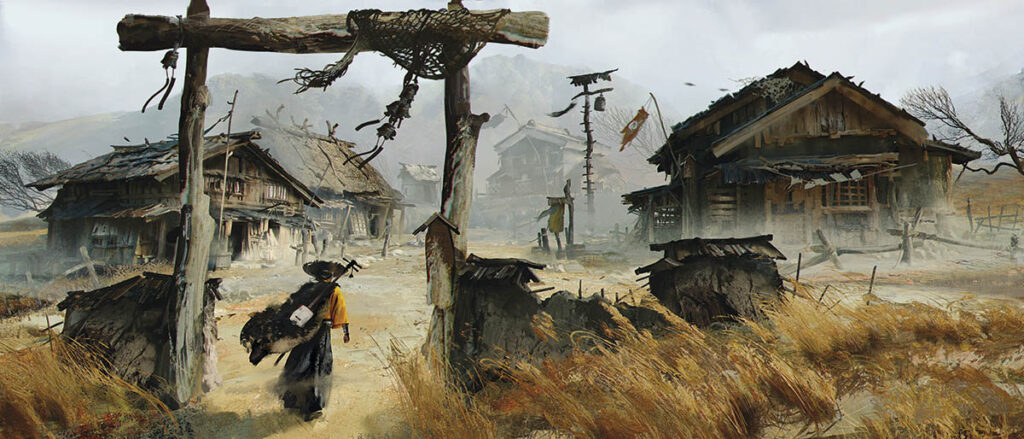
Ishikari Plain Town. Explains Wang, “This was one of our early concepts for the Ishikari Plain town, and we were trying to establish the tone of the region, harsh weather and deep isolation. We leaned into a slight western vibe, wind sweeping dust through empty streets, yellow grass blown to one side by constant gusts. The buildings feel worn down, with wooden beams shaped by years of storms and strong winds. The whole town feels rough and lonely, and there’s always a quiet hint of the unknown and a touch of danger in the air.”
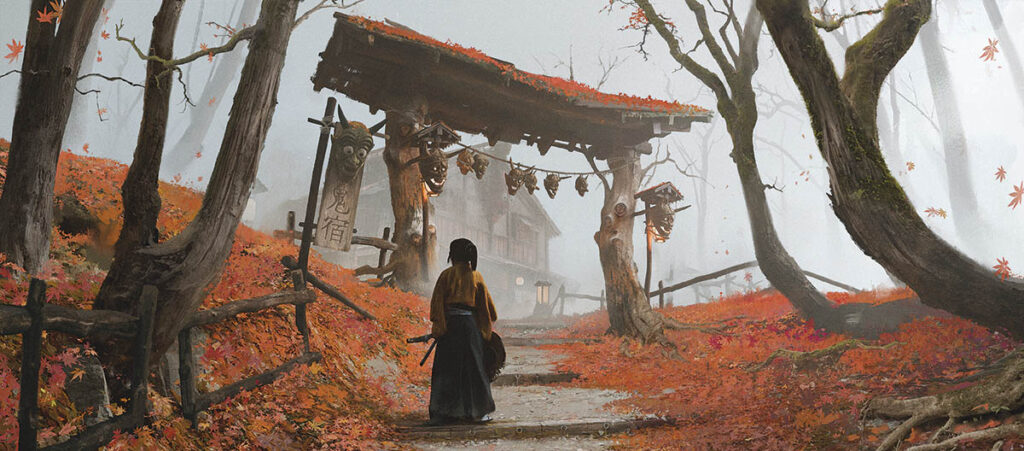
Oni’s Breath Inn. “This is another concept from the Ishikari Plain. Once we locked down the valley theme, Jason Connell pushed us to make this area feel more mysterious and tied deeply into that mood. That’s how the idea of Oni’s Breath Inn began. It sits in a foggy forest. The ground is covered in vibrant red leaves that almost glow through the mist. Strange masks hang from the trees, lanterns, guiding the player toward the inn. The entire space is built around this mask motif; everywhere you look, there’s something watching, something hidden. Even the characters here wear masks, adding to that uneasy, otherworldly feeling. And in the end, the in-game version came out pretty close to this concept.”
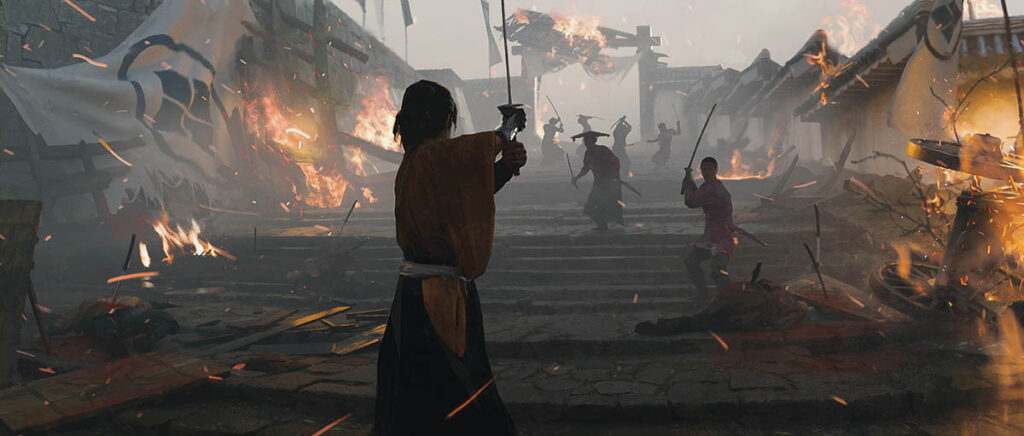
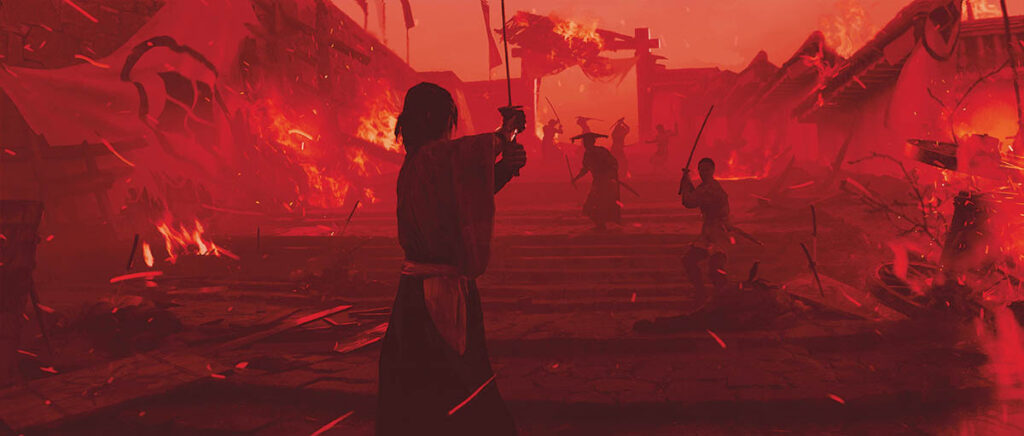
Matsumae Castle Fight & Ghost Stance. “This one is from Oshima Coast, during Atsu’s fight through Matsumae Castle. The mission here is extremely intense; she’s cutting through waves of enemies, and we wanted the environment to reflect that chaos. The air is thick with smoke and fire, visibility drops low, and you often see enemies only as silhouettes moving through the haze. We needed to carve out just enough clarity for gameplay while still selling that overwhelming sense of danger and destruction. And on top of that, we had to make sure it contrasted with the Ghost Stance, which turns the entire screen red. The base atmosphere had to be smoky and muted, letting that moment hit even harder.” (Images courtesy of Sucker Punch Productions and Sony Interactive Entertainment)