VFX Voice

The award-winning definitive authority on all things visual effects in the world of film, TV, gaming, virtual reality, commercials, theme parks, and other new media.

Winner of three prestigious Folio Awards for excellence in publishing.

Subscribe to the VFX Voice Print Edition

Subscriptions & Single Issues


October 06
2026

ISSUE

Fall 2026

TALKING SHOP WITH MODEL ARTISAN JOHN GOODSON

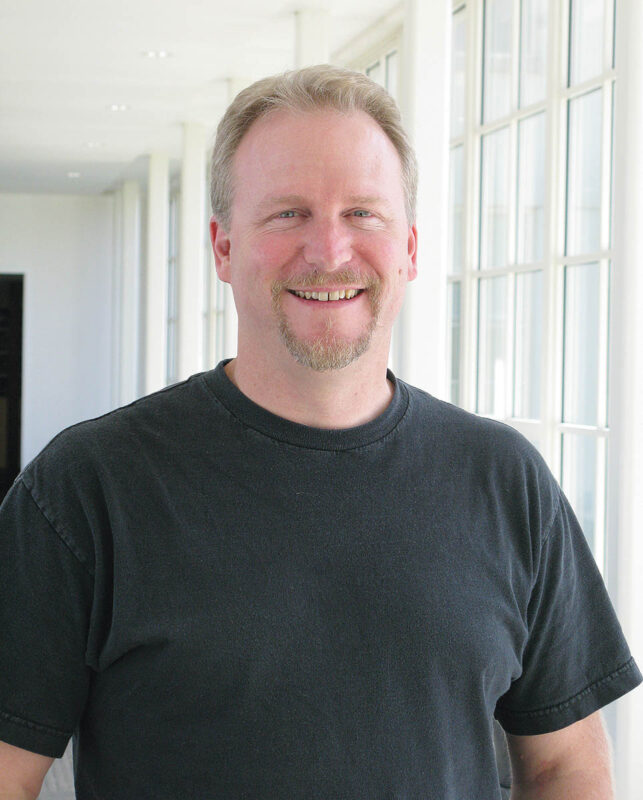
John Goodson, Digital Artist, ILM

One of the most heartbreaking scenes in the Disney+ documentary series Light & Magic, which explores the history of Industrial Light & Magic, details the closure of the Model Shop. Long the heart of ILM’s practical effects operation, it laid the foundation for the pioneering visual effects studio that George Lucas established to create the space battles in the original Star Wars, which resembled the aerial dogfights of World War II. Among those affected was John Goodson, who rose from practical modelmaker to model project supervisor at the ILM Model Shop before transitioning to the digital realm.

“It was really brutal,” John Goodson, Digital Artist at ILM, admits. “The ripples from that are still happening because so many people didn’t make the transition. It is the story of technology. New technology comes in. Older jobs go away. New jobs are created. But for the people caught in the gears, it’s tough.” Goodson transitioned to digital painting. “You get a month’s worth of training, and I was put on the revisions for the special edition of Star Wars: A New Hope. I got to paint Luke Skywalker’s landspeeder. It had been painted in a program I wasn’t trained in. I only knew the one thing they taught me. I had to figure out how to make that work. It was a struggle the whole time I was there, but when we transitioned to a software called Mari, where you could paint in layers of materials, it was better than the real world.”

For Goodson, working at ILM was like going to film school. “I joined the Model Shop in 1988 and believed I knew how to paint. I remember looking at the models, which had this dull paint, and thought, ‘God, these things look terrible.’ But it was because that paint would not reflect bluescreen. If you reflected the bluescreen, that would become a hole in the model, so the shot wouldn’t work. In the Model Shop and Digital, I found people were good at sharing techniques or tips, and just by being in the environment you learned and developed your eye.”
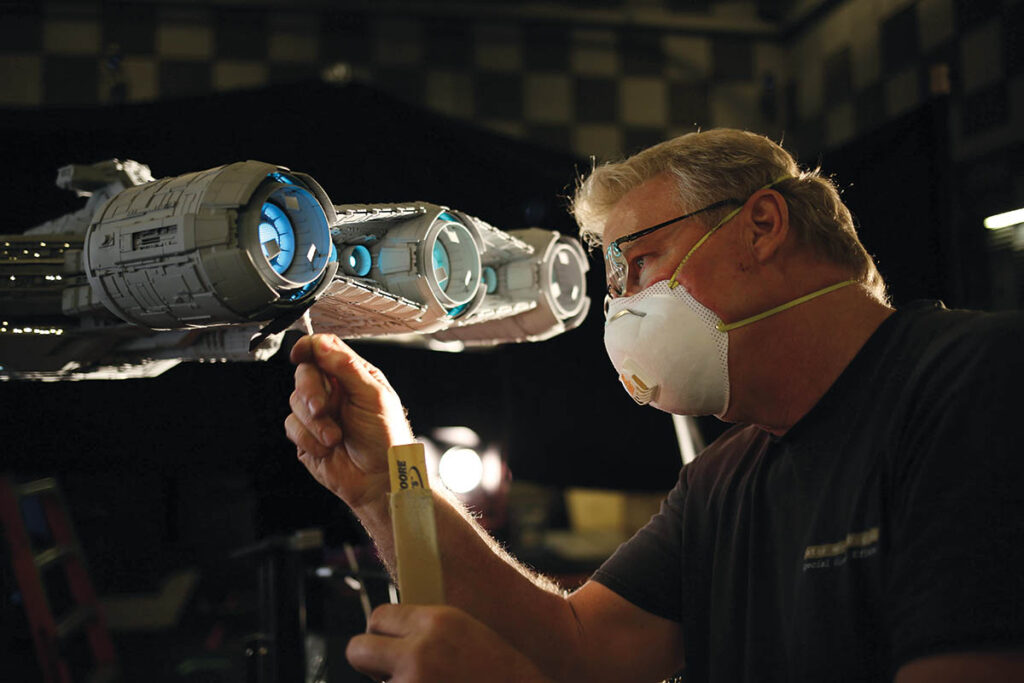
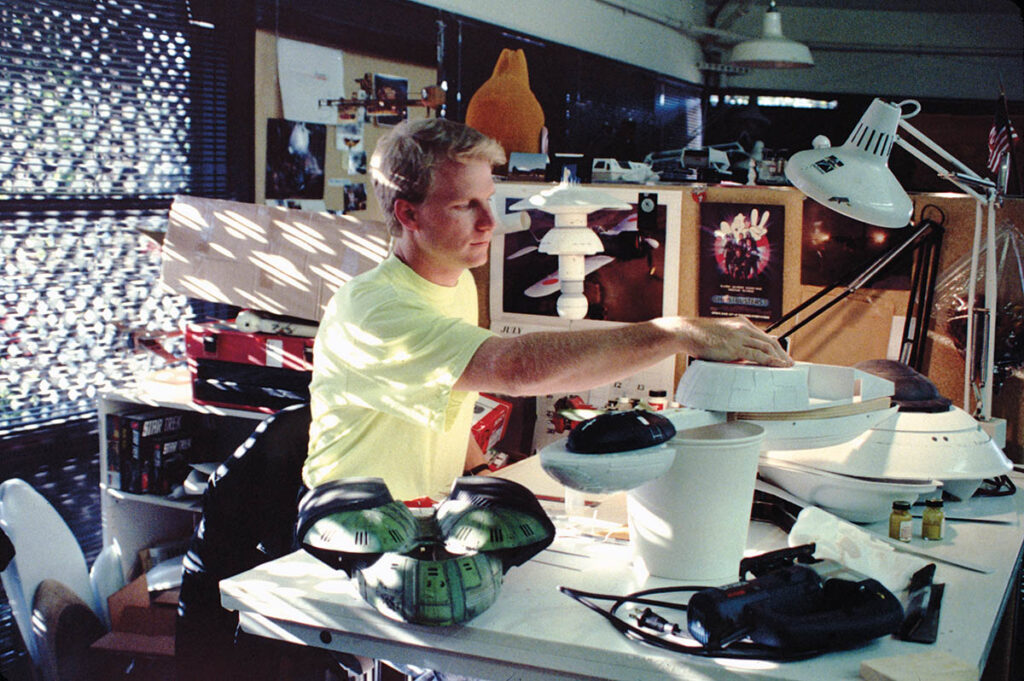
The Light Cruiser gets some touch-ups before shooting. (Image courtesy of ILM)

Goodson’s lifelong passion for visual storytelling began at the age of three when he watched “The Derelict,” an episode of the classic sci-fi series, Lost in Space. “It showed Jupiter II being taken into this giant alien spacecraft, and there were shots of the Jupiter II that were full frame on television,” Goodson recalls. “I was mesmerized. I lived on an Air Force base, and our next-door neighbor was a fighter pilot who got me watching Star Trek. Somebody gave me a copy of The Making of Star Trek book, so I understood that none of it was real, but I was fascinated that this was something you could do. When Star Wars came out, I was 14 and started writing letters to ILM.” A common thread was found in bios published with the Art of Star Wars books. “They tended to be either from industrial arts or architecture. I went to the School of Design at N.C. State [and studied] Product Design; that was as close as I could get to it. The reality was that I was already doing this stuff. I came out to California in 1988 and got hired by ILM for a week on a project called Body Wars, which was like Star Tours, but you get miniaturized and put through the human body. You start learning from the moment you hit the ground. That was the cool thing about the Model Shop. Digital was the same, but it wasn’t as intriguing to me.”

Even with 50 years of experience, there is always something new to learn. “On The Mandalorian and Grogu, we built the two-foot and four-foot Razor Crest and shot in an LED volume, which we’ve never done before,” Goodson reveals. “We got all the interactive light that’s going to be in the plate, which the models were going to be composited into. Here’s something new that works well. It was amazing. We didn’t have that capacity before.” Practical and digital models are intrinsically different. “When you’re building a model and painting it, that’s what you’re going to get. When you’re doing the digital work, you’re working hand in hand with the look development technical director; they take the information you give them in the paint, apply materials to it and massage all those different elements. You can work with one TD and get a completely different result than if you worked with another one. There’s artistry involved in that.”

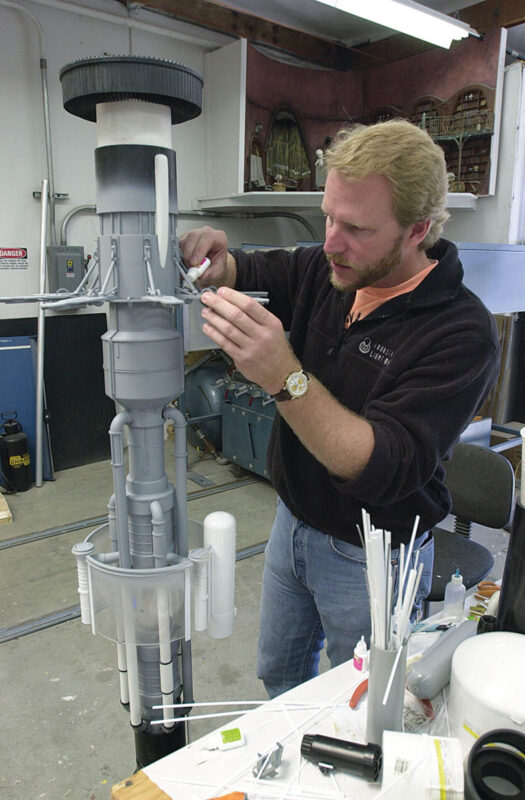
Goodson was a concept modelmaker on Star Wars: Episode II – Attack of the Clones.  He is shown here working on the Droid Factory Tower. (Image courtesy of Lucasfilm Ltd.)
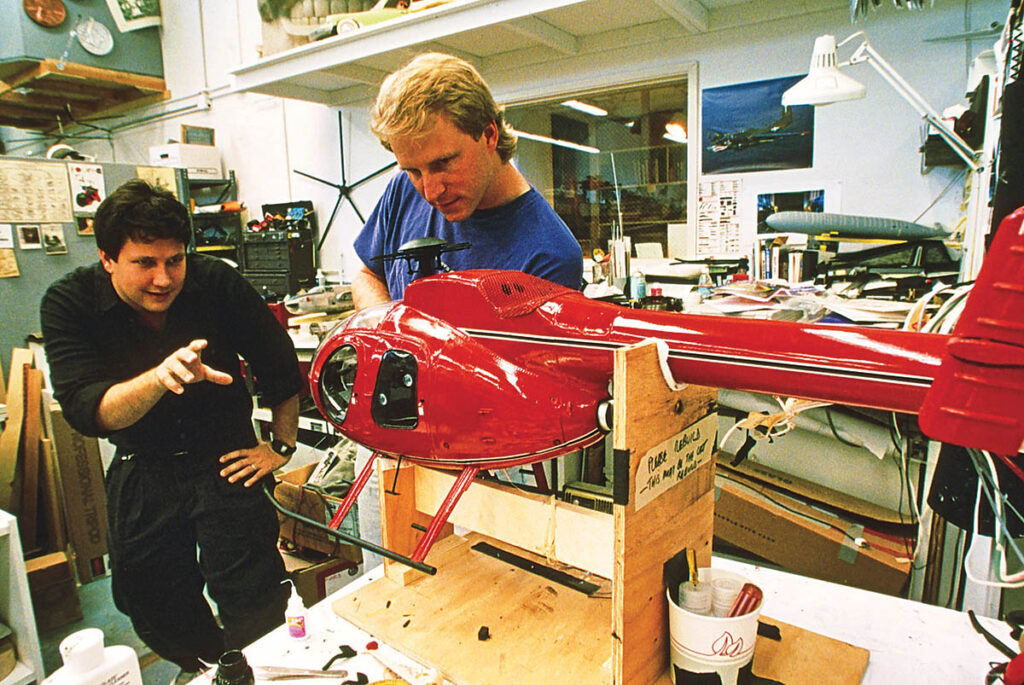
Visual Effects Supervisor John Knoll talks to Goodson about the helicopter model that was going to be shot for the Chunnel chase in Mission: Impossible. (Image courtesy of ILM)

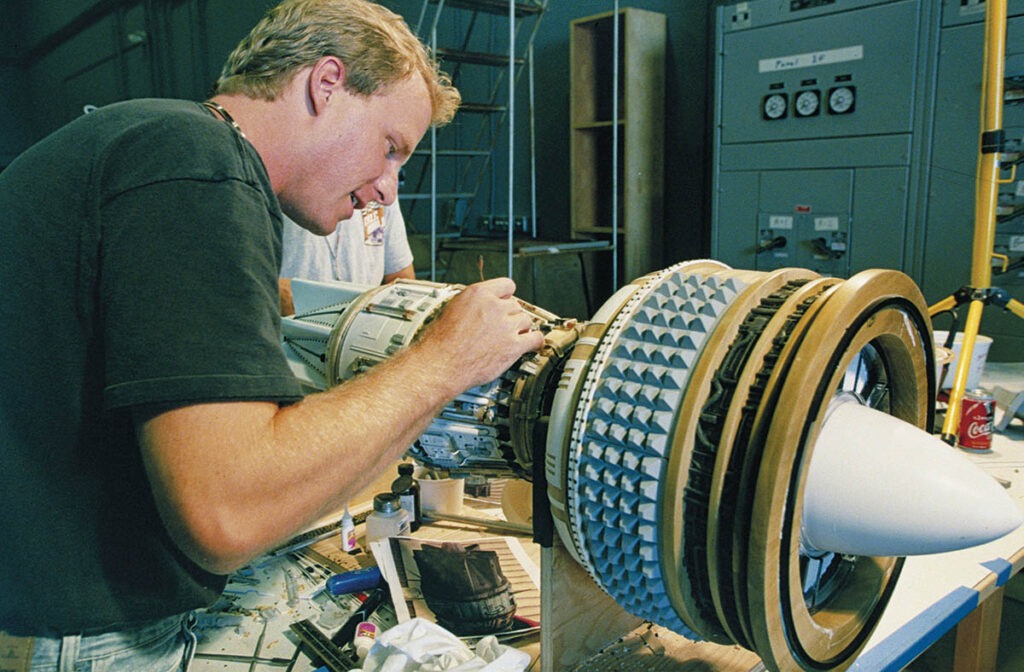
Curveballs have been plentiful, such as during the making of Ghostbusters 2, when Goodson had to make the belts on the hull of the Titanic model thinner while the crew was at lunch. “I wound up putting modeling clay into the low spots between the belts to bring the hull up, took a chip brush and cut it off so I could do a stipple texture on it fast, took pastel and ground it on 60-grit sandpaper and pounded it into it,” Goodson states. “That’s what we shot. But that’s the kind of stuff that you get.” When it comes to practical modelmaking, 3D printing is not Goodson’s preferred method. “I don’t like 3D prints because I don’t trust the material. It’s delicate. But sometimes it is the best solution. I have to get over my bias because on the Razor Crest I work with a guy named Dan Patrascu, a machinist who does 3D printing. The engines on both the four-foot and two-foot Razor Crest are full-on 3D prints. We get the information from the art department, and Dan remodels the whole thing so it can run on his printer. I built the fuselage by hand, but the engines are so complex. We’ve used it on Moff Gideon’s Light Cruiser for the guns and part of the engine. But for the most part, I tend to try to build it by hand.”

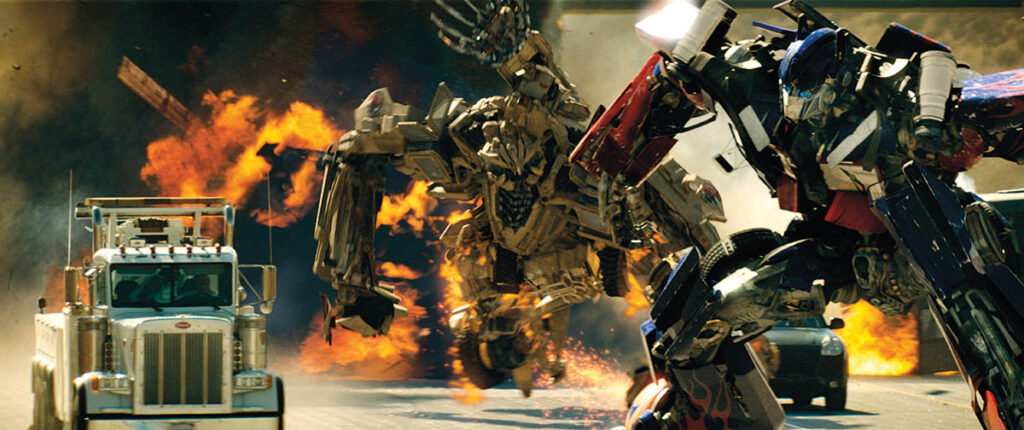
Goodson contributed to the Transformers franchise as a digital artist. (Image courtesy of ILM)

Model designs must be altered to accommodate the desired mechanics. “Ahsoka’s ship has the rotating wing,” Goodson explains. “Where that wing comes in contact with the fuselage is maybe an inch and a half long, and that’s a lot of wing to have cantilevered off this three-inch tube. You’d want to put a motor right in the center of the tube because that would be the optimal location to rotate this wing around the fuselage. However, we had a front mount, so we can’t occupy the center of that. The motor was placed to one side. Dan Patrascu had to design and manufacture gears that operated around the periphery of that tube that rotated the wing. It was a huge challenge.” Large and small models are treated differently. “The bigger you get, the easier it is to apply more things, and it’s more natural. Whereas for smaller models, those details may or may not work that well. It comes down to what the camera is seeing.” Models are often captured with motion-control cameras. “In most cases, you’ve got some storyboards or an animatic. You can look at it and go, ‘We’re going to see the right side of this, so let’s focus all the love on that.’”

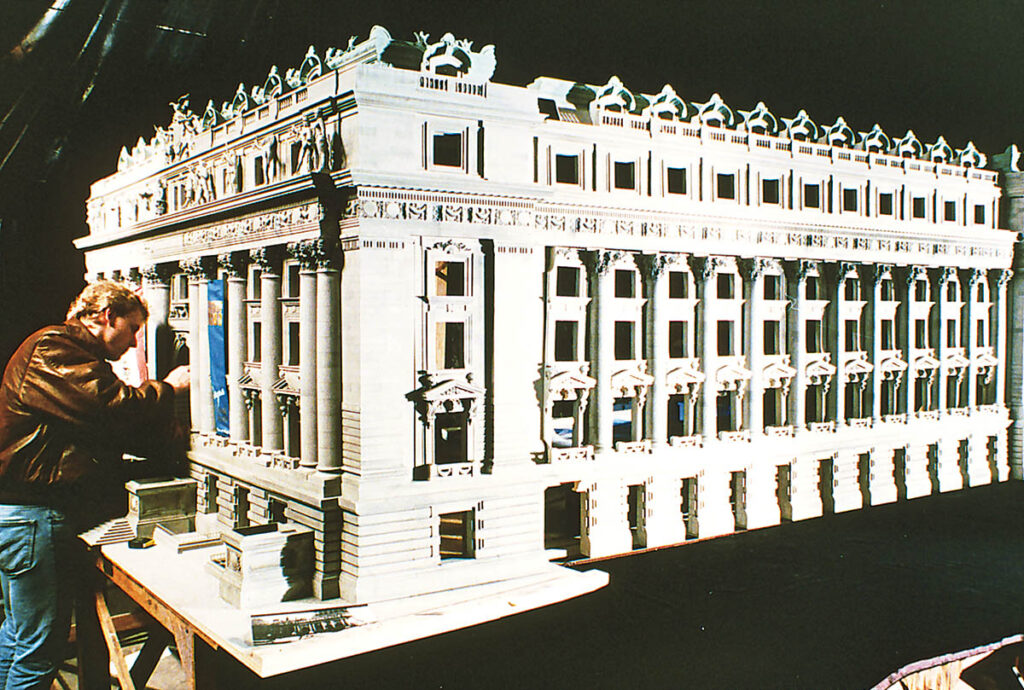
The benefit of making models for Ghostbusters 2 was that there was no question what the final look was going to be in the frame. (Image courtesy of ILM)
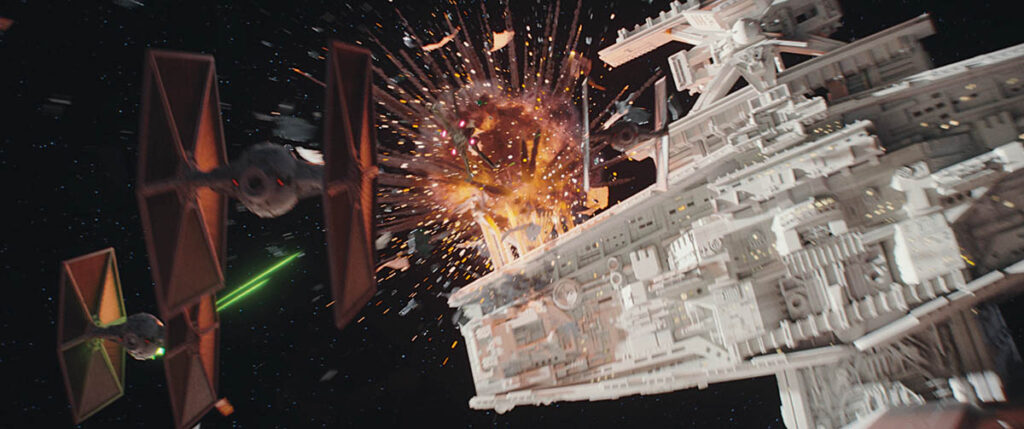
An explosion is set off on a miniature of a Star Destroyer. (Image courtesy of ILM)

Despite receiving VES Award nominations for The Mandalorian, Transformers: Age of Extinction, Star Trek Into Darkness, Mission: Impossible – Ghost Protocol and Iron Man 2, Goodson is most proud of a contribution he made to The Day After Tomorrow, where the digital asset of a frozen oil tanker was declared unusable. “There was a guy at ILM who had the digital asset of the tanker, and what I got from him was the angle sticking up out of the ice and the rotation,” Goodson recalls. “I went over to the Model Shop, got a sheet of plywood, cut a section about two feet by seven feet and rounded off the end so it would be the stern of a ship. Then I took an eighth-inch styrene plastic sheet and pin-gunned that to the side. On the bottom of the plywood, I put a hinge with a piece of pine, and another hinge with another board; that way I could open this thing up and tilt it to the correct elevation. I took the sheet of plastic, pin-gunned it to the side of it and forced it to take a curve. I cut off a little bit above the plywood, so now I’ve got the hull, and I’ve got the deck. Sunday evening, we had a dinner party with this thing sitting in the middle of the table. After everybody left, I’m tearing the house apart, looking for push pins for the bollards, which is what you tie the mooring lines to. By one o’clock Monday morning, it was all there. I drove it down to ILM and sprayed it with this fake snow stuff. [Master modelmakers] Lorne Peterson and Paul Huston took silicone and Q-tips and did these tiny silicone icicles, because in the film, the wind is blowing so hard that the icicles are horizontal. The shot was finished on Thursday. I got a note from [director] Roland Emmerich saying, ‘I don’t know how you did it, but thank you so much.’”

Getting to work on Star Trek VI: The Undiscovered Country was a joy as Goodson is a fan of the original television series.
(Image courtesy of ILM)
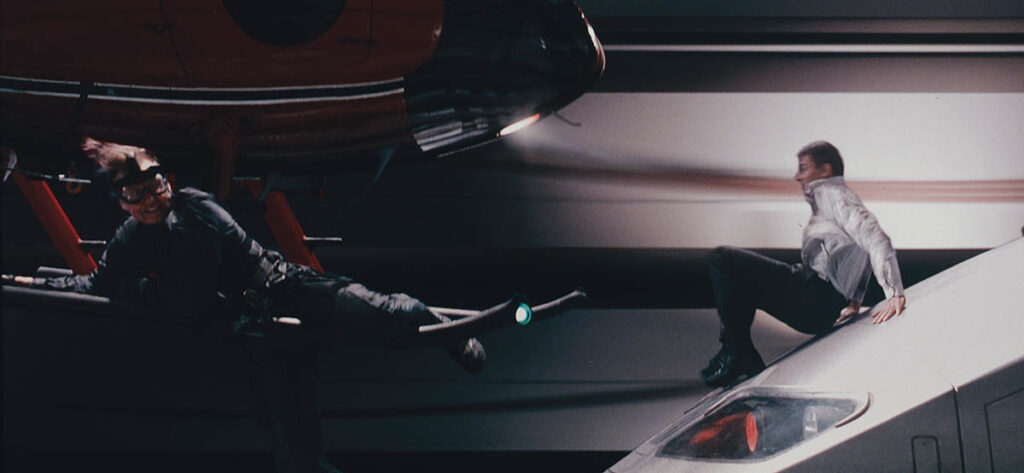
Tom Cruise has to dodge a helicopter through the Chunnel chase in Mission: Impossible. (Image courtesy of Paramount Pictures)
The journey of creating models began when Goodson saw the Lost in Space episode “The Derelict.” (Image courtesy of ILM)
3D printing is not the preferred method for making models. (Image courtesy of ILM)

Today, the spirit of the ILM Model Shop lives on in the garages of Goodson, Dan Patrascu and John Knoll. “We laugh and call ourselves Three Garages Productions!” Goodson chuckles. “While John is working on the cameras in his garage, Dan and I are working in our garages. Everybody keeps going, ‘You guys need to get T-shirts.’ We come together on the motion-capture stage over at ILM where we shot some of Razor Crest behind the tech building, outside the ranch. For a model like Moff Gideon’s ship, you’d usually have somewhere between 20 and 40 people involved in it. You got mold makers, pattern makers, electricians, machinists and painters. All these different hands were on it, and that was part of the pipeline in the Model Shop. Now I’m in a two-car garage, and Dan is in a 1,200-square-foot shop. I’m amazed every time we pull it off. But I do miss having several 1,000 square feet and a lot of different people with different expertise coming in and doing the different parts. Then we collectively work toward the goal of getting this thing to be a finished model.”

Every part of the process contributes to the end result. “Failures contribute too,” Goodson notes. “When we were working on the first Mission: Impossible film, there was a sequence where the MD 520N helicopter goes into the tunnel and ultimately crashes. John Knoll came to the Model Shop and said, ‘I need a model of a helicopter.’ He wanted to go back to show the animators how a helicopter moves. Artists overall are good observers. You’ve got to study the real world. All that stuff goes into taking these fantasy things – whether it’s a Transformer or a spaceship – and making them realistic enough for people to believe in. If we’ve done our job right, people don’t question it.”

An interesting discovery was made while perusing the Model Shop’s warehouse as it was being shut down. “I turn the key, open the door, and this crack of light starts to fill the room,” Goodson remembers. “You look in there and find speeder bikes, minecarts, a full-sized snowspeeder, an arm of a Rancor, the sand skiff, and four-foot-square boxes filled with Ewok and Stormtrooper costumes. It was unbelievable. There was a dividing wall of shelving. On the other side of it were all these wooden patterns from the Model Shop that we wanted to keep. But in the back corner, there was this little cardboard box maybe six inches square with all these letters crammed in it. I thought, ‘I wonder if my letters are in there?’ They said they were on file. And they were in there! I got my letters back.”


Share this post with