Images courtesy of Pixar Animation Studios.

Images courtesy of Pixar Animation Studios.
Toy Story, Pixar Animation Studios’ first feature film, revolutionized the animated film industry. This tale of toys that come alive when humans aren’t around launched one of the highest-earning franchises in film history, with a worldwide gross now exceeding $3.3 billion. Its 1995 release proved that films created by artists using 3D computer graphics could achieve both commercial and critical success. Now, Disney and Pixar have released the fifth installment in the award-winning franchise, Toy Story 5.
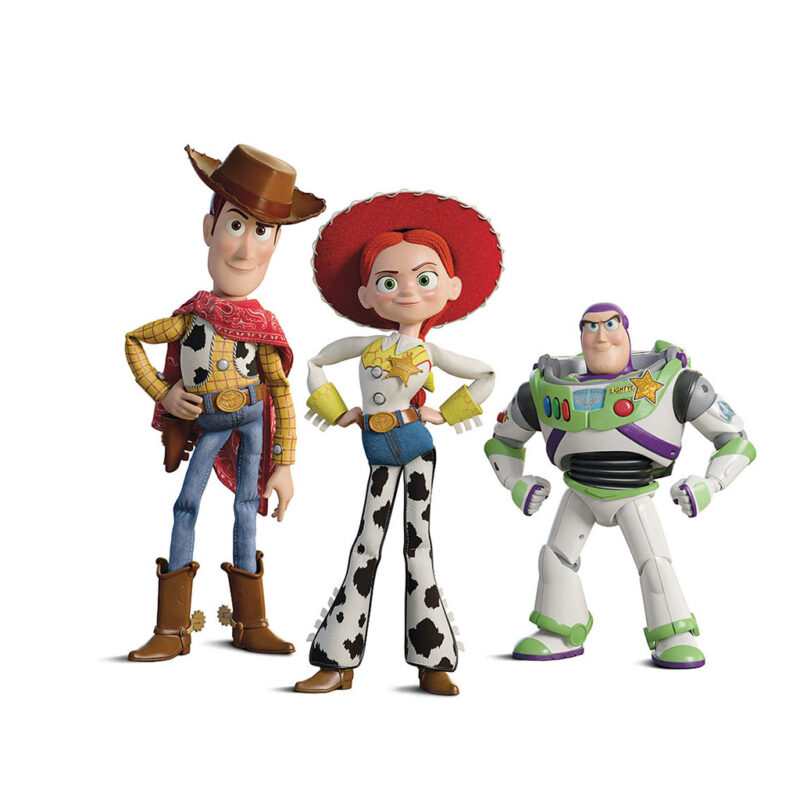
In the 31 years since the first Toy Story, the three main toys haven’t changed much. Woody has a bald spot and a new red bandana cape, Buzz Lightyear sports a star sticker, and Jessie dons a sheriff’s badge. The world around them, however, has evolved, both within the film and at Pixar. Time and technology are tightly intertwined throughout Toy Story 5 and reflected in its production.
“This film has been a real marker of time and of the progression of technology,” Andrew Stanton, writer and director, explains. Stanton – who earned two Oscars for directing WALL-E and Finding Nemo – has been a writer on all the Toy Story films, receiving two Oscar nominations for Best Screenplay for Toy Story and Toy Story 3. He co-directed the fifth installment with Kenna Harris. “Kenna is about half my age, as are many on the crew,” Stanton says. “So, it’s my job to remind people that what makes the toys interesting is the simple magic that they are alive in their world and not in ours. The children can grow, but the toys don’t. We don’t have to top the last film. We go where the child goes. The thing that’s exciting about the Toy Story world is that we can embrace time.”
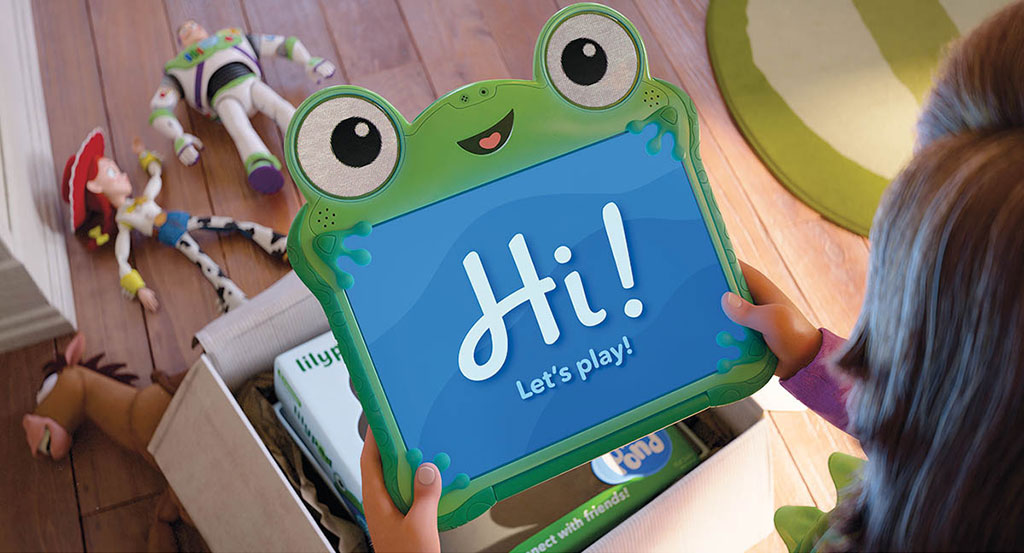
Toy Story 5 reunites with Bonnie, first seen as a four-year-old in the third film, now a shy eight-year-old. Enchanted by the film’s antagonist, a computer tablet named LilyPad, Bonnie abandons friends and traditional toys like her rag doll, Jessie. Making Bonnie, LilyPad and the rest of the film possible are artists working with new technology developed at Pixar, a studio founded 40 years ago by many of the pioneers of computer graphics. “There are interesting parallels in this film to our experiences working on the film,” Harris notes. “Andrew is the established voice of Toy Story. He understands and values tradition. Suddenly, I’m like LilyPad coming into the room. Something new. Flashy. Something that might be entertaining and surprising.
NEW TECH
Chief Technology Officer Steve May was in graduate school when Toy Story was released. He joined Pixar in 1998. “Toy Story 5 is really cool, and it’s fun that Pixar continues to push new technologies,” he says. “Three big ones came together: the Luna extension for Presto, RenderMan XPU and Invertible rigs. It’s appropriate that we are using a new version of RenderMan for the first time on a Toy Story film because what’s older than Toy Story? RenderMan [introduced in 1988].”
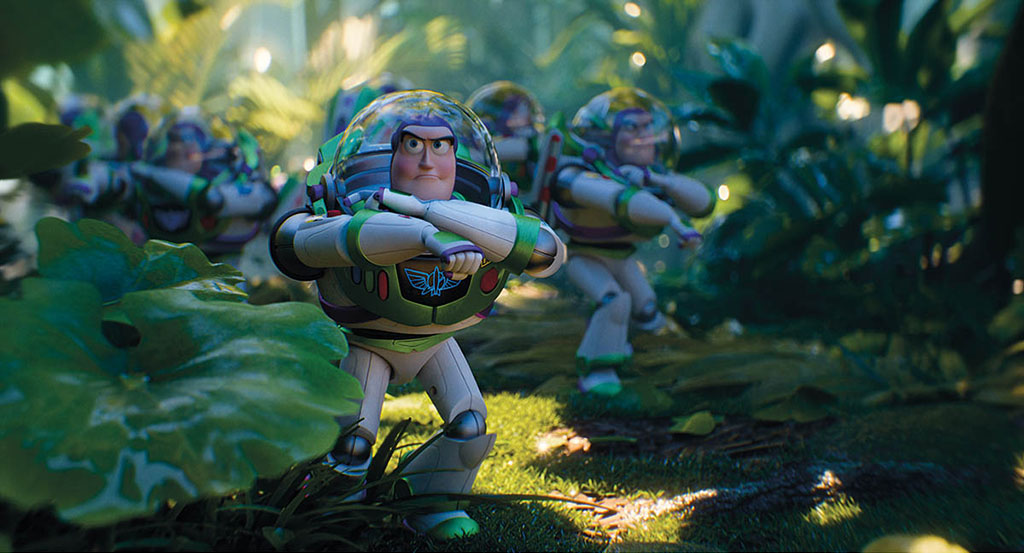
In addition to the three new advances, the film posed a range of technical challenges, including Bonnie’s new friend Blaze’s curly hair, 50 upgraded Buzz Lightyears, 50 plastic horses, Bonnie’s interactions with LilyPad’s onscreen graphics and a stylized fantasy playtime.
LIGHTING AND RENDERING
Pixar first used Luna, the new lighting tool, for a half-dozen interior shots on Hoppers, then expanded its use to two exterior sequences on Toy Story 5. With Luna, lighting artists can work across multiple shots at once. When they adjust the position of the sun in one shot, for example, they immediately see the effect ripple across a grid of shots. “We like to take a measured approach with new technology and give the tools team feedback,” Thomas Jordan, Visual Effects Supervisor, says. Like May, he also joined Pixar in 1998. “We chose one sequence in the epilogue with many characters and another with lots of trees, vegetation, characters with hair and streetlights. Using Luna for the two sequences was a great success.”
Also significant was the first use of RenderMan XPU on a feature film. It marked the first time the crew switched renderers mid-pro-duction. “XPU is not a new feature; it’s a new renderer,” Dylan Sisson, Head of RenderMan Creative Engagement, states. “The challenge was to get GPU acceleration implemented in a way that we could produce the final pixels out of whatever hardware. That’s a hard problem to solve. But now we can roll into a production without worrying about whether a GPU render matches the CPU.”
Although Sisson acknowledges there is often hand-waving around rendering times, he says that with a GPU and CPU running concurrently, the team has seen nine times faster speeds for interactive, full-frame rendering – even faster with multiple GPUs. That gain can affect the entire animation pipeline, from layout to lighting. “Once a shot is in memory, we can see full-frame renderings almost in real time,” Renee Tam, Global Technology Supervisor, says. Tam led a team that checked the pixels produced by XPU. “It’s so much faster than RIS, and the pixels that come back are better,” May notes. “The thing about Luna and XPU is that they work well together, and they leverage USD. It’s the culmination of a bunch of hard work.”
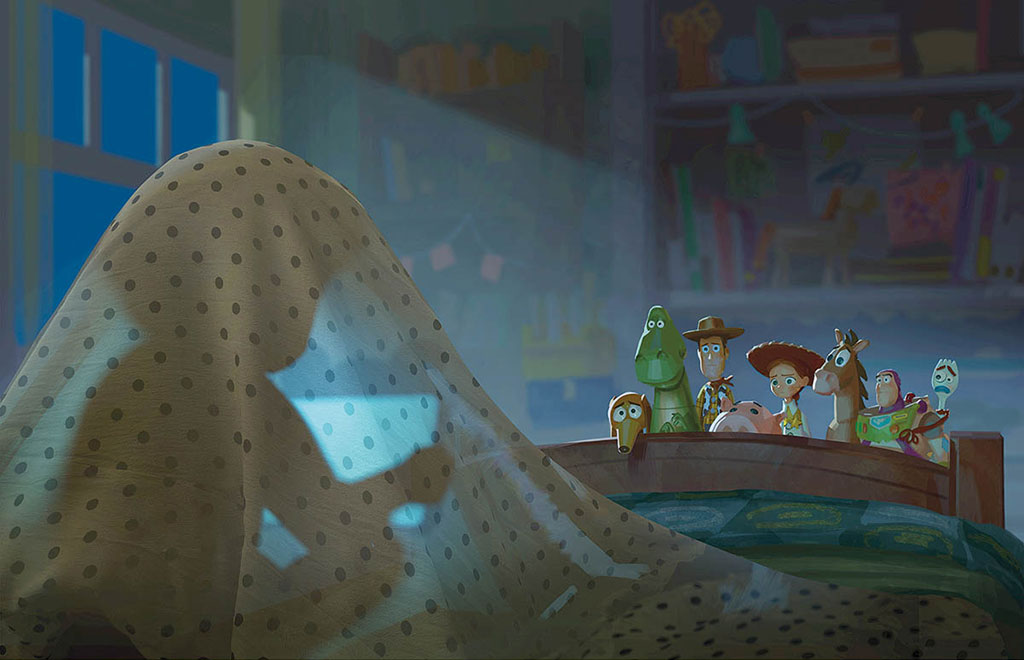
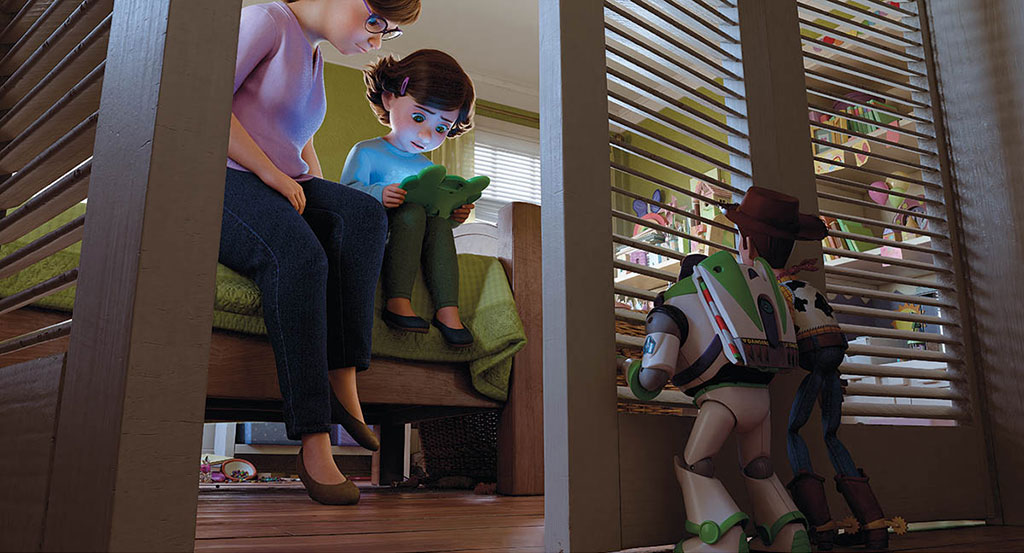
RIGGING AND SIMULATION
There are two “real live” animals in the film, a Quarter Horse mare named Daffodil and a pig named Jimmy Dean. Animators working on these quadrupeds relied on a new rigging system called Invertible. May explains, “The idea is that you can do direct manipulation, inverse and forward kinematics, with every control in the character. You can bend a finger or pull it, move the hand, then pull the elbow and shoulder with it, solve the way feet make contact with the ground and make the ankles roll. Riggers no longer need to build unique controls for special manipulation.”
Harris notes that Daffodil took more than a year to build, rig and sim. “We haven’t had a horse character since Brave, and that one was caricatured,” she states. “The people here are wizards. They made every muscle appear under her skin as she moves. It’s mind-blowing.” Mariana Galindo, Simulation and Tailoring Supervisor, adds, “From a simulation standpoint, it was intense. Muscles firing with skin dynamics plus mane, tail hair and braids — all these pieces interacting together created a majestic animal. The pig had a larger mass and less muscle articulation. So, his dynamic was more about creating jiggle and weight.”
Blaze’s curly hair presented another challenge for the simulation team. The system originally built for Merida’s wild, curly red hair in Pixar’s Brave required upgrades for Blaze’s locks. Pixar named the new system Fizt Strands. “We built a new toolset to create curly hair using spring-based curves and a new solver,” Galindo reveals. “Merida had flowy hair, but Blaze’s hair has tangled curls that feed into each other. We had procedural workflows that helped the artists groom her hair into shapes and curls that sim’d into place. They can shift the hair around for the right posing and positioning – to have a more creative conversation with the character.”
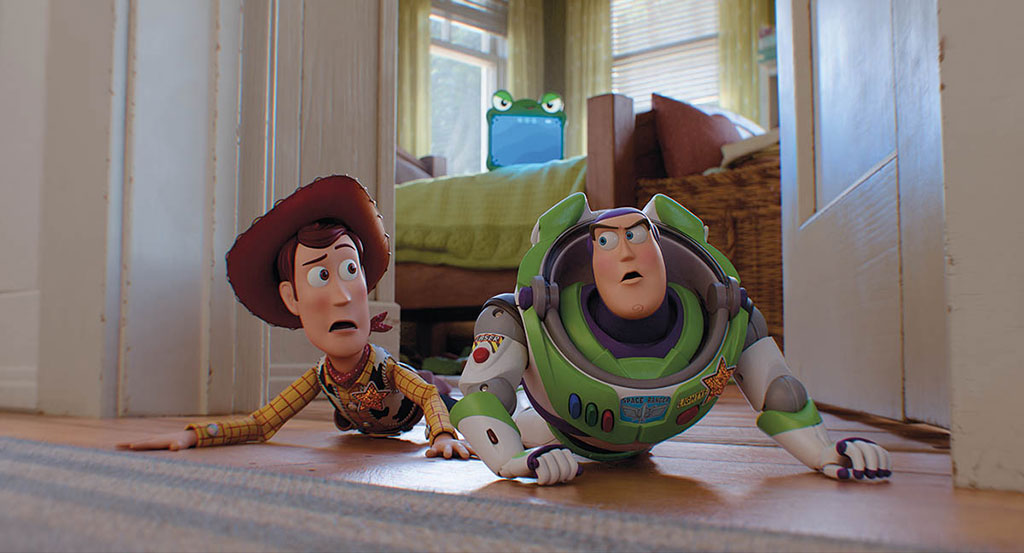
CROWDS OF HORSES AND BUZZ LIGHTYEARS
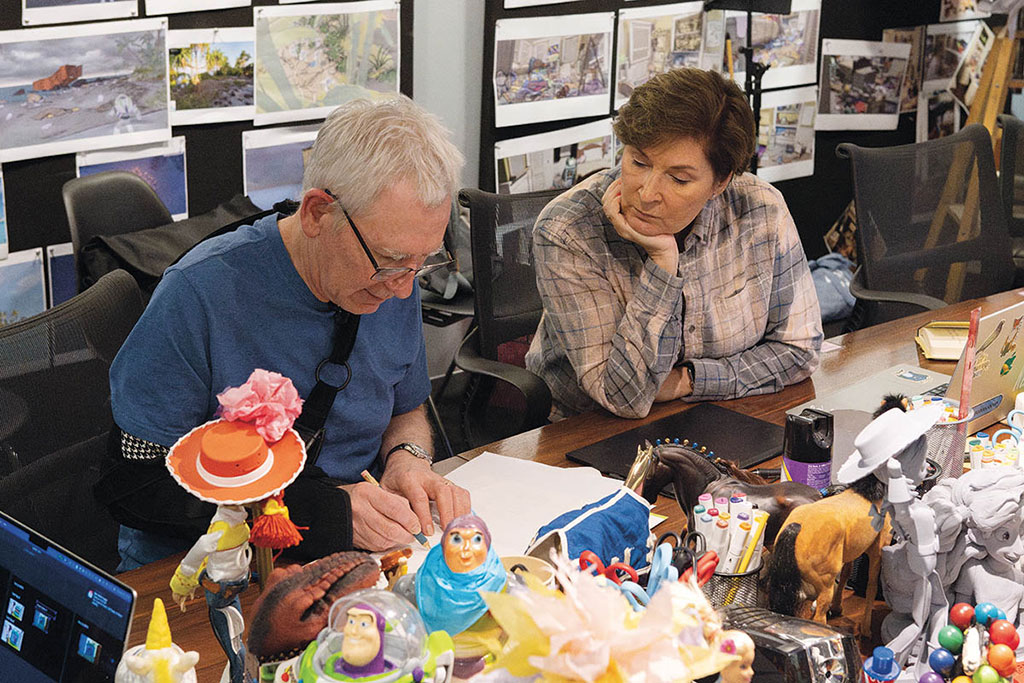
As in previous installments, Jessie the rag doll has a toy horse called Bullseye, but in this film, he’s one of many. The 50 or so toy plastic horses on Blaze’s shelves attest to the child’s love of horses. “We learned there’s a whole subculture of plastic horse collecting,” Bob Pauley, Production Designer, says. Pauley has worked on all five Toy Story films. “We have Disney horses, Barbie horses, palominos and other types, sixth-scale and ninth-scale horses. Horses with springy legs and articulated legs. We even have a knight chess piece.”
The horses don’t stay on the shelves, though. Fifty upgraded Buzz Lightyears ride them. “There’s something nostalgic about working on Toy Story 5,” Pauley admits. “Thirty years ago, I was at my desk styling Buzz Lightyear. Then, several months ago, I was drawing new versions of Buzz, like what a toy manufacturer might do to upgrade a toy. There’s always a technical challenge with these films,” he adds. “In this film, it’s the volume. Fifty Lightyears and 50 horses crunch the rendering.” May notes, “It gets crazy. Creating them and animating all of them at the same time was a complicated problem. Hopefully, the audience will be laughing hysterically.”
The first shots loaded with all 100 characters, crashed everything – software and computers. Though the WiFi-connected Buzz Lightyears appear to operate with a hive mind, they are not background characters. “The 50 new Buzzes and the original Buzz are intertwined,” Harris explains. “They feel called on to do something.” Jordan adds, “With background characters, we can do optimizations. But these Buzz Lightyears come in and out of the foreground constantly. The animators needed access to all the controls.”
Working closely with the animation team and directors, Crowds Technical Supervisor Paul Kanyuk’s team wrangled 50 Buzz Lightyears on and off horses using a path-based system for crowd choreography. To avoid drawing 50 separate paths, they created a central guide path that they could bend into other paths using the new Bendolater tool. “We try to start with pre-animated cycles,” Kanyuk says. “Buzz alone, Buzz on toy horses with springy legs, horses with wheels and so forth. The complexity comes from ground adaptation, blending from one clip to another, and intercharacter dependencies. It gets very complicated very quickly. In one sequence, they’re even flying. I did a lot of Python scripting to automatically figure out which kind of animation applies to which character based on the context.”
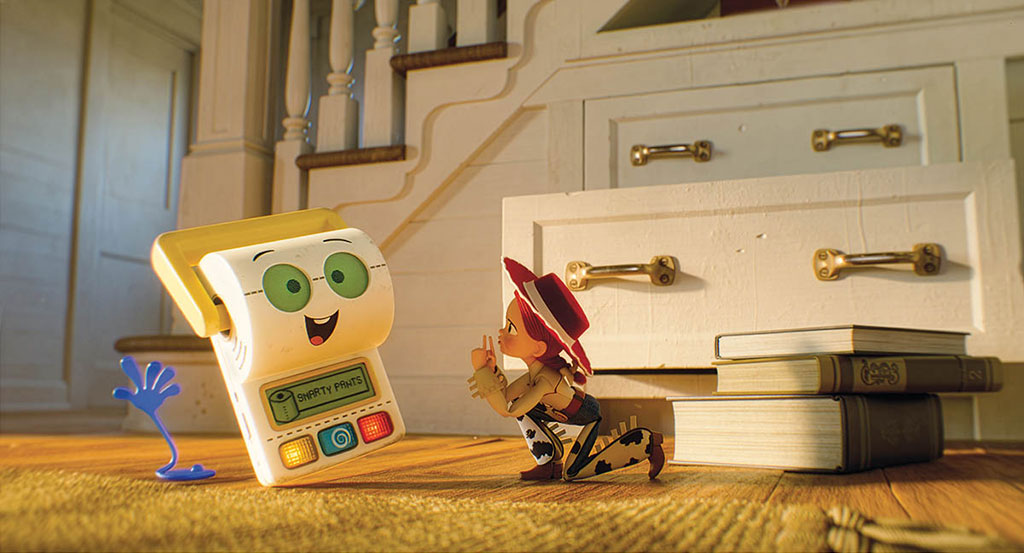
Once the riders and horses are galloping along, the Crowds team bakes that animation and, via USD, injects it back into the animation system for the layout artists. “It’s almost like an animated cache with bells and whistles,” Kanyuk explains. “We promote the pre-animated cycles to full animation.” At that point, the horse-and-rider unit becomes two units. The upgraded new-tech Buzz Lightyears shine compared to the cache of Blaze’s old tech and a weird subculture of toys left outside in a plastic shed. “They’re weird and adorable,” Pauley says of the old-tech devices. “And existential. They’re approaching the end of their time. We have Smarty Pants, a potty-training device. Snappy, an old digital camera. And, Atlas, a GPS device.”
The film’s main antagonist, however, is a new technological device.
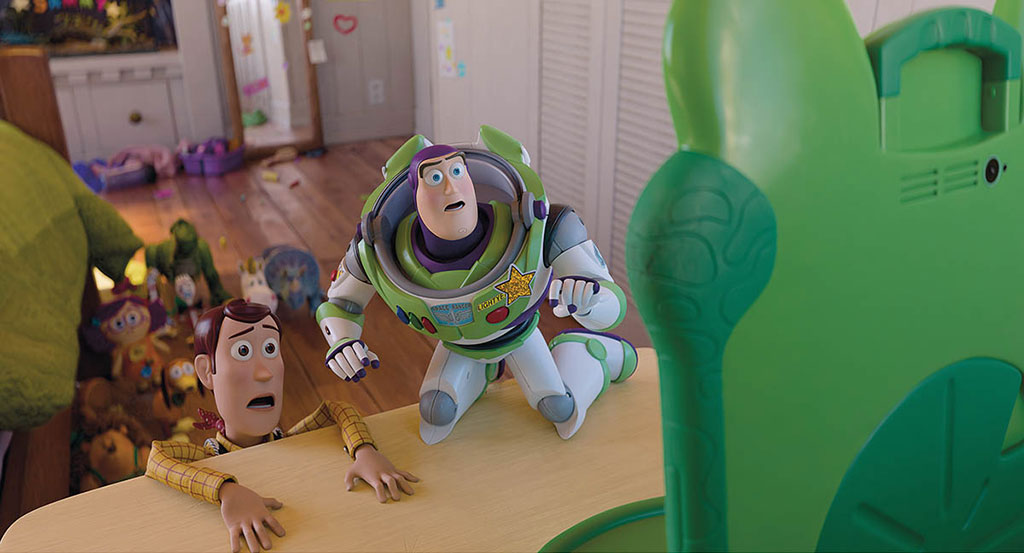
LILYPAD
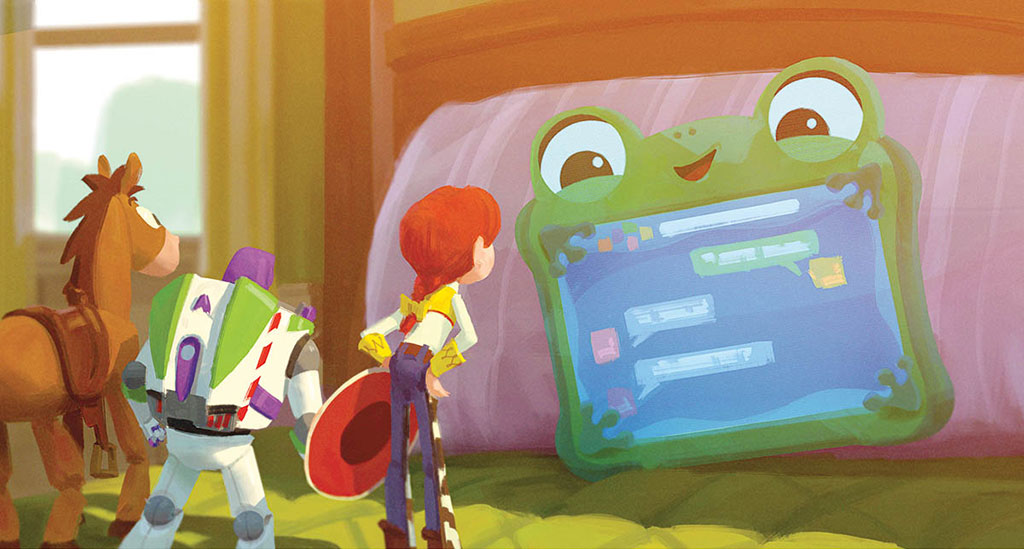
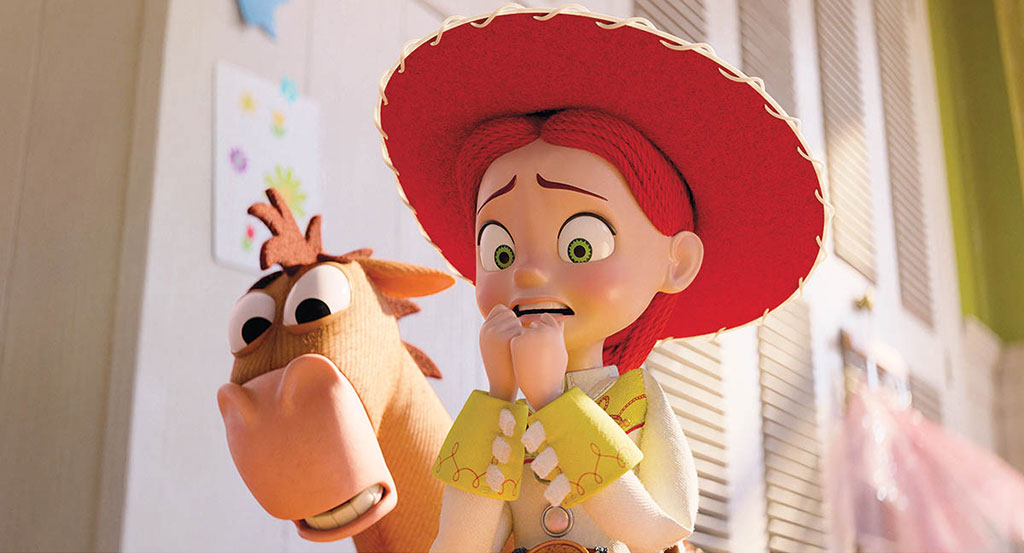
LilyPad resembles an iPad, but she’s also a character, a screen encased in a green frog-shaped shell with a face and hands. She plays a central role in the story as Bonnie struggles to make friends in real life. Bonnie’s toy, Jessie, wants to help, but LilyPad is having none of that. “It’s fun to see LilyPad get into verbal barbs with Woody and Jessie, but we knew from the beginning we did not want to vilify her,” Harris says. “She had to be a character that would change and be accepted into the rest of the film.”
Animators had to balance the attention-grabbing graphics on LilyPad’s screen with her animated face and hands, a challenge that also tested lighting artists. “If you see LilyPad’s point of view, there’s a grid on the image, but if you see her from someone else’s point of view, she’s in shadow,” Jean-Claude Kalache, Director of Photography, says. “We put her in shadow as much as possible. She’s an antagonist, but also, technically, it makes sense to shoot against dark.”
Her screen is always a source of light. Thanks to a script the crew developed that made her screen ignore light shining on it, it is always visible and casting a glow. “It’s the light that hypnotizes kids and takes over their world,” Kalache says. “You literally feel it. It wasn’t hard to research. I could just look at everyone on their phone in the room. There’s blue on their faces.”
For animators, the next challenge was having Bonnie’s finger interact with the animated graphics on the screen. “We’ve never had a screen that’s a character in itself, so we needed a way for the animators to influence the 2D screen graphics,” Jordan says. “The art department creates the onscreen graphics. Animators don’t have tools for that; it’s outside the animation workflow. So, we came up with a system we call SketchPad. An animator can draw as if they were sketching in 2D with a pencil, but they’re drawing in 3D over time. We can use that as a guide for timing. We also used that tool for our fantasy scenes.”
STORY TIME
The characters in Toy Story 5 interact across different time periods, each with its own treatment. “We have different camera setups for shots in the ‘80s than the ‘50s,” Kalache says. “And we added camera artifacts that were fixed over the decades.” As for the imaginary times, Andy’s fantasy sequences were hyper-realistic in previous films. But Pauley explains that in this film, Bonnie and Blaze play differently. They conjure poetic, sweet, pastel, sketchy scenes – more emotional than realistic. “In one moment, they’re in her hallway and in another they’re in a grand ballroom drawn in the style of pastel chalk, like a child making arts and crafts,” Jordan shares.
There’s an homage to Bambi that transforms into something Bambi-esque, then evolves into new spaces, including a wedding chapel and a gazebo. “We had to forget everything about lighting and start over,” Kalache reveals. “It took three months of research, and then, once we put the vision together, more time to figure out the number of tools we needed. The imaginary sequences were difficult because we had to learn what they were. It was very hard.”
They succeeded. Harris notes, “I was talking with Andrew [Stanton] yesterday, and we agreed that working on this film was not easy, but the team was so tight and well-formed that challenges along the way didn’t feel like impossible challenges. We didn’t have a moment like that. Everyone problem-solved along the way.”
Woody, Buzz Lightyear, and Jessie haven’t changed much over the years, but the crew – artists, animators, software developers, and beyond, who create these beloved characters – have perfected their craft. “They are professionals to the point of being the masters of their craft,” Stanton says. “We used to talk about how to execute something; there used to be some technological thing to conquer. Now, I tell experts in their field, this is the mood I want, the result I’m trying for. I feel we’ve reached a place where if you can think of it, you can do it. And that allows us to be smarter and better storytellers.”
Battle-testing XPU
Pixar progressively shifted its rendering method from its original Reyes in the 1980s to a hybrid ray-tracing version of RenderMan, used until Finding Dory. Around a decade ago, the studio made another decisive leap, adopting the Monte Carlo path tracer RenderMan RIS.
“Then we started working on GPU acceleration,” says Dylan Sisson, Head of RenderMan Creative Engagement. Now, the latest version of the venerable software, RenderMan 27 with XPU, can use any idle CPUs or GPUs for rendering without changes to any assets or light shaders. The GPU renders match the CPU renders. “Ten years ago, GPUs didn’t have enough memory to render production frames. But now we can fit a full frame on the most advanced GPUs,” Sisson says. “The new NVIDIA Blackwell can store 99% of the Pixar shots.
That means fast, interactive rendering of full frames. How fast? Sisson says there are many variables when judging speed, but he’s seen speeds nine times faster using the combination of GPU and CPU. And he notes they can use multiple GPUs.
To battle-test XPU on Toy Story 5, the team chose an interior at Bonnie’s new friend Blaze’s ranch. Because they could al-ternate between RIS and XPU without changing any assets or light shaders, they could compare and evaluate XPU renders in each shot. Renee Tam, a Global Technology Supervisor, led a team that checked the pixels XPU produced.
“XPU renders are sharper a lot of the time because the tessellation is better,” Tam says. “There are edges in the geometry where the calculation is more accurate. But accurate doesn’t always mean good. It means different. If a shot doesn’t look right, we go into every single asset, every single light, and we can have tens of hundreds of lights, to figure out what is happening.”
For example, a large dog pillow on the floor looked much brighter when rendered with XPU than with RIS. When the team zoomed down to a micropixel level on the RIS render, they could see holes; the old algorithm did not make a smooth surface from the geometry tessellates. “The RIS renderer looked through the holes to the dark inside, so the pillow looked darker,” Tam says. “With XPU’s better tessellation, the surface was ‘water tight,’ and the surface was brighter.”
To give the pillow from the better renderer the approved look from the RIS renderer, the team rendered it with XPU and then tweaked the lighting. Similarly, they would soften lighting if a character’s geometry looked too sharp. XPU’s iteration speed made that task easier.
According to Sisson, Renderman 27 with XPU is now avail-able. Pixar plans to release a version of XPU with full-frame rendering and the final features for visual effects feature film production workflows in the fourth quarter of 2026.