Images courtesy of LAIKA Studios.

Images courtesy of LAIKA Studios.
Releasing two movies within the same year is not for the faint of heart. “I’m sure it has taken years and years off my life,” laughs Travis Knight, who directed both Masters of the Universe and Wildwood, an upcoming stop-motion animated fantasy film from LAIKA Studios. “I have been working on it in various forms for 16 years. … It’s happenstance that Wildwood is coming out in the same year that I’ve got my little costume drama.”
Adapting the children’s fantasy novel by Colin Meloy, featuring illustrations by his wife, Carson Ellis, proved to be a long and winding journey. The story follows 12-year-old Prue McKeel, who ventures into Wildwood – a magical world inhabited by talking animals and rival factions – to rescue her baby brother, Mac, from a murder of crows. “We got to a point where we had made five movies, and then I thought, ‘We can do it.’ And boy, was I wrong!” Knight admits. “At times, I felt like the universe was conspiring against us. The pandemic hit. These crazy wildfires ripped through Oregon. There were riots in the streets of Portland. It was one thing after the next when we were trying to make this movie. But we persevered. I’m so happy with how it has come together. However, I have to say it’s the hardest thing I’ve ever done. No question about it.”
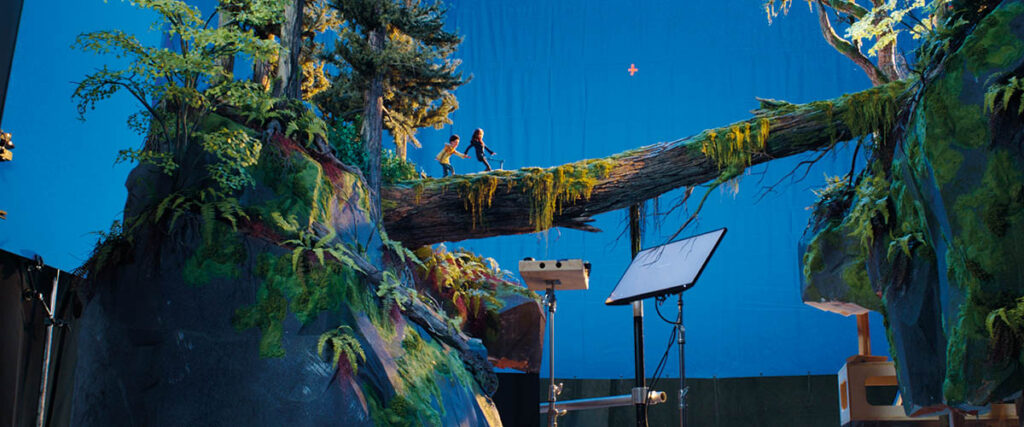
In addition to doubling the typical number of shots in a LAIKA film to 2,800, the production expanded its VFX team from 90 to 300 members and enlisted external support. “Visual effects have always been an absolutely indispensable part of what we do, and it’s one of the things that actually makes LAIKA unique in that handcrafted, practical, virtual and digital are entwined together,” Knight notes. “Each one of those techniques informs the other; that’s how we ended up with the 3D printing and other things that start life in a digital way and are reborn as a physical thing. It’s weird to even talk about it as if we’re bifurcating everything. Stop-motion animation is effectively a visual effect, and it used to be considered one back in the day. CG and stop-motion – how those things co-mingle – we’ve been doing that since Coraline. But this movie required a lot of handholding between those two things in a way that we hadn’t done before. Actually, it was so challenging that we did have to go outside our own walls for the first time and work with another partner. We wanted to find someone who understood what we were trying to do and felt like a kindred spirit. We worked with Wētā FX, and it was a joy.”
“We will choose to do things the difficult way because it’s uncomfortable, and other studios flat-out don’t do it; that goes back to the spirit of stop-motion animation. Who would ever be crazy enough to take a week to get three and a half seconds of animation when you can pick up a camera and tell stories at 24 frames per second? We are chasing an art form that welcomes doing things in a difficult way. If we make it too easy on ourselves, then we’re doing it wrong.”
—Steve Emerson, Visual Effects Supervisor
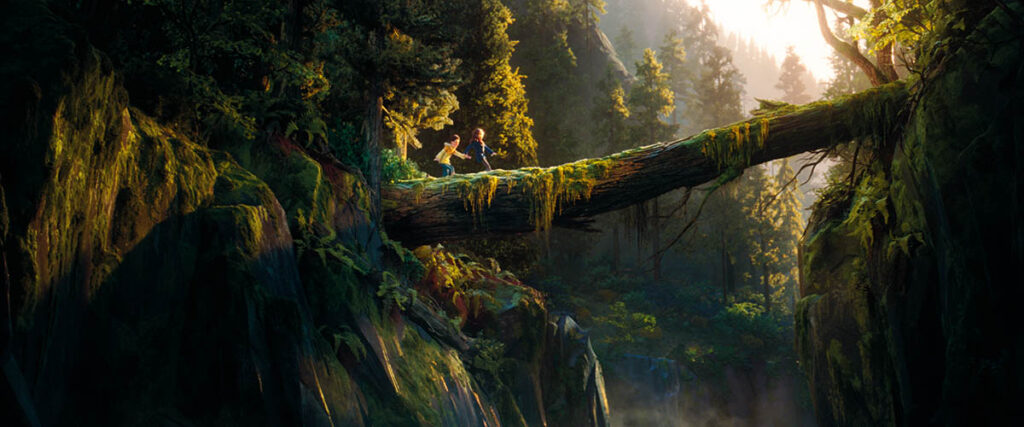
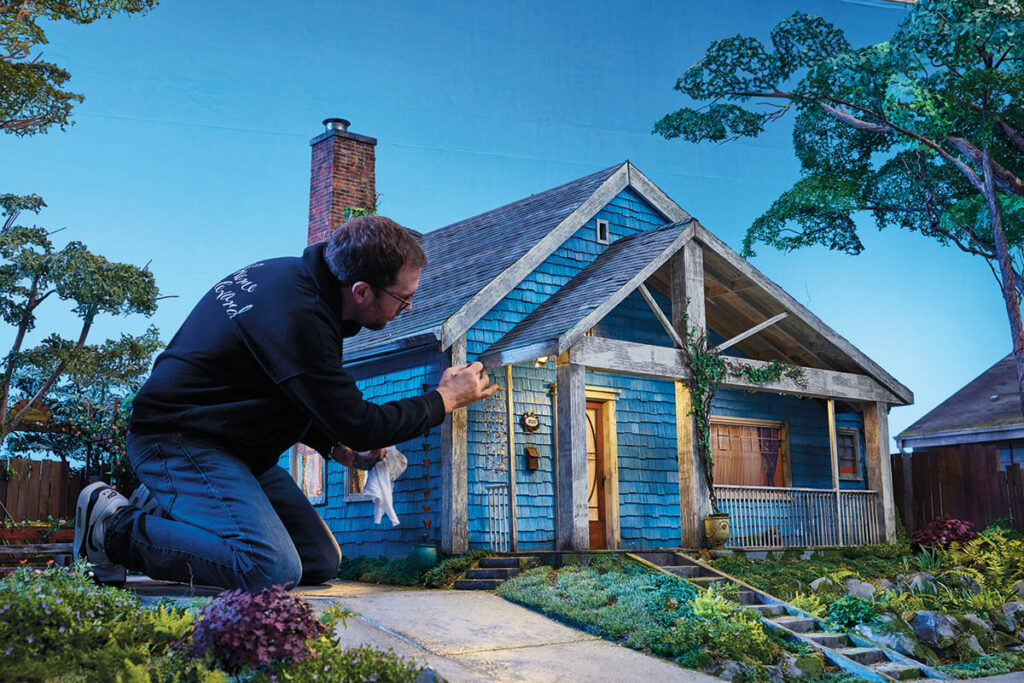
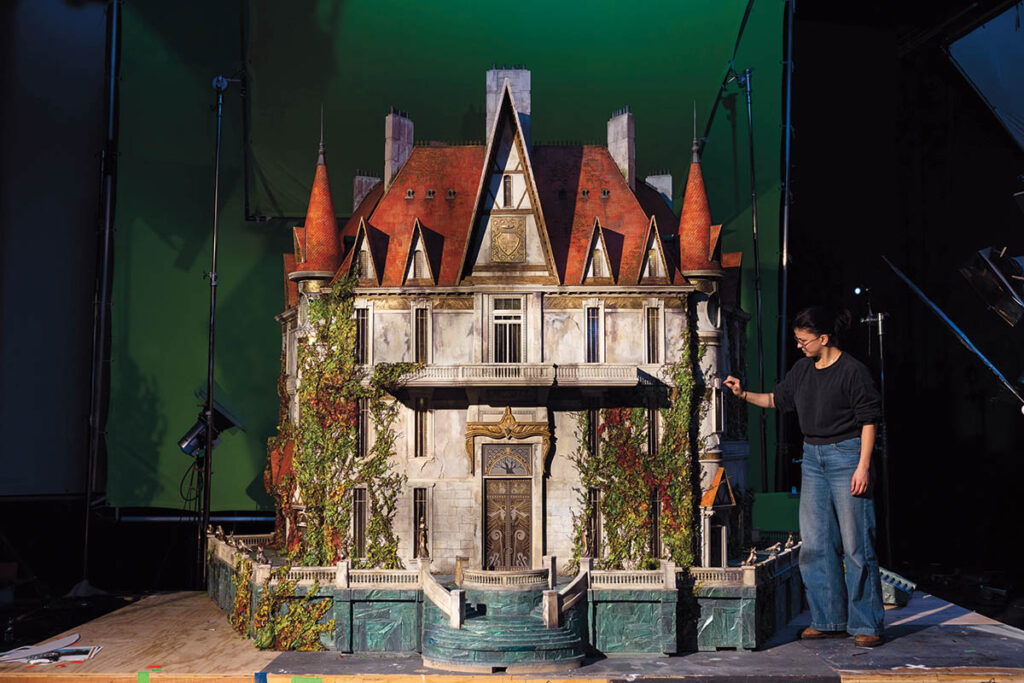
The character design shapes the film’s language. “The world-building ‘wraps’ around the characters to create a holistic vision that feels natural and helps to keep the audience focused on the storytelling,” Nelson Lowry, Production Designer, states. Two buildings serve as visual touchstones for Portland and Wildwood. “Prue’s house is at the heart of the McKeel family, and it’s where we are introduced to Prue and her family dynamic. The Pittock Mansion is central to Wildwood’s history. It’s both the home of Alexandra, Grigor and Alexei and, later in its history, a government building that houses a corrupt governing body. These locations act as an anchor for each side of the story.” Different techniques were used to convey a sense of motion in the forest vegetation. “In some cases, we paint UV reactive paint, which you can’t see until you do an exposure with a black light, and that isolates the leaves. We can add a little shimmer and offset them slightly in the composite. The rigging department came up with a brilliant idea where we slowed the footage way down and hit the trees with an air cannon. The magic of stop-motion and building things practically is those kinds of tricks you feel but may not be aware of them. However, it makes the forest feel alive.”
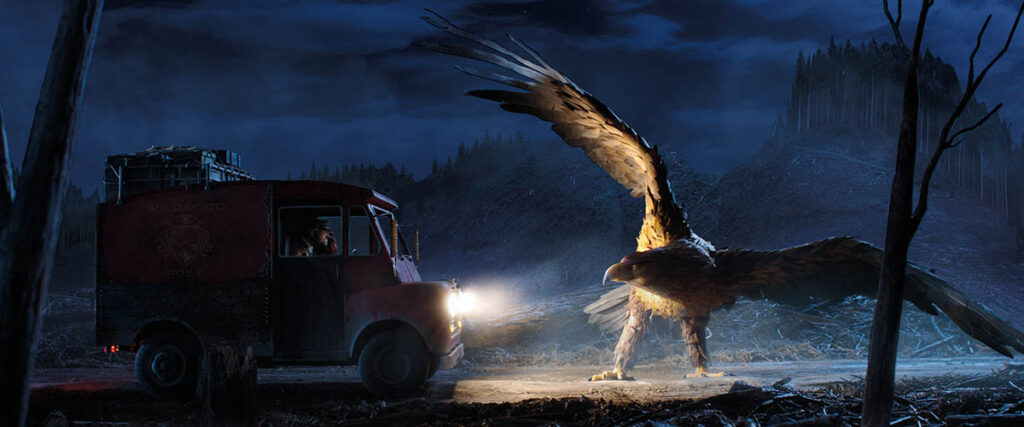
Shooting stop-motion differs significantly from both computer animation and live-action. “In stop-motion, the thing that’s missing is the serendipity of an actor coming in and performing something, then you reacting to that and adjusting yourself,” Caleb Deschanel, Cinematographer, observes. “You have to accept that it’s going to be animated a certain way, and where it goes is going to create its own reality. You have to get into the headspace of doing that movie. The other thing, because everything’s in miniature, depth of field has changed and all sorts of other things. When we were first starting on the movie, I went outside and shot a number of scenes at different light levels and f-stops so I had an understanding of real human beings in a real situation and what the depth of field should feel like. I did a lot of experimenting early on to get my head around how we were going to create that reality in this stop-motion world.” The project changed considerably from its original conception. “You go into a scene where you’re in the kitchen, and you think, ‘We can shoot this scene in the kitchen.’ But we’re looking in one direction. Then, suddenly you get a shot and need a closer shot. We don’t need the whole set, so they tear out the back of the set, move it to another stage, and set it up for another shot with another character looking in the other direction. You suddenly have this kitchen that’s been blown apart, in four different sets, on four different stages, with different parts of the scene being filmed. It was a shock to me how much splintering went on with all these sets.”
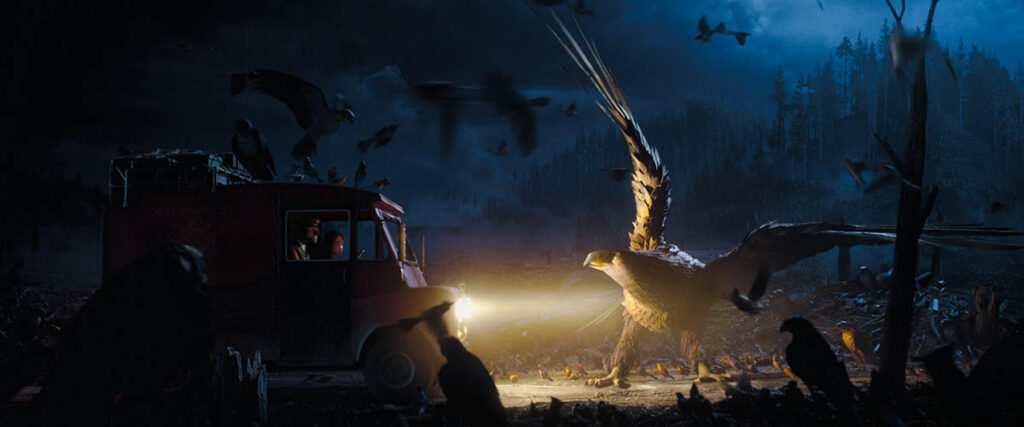
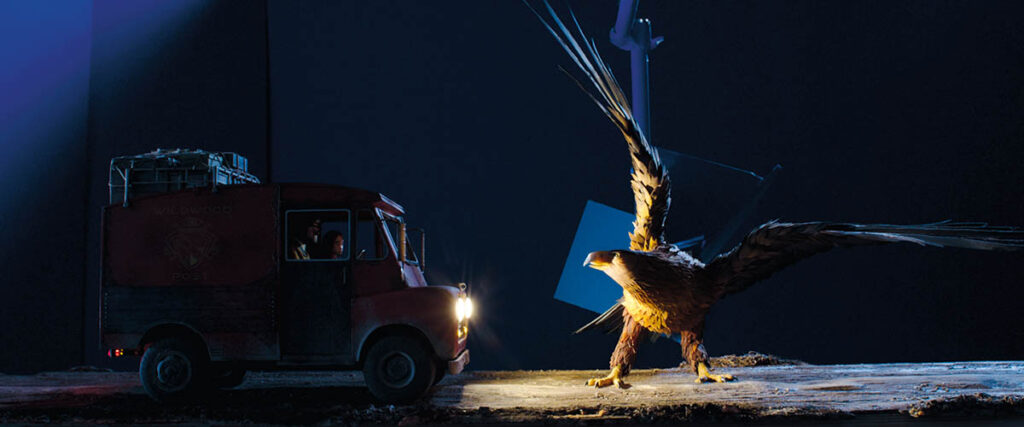
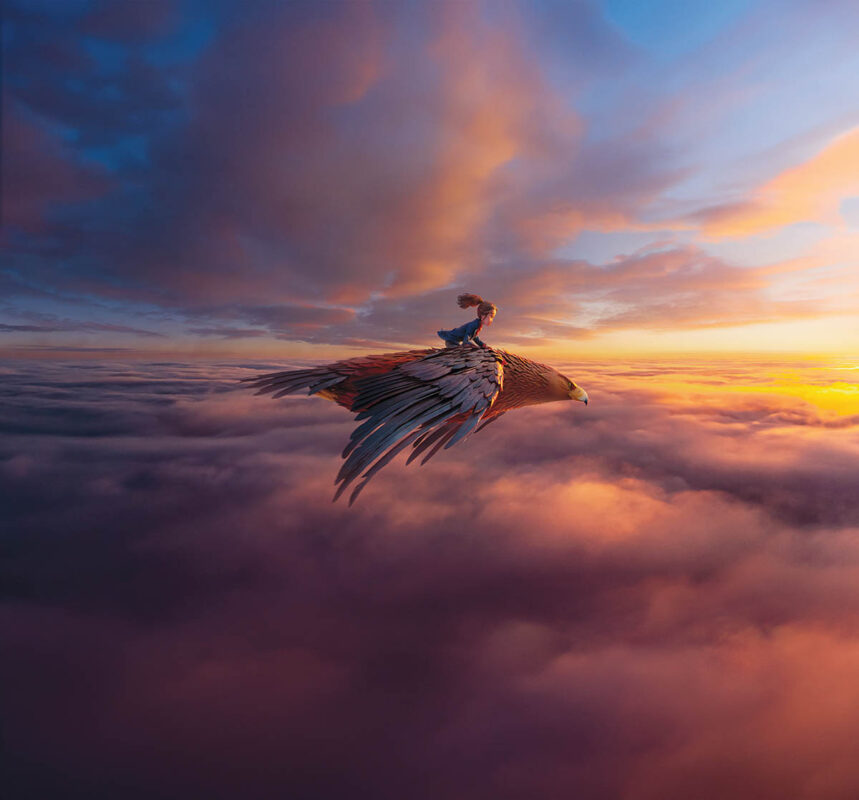
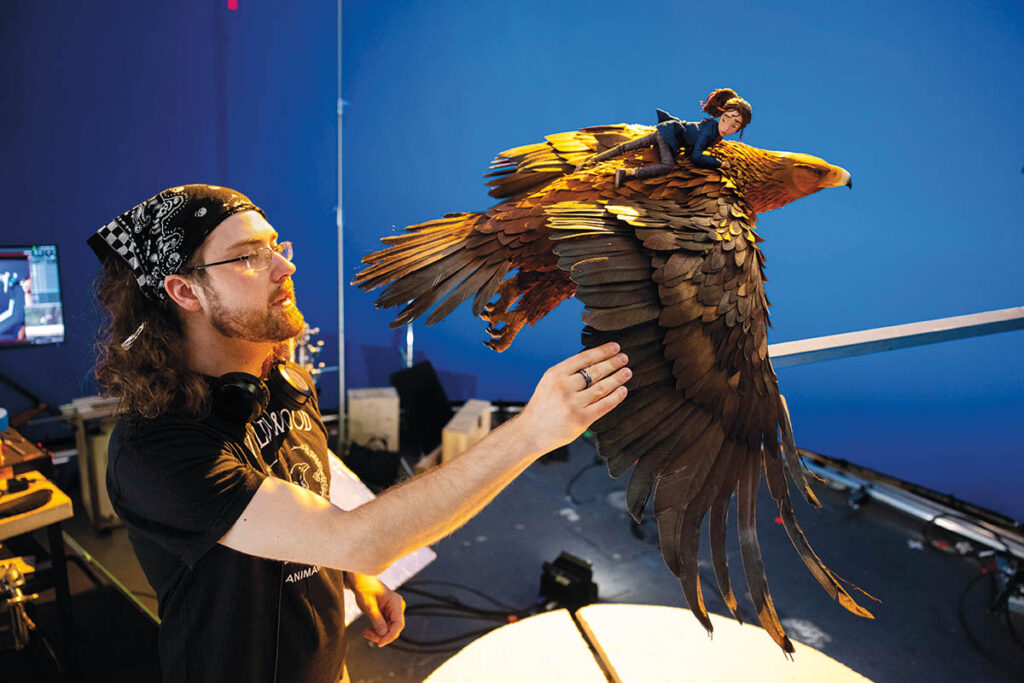
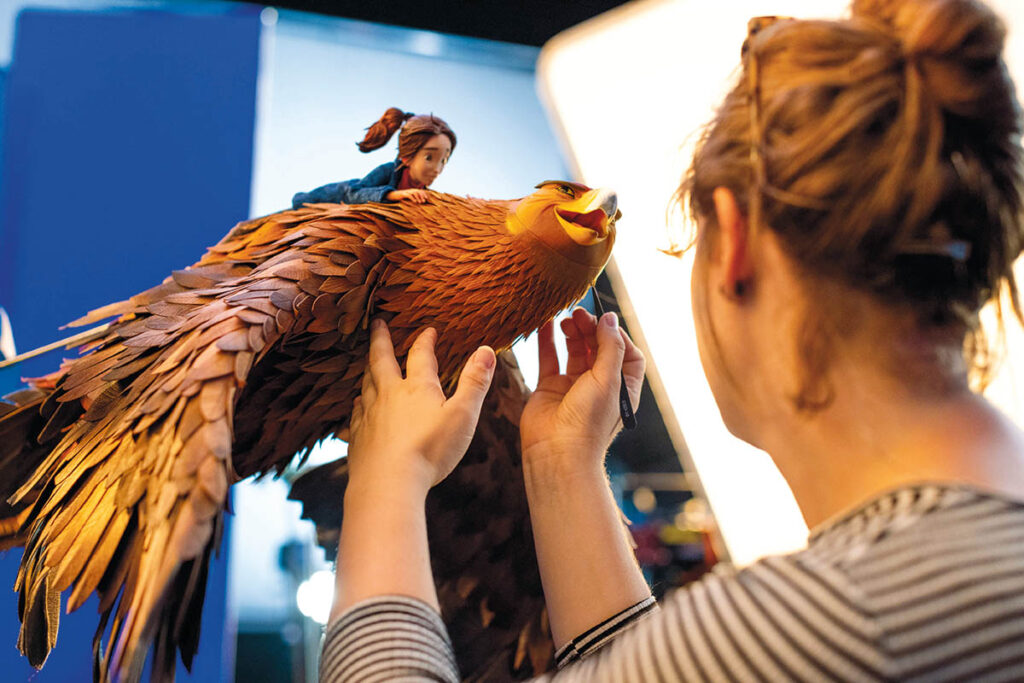
The sheer volume of characters altered the puppet fabrication workflow. “We have embraced more digital tools for our design work, yet we are still doing all of our fabrication by hand,” Ollie Jones, Puppet Fabrication Supervisor, explains. “Using Maya, AutoCAD and Inventor to create armatures upfront – as well as rig systems, so we can preview – has enabled us to be able to stack. We can give an avatar to our costume or armature teams so they can design within the constraints of the puppet. At the same time, we can be producing cast elements as well. We produced 236 fully functional puppets for the show. We wouldn’t have been able to do it unless we could have a more parallel fabrication process.” A new wax 3D printer was adopted. “Due to wax’s supreme accuracy, we were using it to produce coyote fur that could be molded and cast in silicone. We soon realized we could 3D model organic shapes that could be printed, melted and investment cast in bronze. This enabled us to make complex, bespoke metal parts for our armatures, character props and wardrobe at lightning speed. The whole process is a fitting metaphor for the studio; an antiquated process being invigorated with 21st century technology.” The biggest puppet to fabricate was the golden eagle known as The General, which featured a five-foot wingspan and 3,000 individual feathers. “Two of the puppets were built solely for flying, gliding and repetitive flap cycles. We used fabric for the feathers, and the poly satin had a little gold thread that modulated against the dawn sky. To keep weight down, we used FDM prints, which are like light, [3D] printed material, and an aluminum armature. Still, we needed some motors in the shoulders for repetitive motion. Then we built a bird that could fold in its wings, which was probably the hardest thing we did on the show. Nature has done some kooky stuff with birds!”
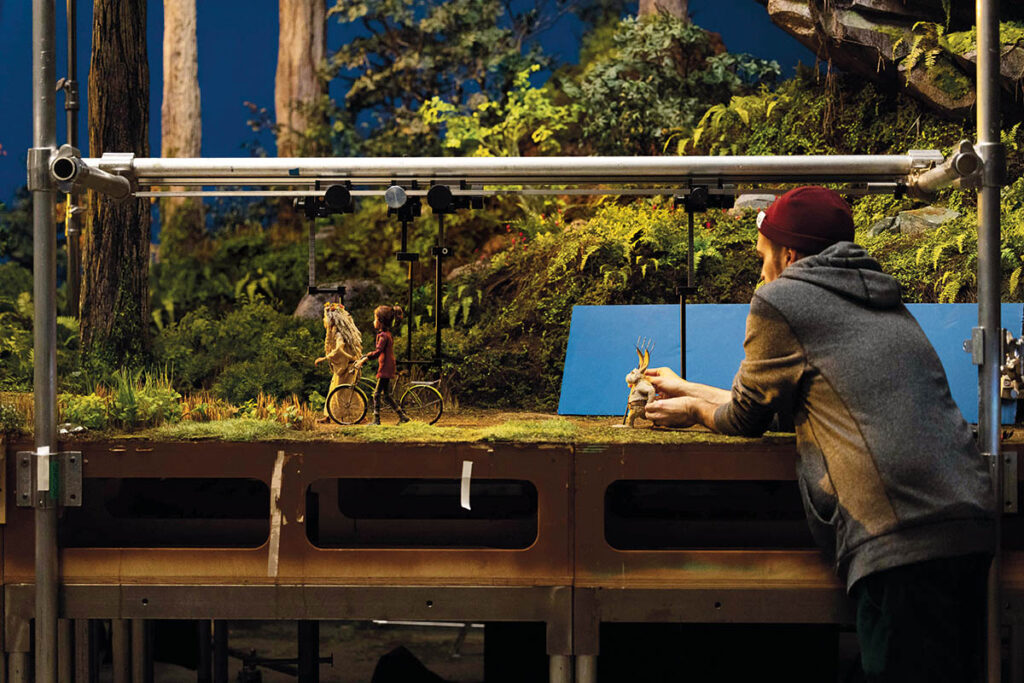
Mac’s kidnapping was intricately executed. “Mac is on a flying rig, so he’s suspended in the back with a series of liners so you can get the x, y and z axis onscreen,” Brad Schiff, Animation Director, explains. “Then we had hooks with monofilament that pulled up his onesie. As he’s standing there on the play structure, if you look at it, as the crows grab him, you’ll see the onesie get pulled first before he comes up with it. The clothes were rigged separate from the puppet so you could get that offset of movement and performance between his onesie and him going up, all the while feeling that it was the crows’ talons that had a hold on his onesie. We put some practical static crows in there to make sure that they fit on the other side of his giant head. We did a block where we had all that stuff put together so visual effects would have a good lighting reference for what the crows should look like and to ensure that the placement would work.” Digital characters had to emulate their practical counterparts. “We go back and forth, and a lot of that is done with Benoit Dubuc, our Facial Animation Supervisor, who’s now the Visual Effects Character Animation Supervisor. We work closely together and make sure what they’re doing jibes with what we’re doing. We talk about all the things I talk to my stop-motion animators about, as far as weight and legs going out to in as a character walks, so that those two worlds mesh together.” Liberties had to be taken with the coyote soldiers. “What was the ankle on a real dog became the heel. It was the only way we could get them to feel strong.”
Editor Christopher Murrie-Green says, “We’re at the point with visual effects now, where you can pretty much do anything that you want with time and budget. It’s liberating in that sense from the standpoint of a storyteller. You can unhook yourself from that practical part of it and be purely, ‘Let’s just figure out what are we trying to say visually? What are we trying to say about this character in this moment? What’s the best way to get the emotion across? What’s the best way to get the audience to buy into this moment?’ It doesn’t matter whether it’s 20% practical and 80% visual effects – that math never enters my mind. It’s only when we get into the technical side, when we’re breaking shots down and preparing for the shoot, that you get into the nitty-gritty of how this is going to be achieved in terms of visual effects.” The introduction of the Bandits’ camp went through several iterations. “It ended up being greatly simplified because we found that despite all the different creative ways to portray this idea of what this civilization was, it worked best to strip it all away. It became shots about people, which are fairly simple. It’s easy to shoot people embracing and being happy to see each other. Then you can let the background inform what the civilization is and the logistics of their lives; they live in the woods and are barbarians; that’s the framework around it. The part that matters is, ‘Who are these people?’”
“Visual effects have always been an absolutely indispensable part of what it is we do, and it’s one of the things that makes LAIKA unique in that handcrafted, practical, virtual and digital are entwined together. Each one of those techniques informs the other; that’s how we ended up with the 3D printing and these other things that start life in a digital way and are reborn as a physical thing.”
—Travis Knight, Director
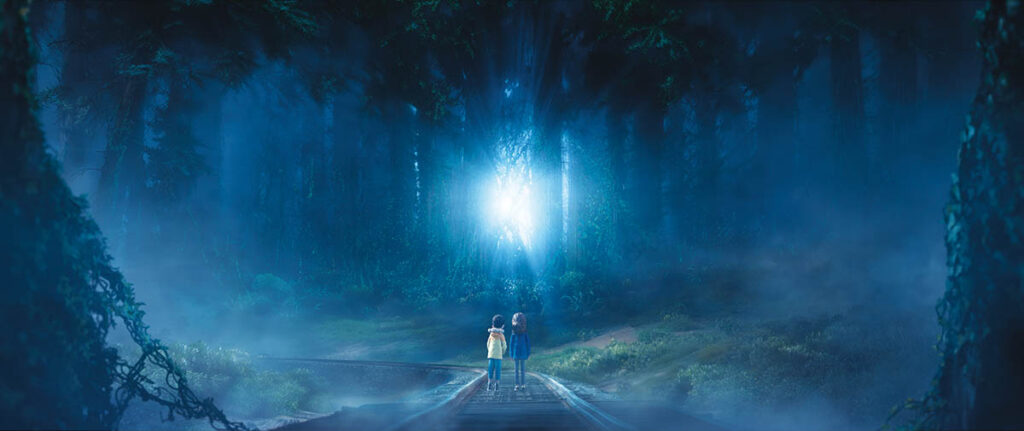
Wildwood is a love letter to Portland, Oregon, where LAIKA is based. “The advantage with the Portland side of things is we can travel into [the city], as our art department did, and bring the spirit of it into the work and into those crowds,” Steve Emerson, Visual Effects Supervisor, states. “Ultimately, we’re paying tribute to the city itself. When we get into the bigger battle stuff, that becomes something else entirely. That, to me, is much more about an emotional response to the scope of that crowd.” Prue flying on the back of The General is more about chasing emotions. “If you are on an eagle in the sky looking out to the horizon, but you want to express a feeling of danger or excitement, you need the sense of speed. We ended up going in and augmenting the performances with wisps of vapor whipping by the puppets to give the audience a sense of speed in those shots. The best part of being in visual effects here is that the stop-motion animators are giving me something that was so difficult to create, then empowering me with the ability to add to that emotionally, story-wise, and to help beautify it.” Light and shadow were important tools for guiding the viewer’s eye. “That whole forest of trees can be complex and busy, so we’ll cast a shadow over it. Suddenly, everything simplifies, and we’re looking exactly where we want to look. [One] thing that happened a lot on this show is that we’d put a forest behind the characters, and even if we had a sunlit camera move on it, if there wasn’t a sense of life, motion, shadow creeping across, or a little bit of bokeh, Travis would look at it and immediately say, ‘It looks like a picture. It doesn’t look like a living, breathing environment.’ We’re doing a lot of that with the extensions of the forest.”
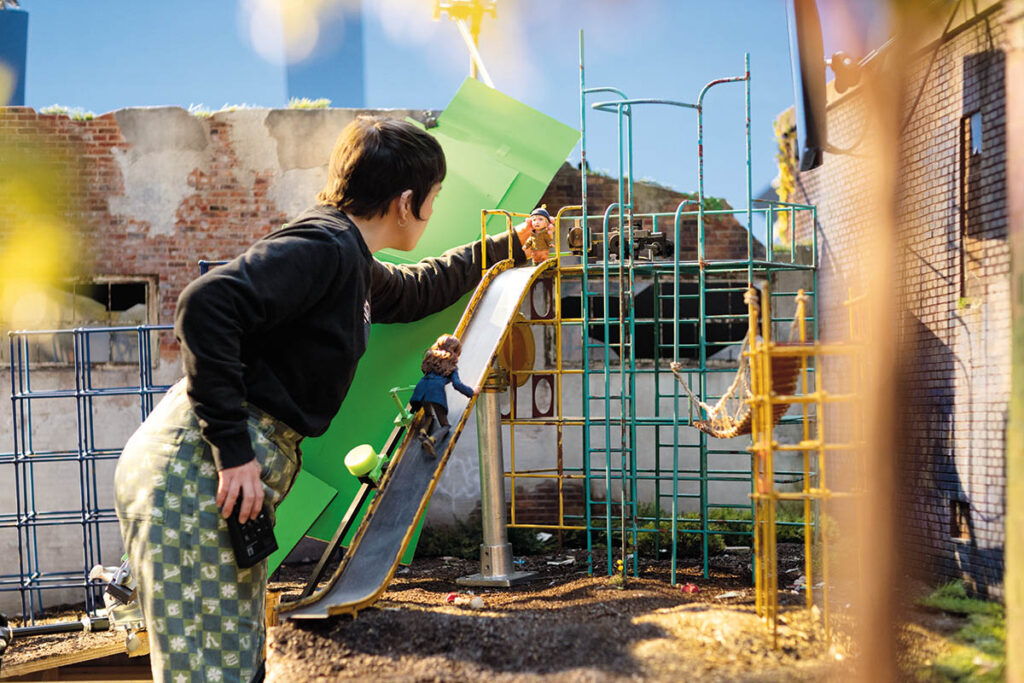
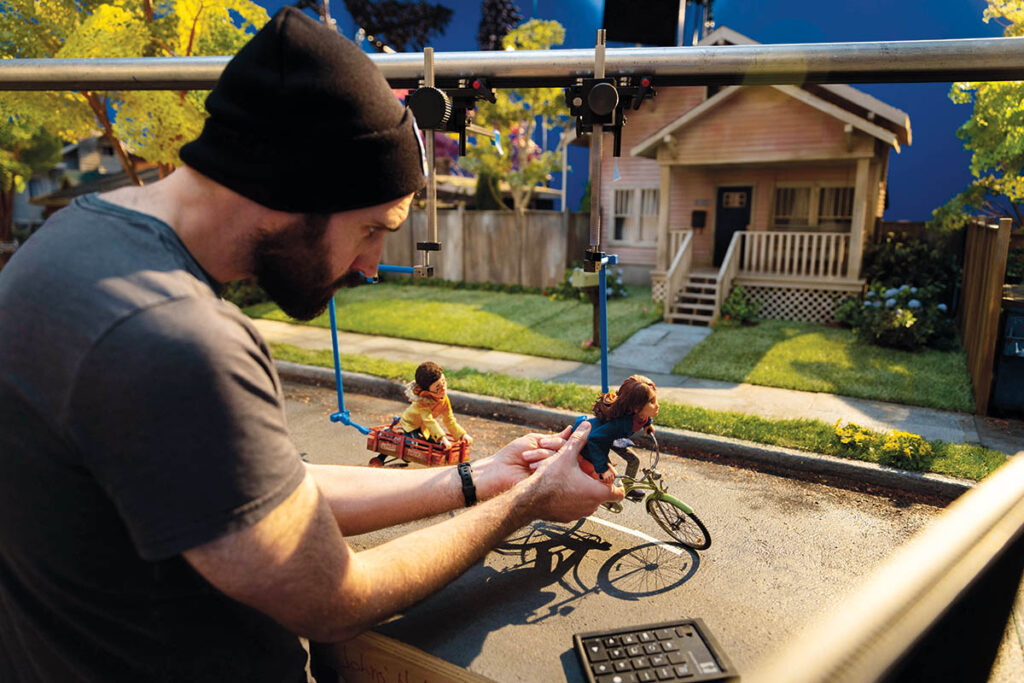
The level of ambition behind the shots far exceeded anything LAIKA had attempted across its previous five films. “On Missing Link, we were 1,450-odd shots,” Emerson notes. “On [Wildwood], we were over 2,800. We were basically going to make two LAIKA films, and beyond that, the complexity and ambition of what’s in those shots were so far beyond anything we had ever imagined before. We knew going into this that it could be a four- or five-plus-year run to finish this movie. I’ve been on it for six years, including pre-production. We didn’t have the luxury of being able to step into a film that we knew was going to take us five years of production and say, ‘We’ve got to lock everything down.’ That’s because we knew technology was going to change, and we would have to adapt or we weren’t flat-out going to be able to make it work. There was an element of flexibility with the underlying pipeline on this film that we didn’t have to deal with nearly as much on past films.” For LAIKA, taking the easy route was never an option. “We will choose to do things the difficult way because it’s uncomfortable, and other studios flat-out don’t do it; that goes back to the spirit of stop-motion animation. Who would ever be crazy enough to take a week to get three and a half seconds of animation when you can pick up a camera and tell stories at 24 frames per second? We are chasing an art form that welcomes doing things in a difficult way. If we make it too easy on ourselves, then we’re doing it wrong. When audiences watch a LAIKA film, they recognize we’re doing that.”