Images courtesy of Blind Beagle VFX.

Images courtesy of Blind Beagle VFX.
In Boots Riley’s I Love Boosters, a gang of impeccably dressed shoplifters joins forces with a factory worker on a mission to take down a ruthless fashion mogul. The surreal sci-fi heist comedy features teleporters, giant debt tumbleweeds, futuristic vehicles and imagery that drifts between the familiar and the absurd. Bringing that world to life required effects work that could translate Riley’s offbeat sensibilities into something tangible.
When it came to the film’s ambitious third-act chase sequences, that challenge fell to Christopher Lee Warren, Founder and Director of Photography at Blind Beagle VFX. Riley was introduced to Warren through filmmaker Roman Coppola, who had previously collaborated with Warren on Megalopolis. After decades in the industry, Warren had recently launched Blind Beagle, assembling a team that included his brother and son. Together, they contributed custom-built miniatures, motion-control photography, practical effects and background plates for Fuse Technical Group.
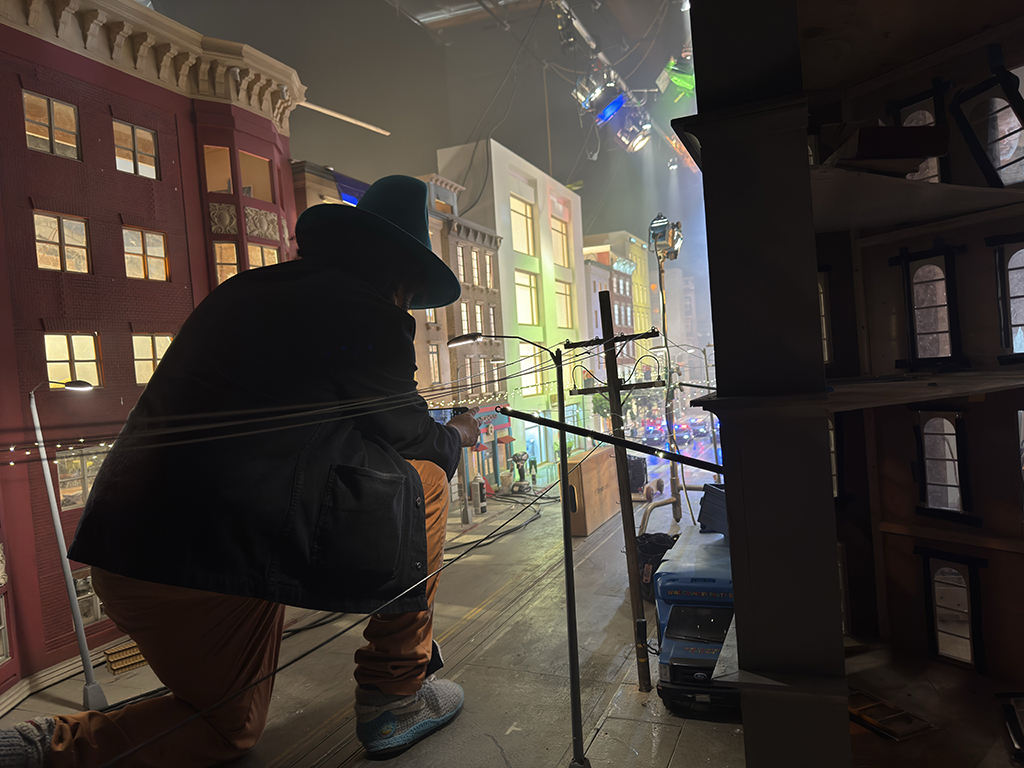
“Collaborating with someone like Boots is a breath of fresh air,” Warren says. “He wants to push the envelope, and sometimes he’s not even quite sure what that envelope is. I want to do another movie with Boots right away.”
With Blind Beagle, Riley found a crew of artists willing to embrace experimentation and imperfection. “There are things we don’t know about the ways light works. So even the best CGI is often some smoothed-out version of reality, as opposed to rough around the edges, which is how things feel in real life. Practical effects feel rough around the edges in beautiful, uncalculable ways,” says Riley, who also helmed Sorry to Bother You and I’m a Virgo. “On the other hand, you could make a CGI skyscraper stand up, walk over and take a shit, and it wouldn’t be awesome. It would just be. But that should be awesome.”
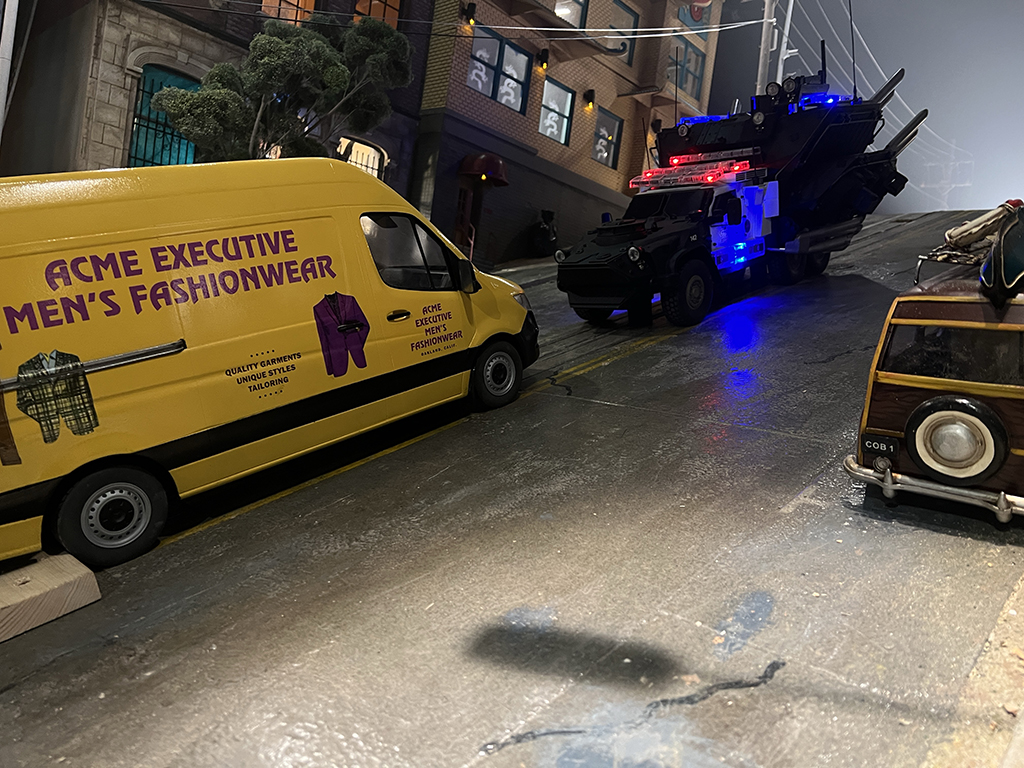
For the bulk of his career, realism was the goal. Warren’s credits include The Abyss and Terminator 2: Judgment Day, films where miniature work succeeds because audiences believe they’re looking at full-scale objects and environments. On I Love Boosters, Riley was asking for something different. “Boots comes along and says, ‘Don’t make it look too real,'” Warren recalls. “I’m thinking to myself, ‘What do you mean, don’t make it look too real? I was trained my whole life to make things look real.'”
Vehicles move differently and physical imperfections are more visible at 1/12th scale. “Boots wanted some speed and action,” Warren explains. “I couldn’t shoot it at as slow a frame rate as I would have liked to because 1/12th scale starts to look too slow.”
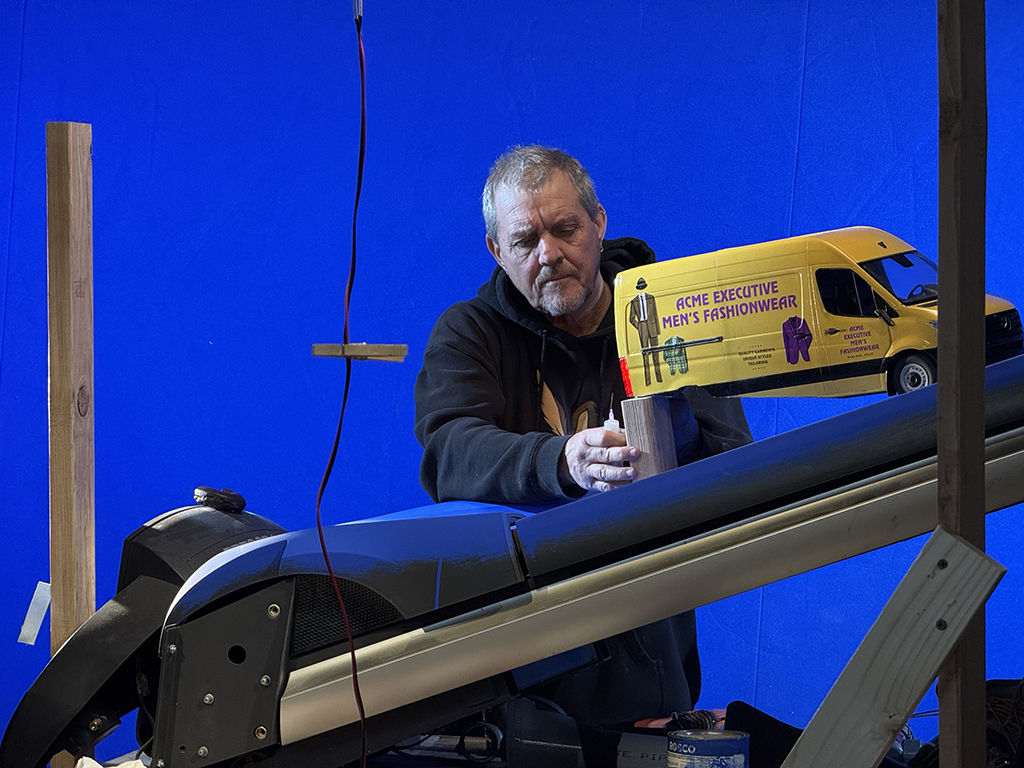
The adjustment wasn’t always easy for a DP trained to hide the mechanics of miniature photography. “Boots kept saying to me, ‘Chris, don’t make it look too real,'” Warren laughs. “I’d say, ‘Boots, did you see the way that van just bounced? That’s not real. But you’re going to put it in the movie, right? So don’t worry about it.’ So I never pulled off the throttle.”
Riley occasionally pushed boundaries even further. At one point, the director challenged Warren to deliberately break the rules. “Did I break the laws of physics? I did on one shot,” Warren reveals. During production, Riley asked whether a truck could briefly leave the ground. Under ideal circumstances, Warren would have built a more elaborate motion-control setup using programmable cable rigs and multiple motors to guide the vehicle through a carefully controlled arc. Working within the production’s schedule and budget, the team instead devised a simpler practical solution that launched the truck into the air.
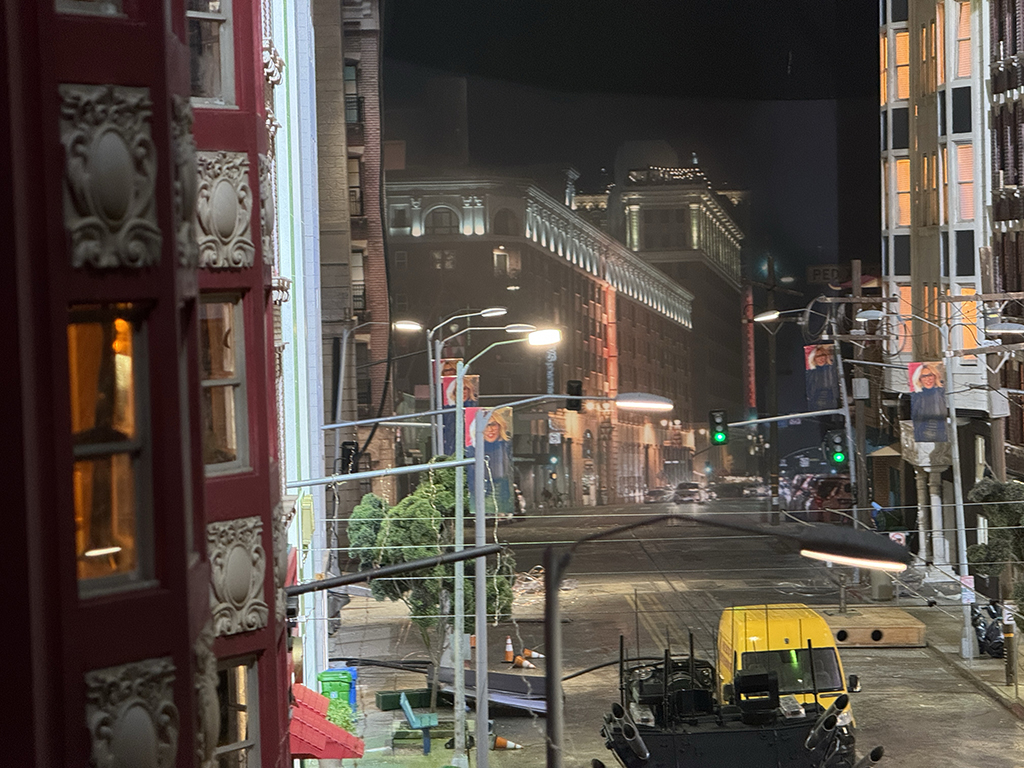
Rather than creating blur digitally in post, Warren preferred generating it naturally during photography. “I was able to sync the Nikon Z9 to the Cooper System, which I don’t think anybody’s doing these days. I shot a second pass for the headlights. I shot a third pass for the police lights so they can project onto the walls. Then I shot each pass three times so you’d have some room in post to play around with the exposures. Everything I did on the show was old-school techniques. None of that going down the hill was shot at high speed. And it’s flawless. You can’t tell that I shot at 60 frames, 100 frames, or at one second because of the blurs. I blurred the image while I was exposing it.”
One of Warren’s first opportunities to contribute came before a single miniature was ever photographed. During an early production meeting, the team discussed how to tackle the film’s climactic chase through the streets of San Francisco. It was shaping up to be an expensive sequence with a daunting number of moving parts. “I’m sitting in the background listening to them. Then I say, ‘I just shot a movie. I have all these buildings,'” Warren recalls. “I took my phone and showed them the street I had. It was almost as if a sense of relief went through the whole room. ‘Chris has got this sequence.’ And that was it. I was hired to do that sequence too.”
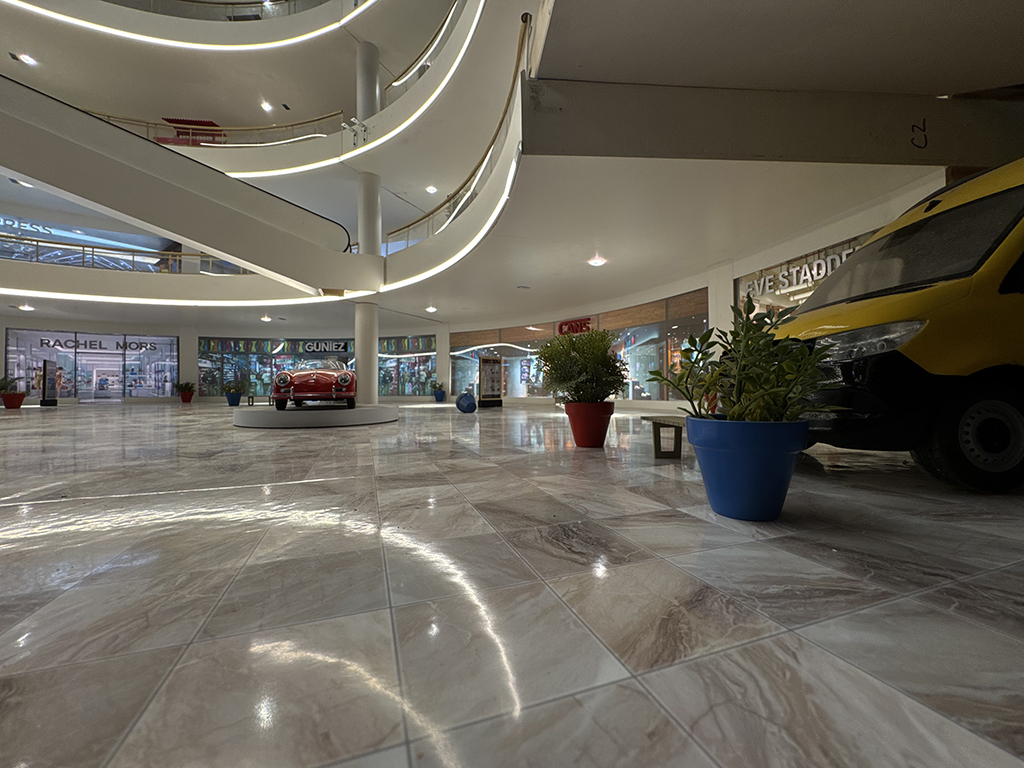
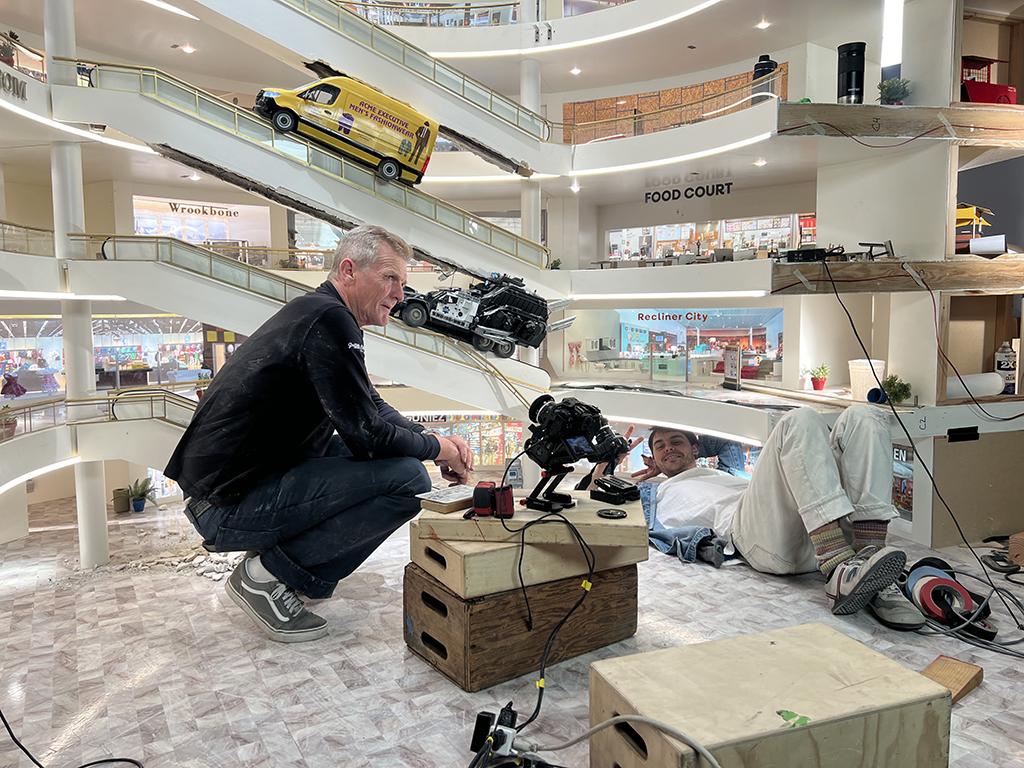
That practical problem-solving mindset would define Blind Beagle’s work throughout the film. For the chase set inside a shopping mall, Warren combined location photography, miniature construction and traditional effects techniques. “Our Miniature Production Designer, Ian Hunter [a two-time Oscar winner for First Man and Interstellar] drew some plans for the mall, and the team built it. Then I had to figure out the stores. I went to the Glendale Galleria and shot a storefront. I didn’t find all the shops I wanted, so I went to another mall, and I shot all those fronts. I knew what I wanted. I knew how it was going to look, then I made translights out of them.”
“There are things we don’t know about the ways light works. So even the best CGI is often some smoothed-out version of reality. As opposed to rough around the edges, which is how things feel in real life. Practical effects feel rough around the edges in beautiful, uncalculable ways. On the other hand, you could make a CGI skyscraper stand up, walk over and take a shit, and it wouldn’t be awesome. It would just be. But that should be awesome.”
—Boots Riley, Writer/Director, I Love Boosters
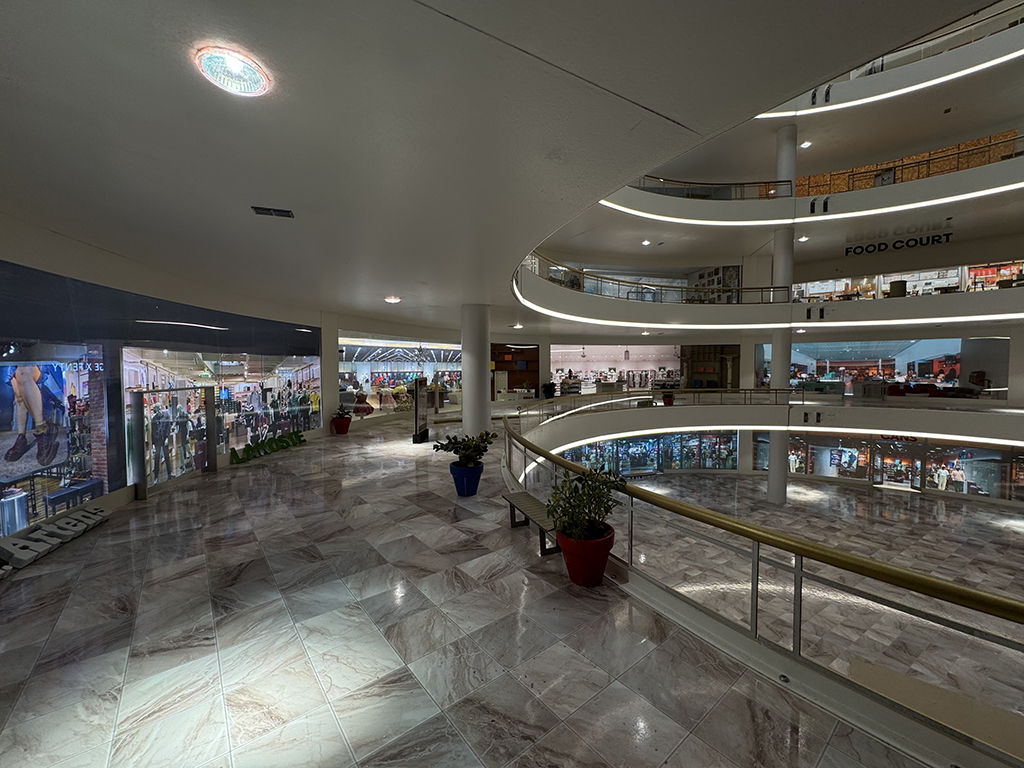
The technique remains a staple of miniature photography. “You print the storefront on it, install it, put lights behind it, and if done properly, it looks like there’s depth. Because everything’s in 2D, that’s the beauty of the artistry of miniatures. Pay no attention to the fact that that’s a flat piece of acetate with an image on it,” Warren says. “Because I’m not trying to tell you to look at that. I want you to look at the overall picture.”
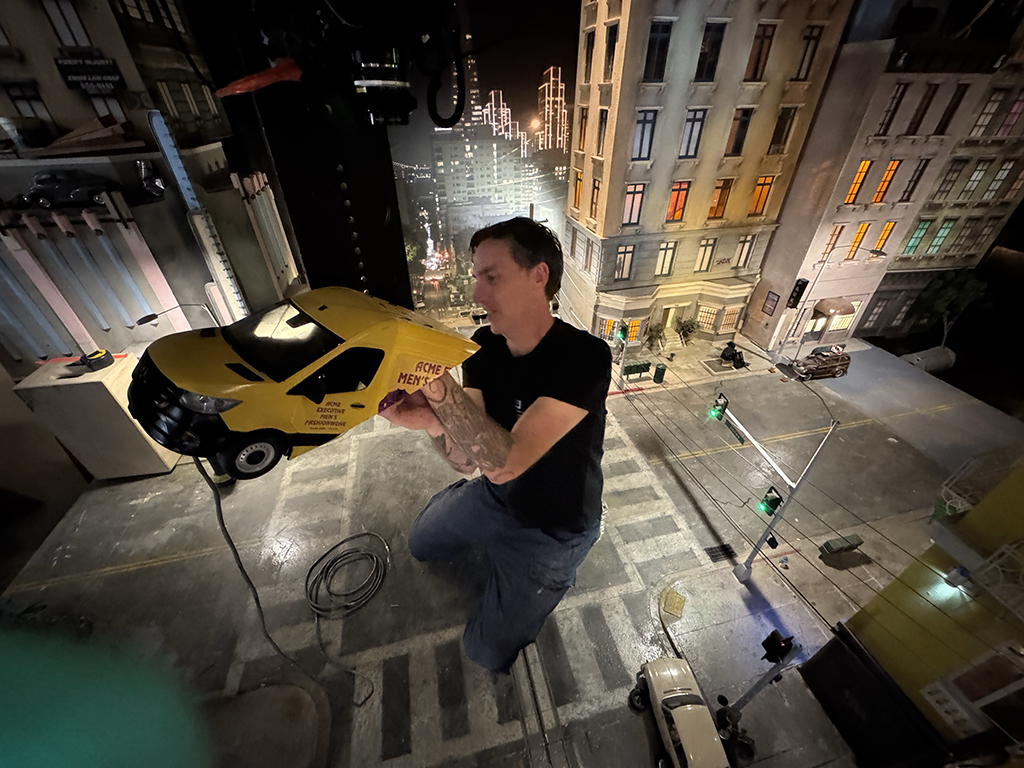
The sequence also includes one of Warren’s favorite contributions. “There is an actual matte painting – painted, not digital – in that mall sequence. I like painted paintings. I don’t like digital paintings. I’ve done four actual color-painted matte paintings since we opened. I don’t know how to do LiDAR. I don’t know how to do CGI. I just know how to build and shoot stuff.”
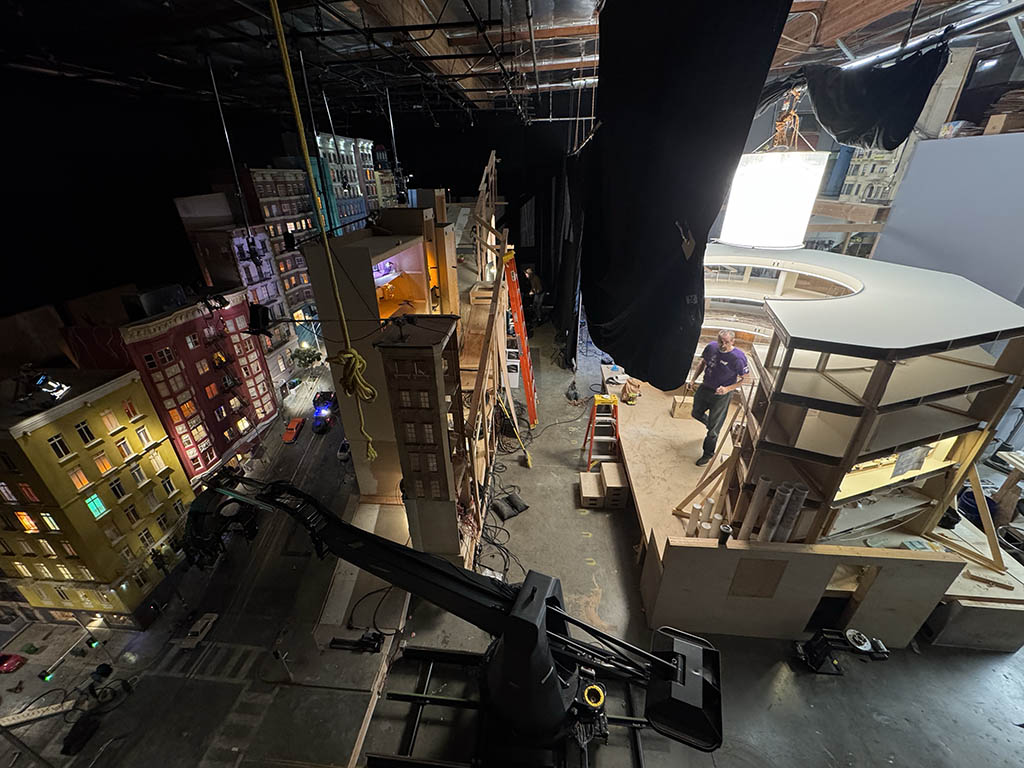
Among the film’s most memorable sci-fi inventions is a handmade transport device that allows the Velvet Gang to deconstruct, transport and accelerate situations through blasts of water-like energy. During the chase sequence, the device becomes lodged beneath the gang’s van as the police tanker bears down on them. “We actually built miniature teleporters,” Warren notes.
While the finished effect appears fantastical, some elements were practical. “All the accelerator stuff was all real water,” he explains. “The elements were shot for real. They weren’t digitally corrected. They weren’t digitally created. I built my own little rig, and then we shot water.”
To sell the illusion that the energy was moving through real space, the team also staged miniature interactions, placing tiny figures nearby and triggering practical splashes. Warren recalls, “We actually made it splash on the floor and had things that moved back and forth to make it look like it was going through the room.”
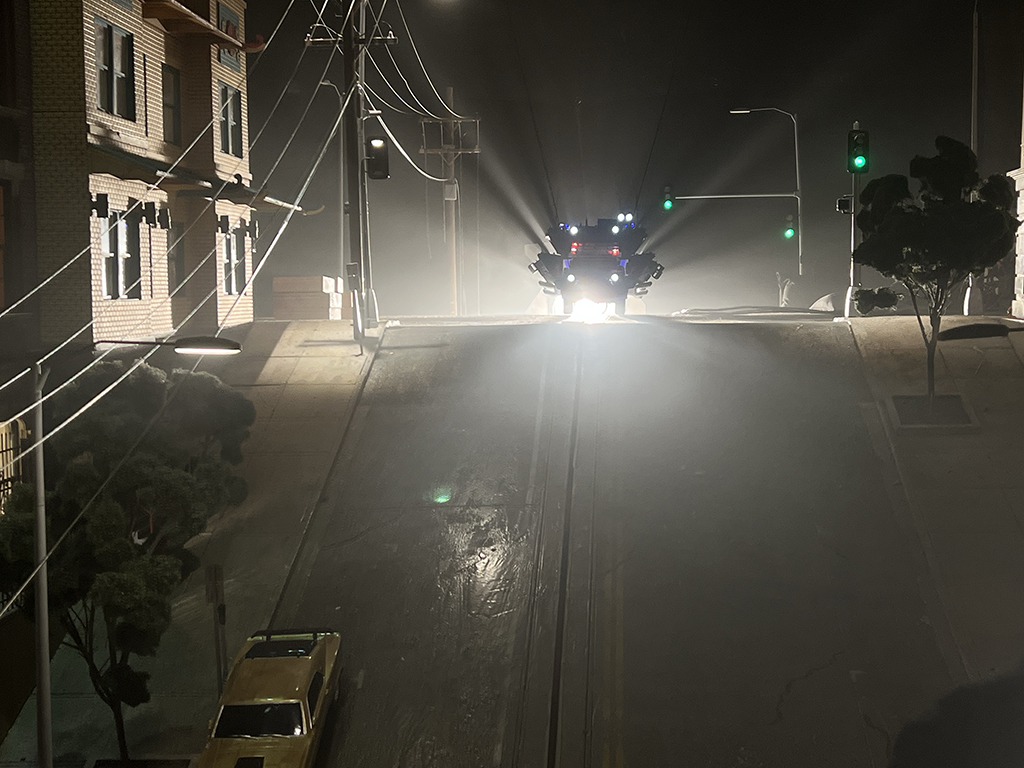
One of Blind Beagle’s most ambitious builds was the police tanker that appears in the chase sequence. Like many miniature projects, it began with a foundation. “You’ve got to start with a chassis. You’ve got to start with something,” Warren says. “We found a model online.” The tanker itself was built from a combination of 3D-printed and handmade components.
“Our Miniature Production Designer, Ian Hunter, a two-time Oscar winner, drew some plans for the mall, and the team built it. Then I had to figure out the stores. I went to the Glendale Galleria and shot a storefront. I didn’t find all the shops I wanted, so I went to another mall, and I shot all those fronts. I knew what I wanted. I knew how it was going to look and then I made translights out of them. You print the storefront on it, install it, put lights behind it, and if done properly, it looks like there’s depth. Because everything’s in 2D, that’s the beauty of the artistry of miniatures.”
—Christopher Lee Warren, Founder & Director of Photography, Blind Beagle VFX
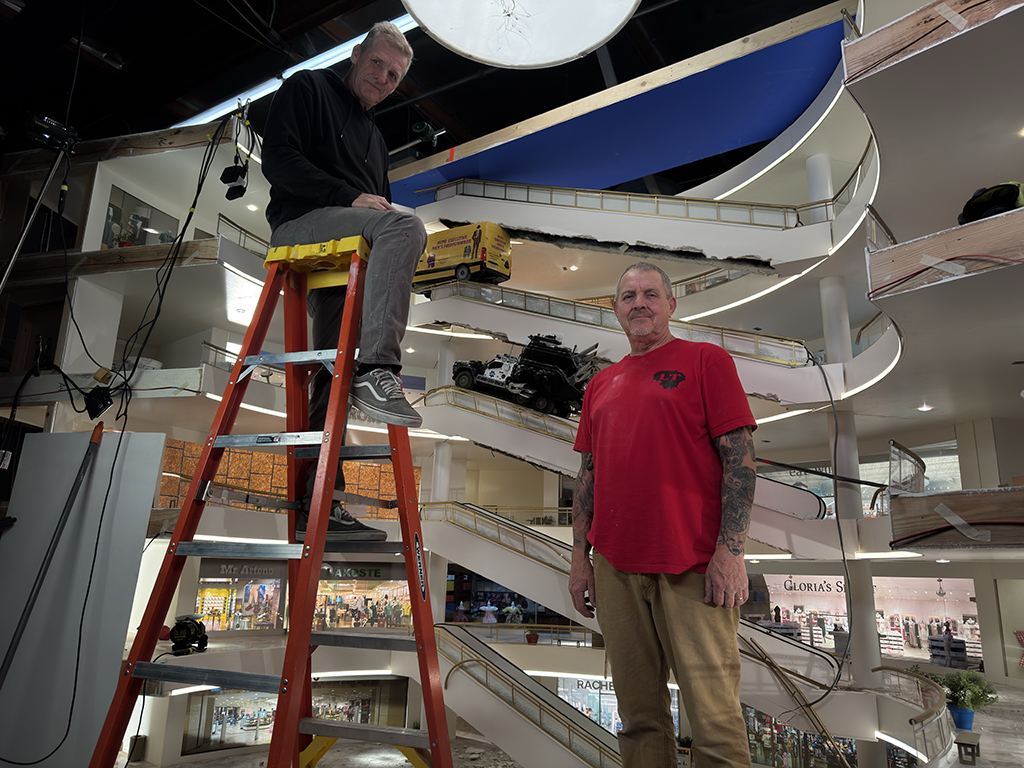
The tanker became the centerpiece of a larger miniature environment that blended practical vehicles with motion-control photography. “Those two [the van and the tanker] are the only remote-controlled cars in the whole thing. Everything else moved by motion control, even the shuttle bus with the skinless people in it.”
Even the most carefully engineered miniature work can go sideways. For example, there’s a shot where the Velvet Gang drives their van through the window of a building. “Normally, I’d have a pyro guy with a squib in his hand who breaks the glass on impact, but that wasn’t in the budget, so everything was timed by hand. We did one take, and Boots said, ‘Let’s do it again.’ So we set up to do it again. And the timing was off. The van hit the window, and the window just falls out. It took two days in the body shop.”
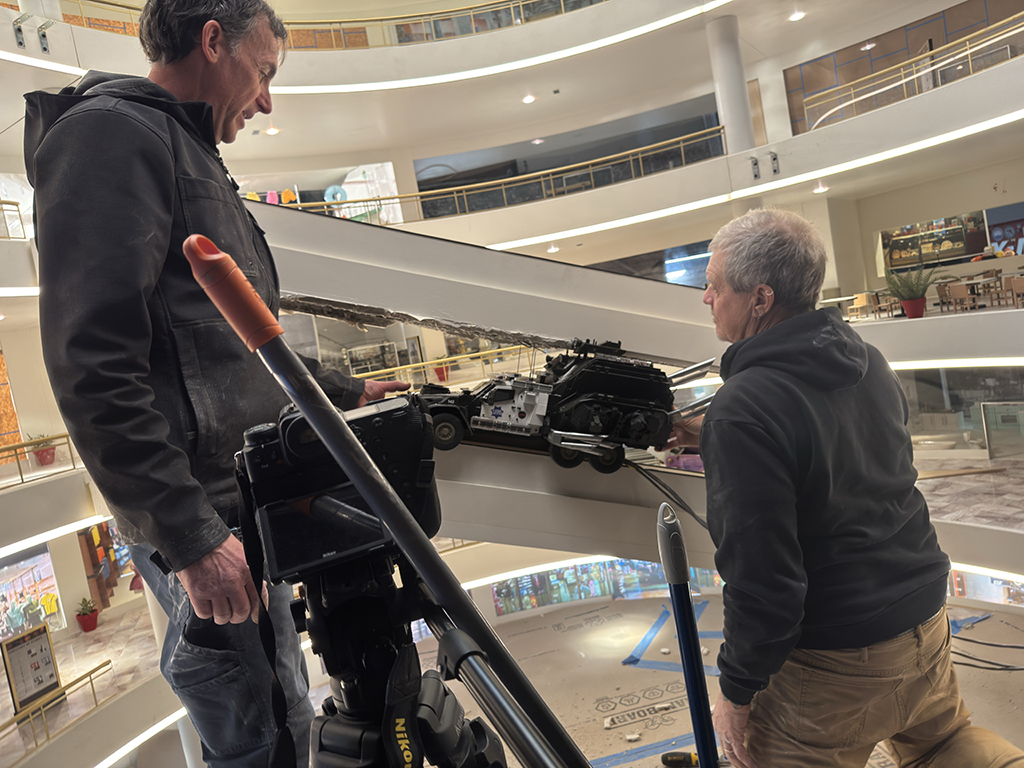
What does a body shop look like for a miniature vehicle? Warren deadpans: “A table. Someone’s workbench.”
Despite its sturdy appearance on screen, the miniature van was a relatively delicate build. Even after taking that tumble, some members of the team were convinced it could withstand the fall. Warren disagreed. “It’s not very strong,” he says. “Everybody’s like, ‘That thing’s like a tank.’ No. Give it 15 minutes, guys. It’s wasted.”
One notable shot wasn’t in the storyboards. During the shoot, Warren pitched an idea to Riley. He wanted to position the camera inside the miniature environment and let the action play out directly toward the lens. “I want to set up and look outside, and I want to see the van come into our face. That’ll give you a good cut,” Warren says.
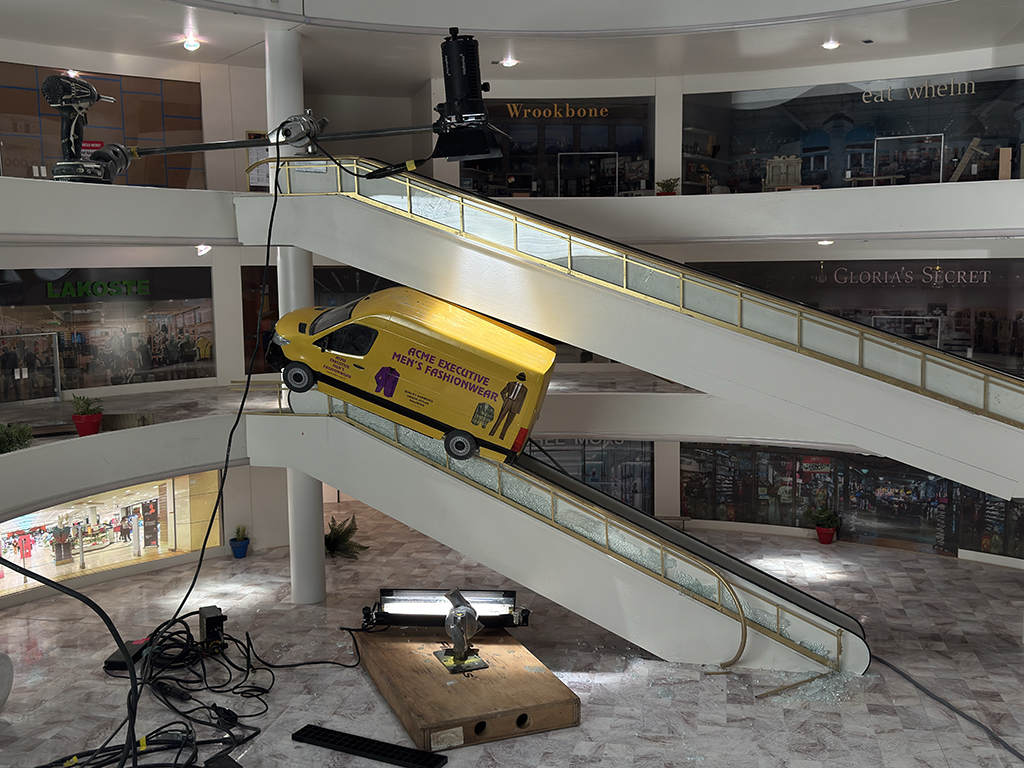
Riley’s response was immediate. “Let’s do it.”
That collaborative spirit extended beyond any single shot or sequence. For Warren, I Love Boosters was a joyful family affair. “There were four Warrens on this movie. Myself, Gene, Brandon and Jon. We’re not corporate. We’re a little family business that just likes to make miniatures and shoot them.”