Image courtesy of DNEG © 2026 WBEI

Image courtesy of DNEG © 2026 WBEI
Frustrated with a lifetime of malfunctioning products that have thwarted his attempts to nab the Road Runner, Wile E. Coyote takes the ACME Corporation to court in the live-action/animation comedy Coyote vs. Acme. The film’s David-versus-Goliath premise took on an unexpected real-world dimension in 2023, when Warner Bros. Discovery shelved the completed feature amid broader cost-cutting measures. Days after the news became public, the studio reconsidered its decision and allowed director Dave Green to shop the film to other distributors.
Luckily, Ketchup Entertainment acquired the worldwide distribution rights in 2025, and the rescued film went on to become a box-office success story, earning nearly $16 million domestically in its opening weekend. Production Visual Effects Supervisor George Murphy oversaw the integration of the beloved Looney Tunes characters into the live-action world, and enlisted his colleagues at DNEG to produce big-screen versions of Wile E. Coyote, Road Runner, Foghorn Leghorn and more. The team also produced various visual gags such as a falling piano hitting a car, exploding rocket skates, a tumbling 18-wheeler and an oncoming cartoon train.
Successfully integrating a cartoon character into a real environment isn’t just about matching the on-set lighting. “It goes deeper than that,” notes Alexander Seaman, Visual Effects Supervisor, DNEG. “It’s to do with the character design and making them feel like the cartoon characters. Our original brief was to keep the essence of the 2D characters because that’s how we recognize them as cartoons. [We used] 3D camera technology for the shoot and some of the all-CG shots, so there is a bit of a 3D movement to them. The animation-visual effects pipeline we adopted made use of cell shading on the characters. Particular attention was paid to ensure the line generation was as close to the style of the original cartoons as possible. Line thicknesses and sizes were driven based on the animation team’s work. The lighting was visually simplified, but there were a lot of very fine parameters to make sure the characters looked exactly like the characters we recognize. One of the biggest learning curves for me involved the colors of the characters and making sure all our technology was absolutely identical for color calibration. If Road Runner’s blue or Wile E.’s brown was just a hint off, the character had a completely different aesthetic.”
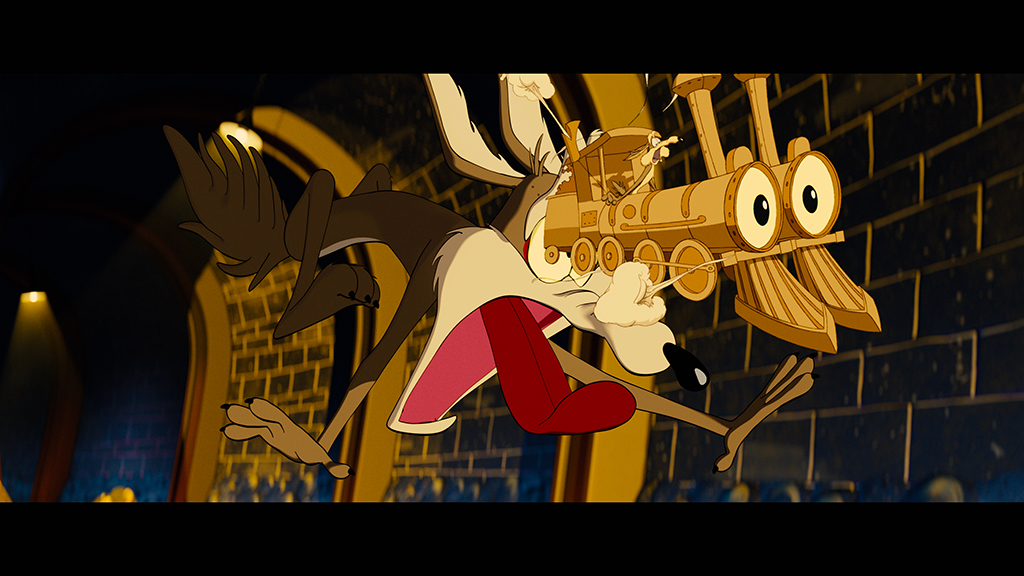
Among the many fun, cartoonish antics are Wile E. Coyote’s bulging eyes turning into a miniature train caboose while a massive train speeds toward him. “That is actually a 2D gag,” explains Keith Roberts, Animation Director, DNEG. “Wile E. and the eye bulge are 3D. Then we transitioned to a 2D gag that was animated by Andy Brooks, one of our 2D guys. That kind of integration is a blast and some of the most fun stuff you could ever do as an animator.” The project allowed the animation team to break away from the usual mandate for photorealism. “The great thing about DNEG is we’ve got a feature animation arm as well as a visual effects arm so we were able to pick, mix and match, and correctly cast animators to the tasks,” Roberts says. “There were all kinds of challenges. First, we did some tests on twos and on ones. If you have Wile E. walking next to a live-action character on twos, it looks uncanny. But if you do it on ones, you buy it, and it looks like it’s in the scene. We had to make those kinds of decisions for every shot. Because the Warner Bros.’ style of animation is spars that was also a consideration when we were doing the animation.”
“Special effects rigged the car with hydraulics and mechanisms to crush it in a fast, believable way. But when we got back to the sketch vis, or the idea part of the animation process, we were still unsure. Is it a real piano that hits the car, or is it a toon piano? With all the gags throughout the movie [that depended] on that decision, we tried both versions. It’s reverse engineering driven by what is the funniest animation. The funniest animation is a really heavy piano with lots of lightweight keys and springs that fly out of it.”
—Alexander Seaman, Visual Effects Supervisor, Coyote vs Acme
A falling piano is not unusual in a cartoon, but having it smash into a live-action car is a different matter. “Special effects rigged the car with hydraulics and mechanisms to crush it in a fast, believable way,” Seaman explains. “But when we got back to the sketch vis, or the idea part of the animation process, we were still unsure. Is it a real piano that hits the car or a toon piano? With all the gags throughout the movie [that depended] on that decision, we tried both versions. It’s reverse engineering driven by what is the funniest animation. The funniest animation is a really heavy piano with lots of lightweight keys and springs that fly out of it.”
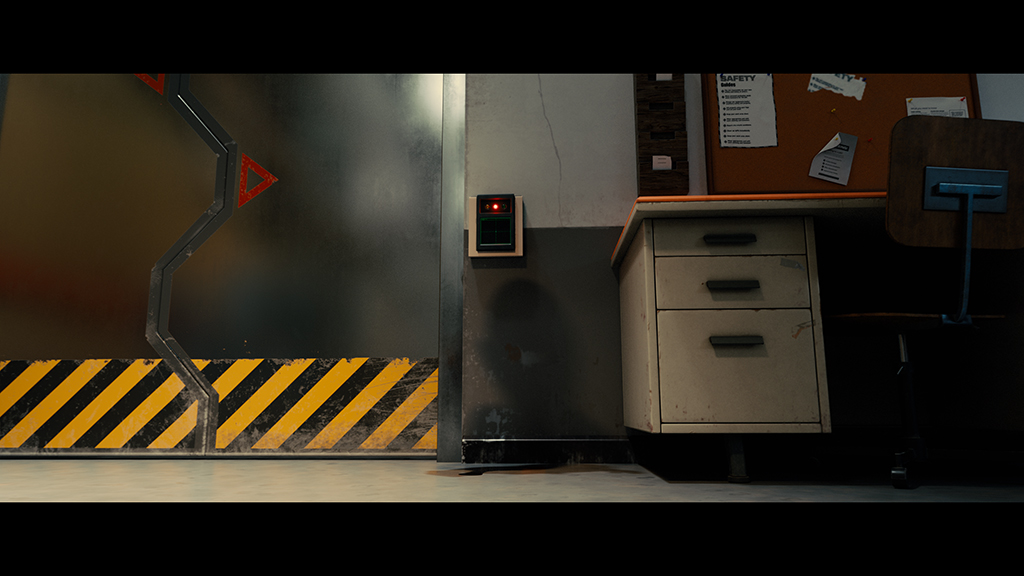
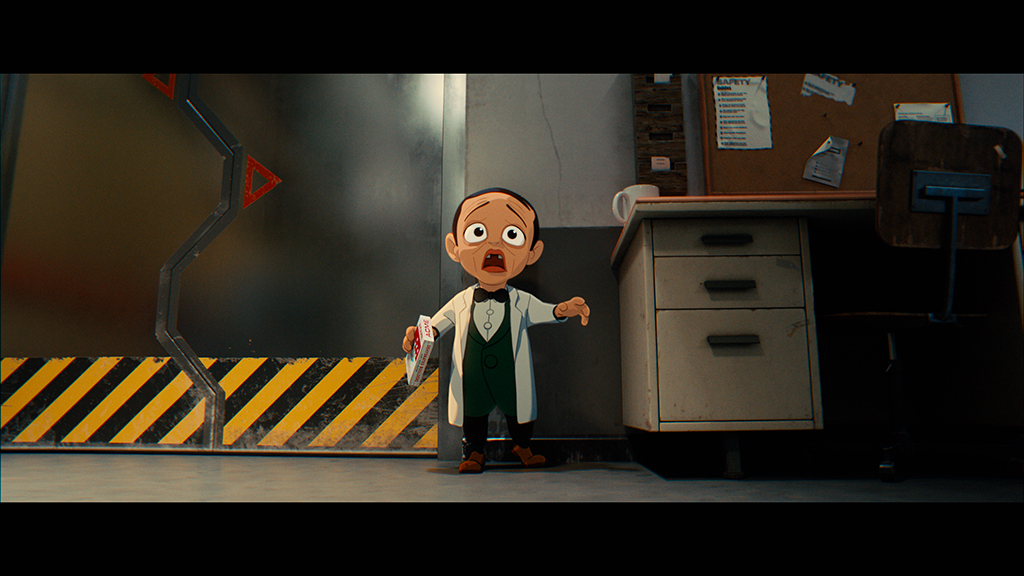
The team decided on a scene-by-scene basis whether to use practical or cartoon explosions. “When Wile E. is outside the courthouse riding on the back of the rocket, it hits Will Forte’s car, and the actual car explodes, flips up, lands and there’s fire everywhere,” Roberts says. “That was a practical explosion. We did it on the backlot, comped it in, and that looked great. There’s an explosion in the courthouse where Wile E. is putting all of his stuff in the box near the metal detector, and he has the grenade and realizes the pin’s not in the grenade. And that’s a big explosion we basically played on Will Forte’s face with a huge air cannon. Will was a great sport on that day, because the force of the wind blowing on his face was absolutely immense.”
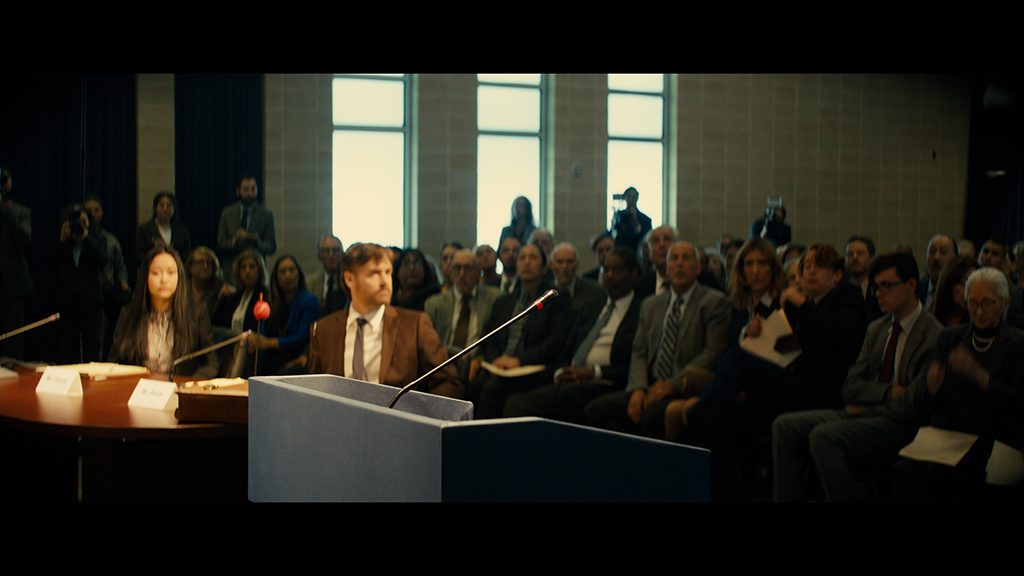
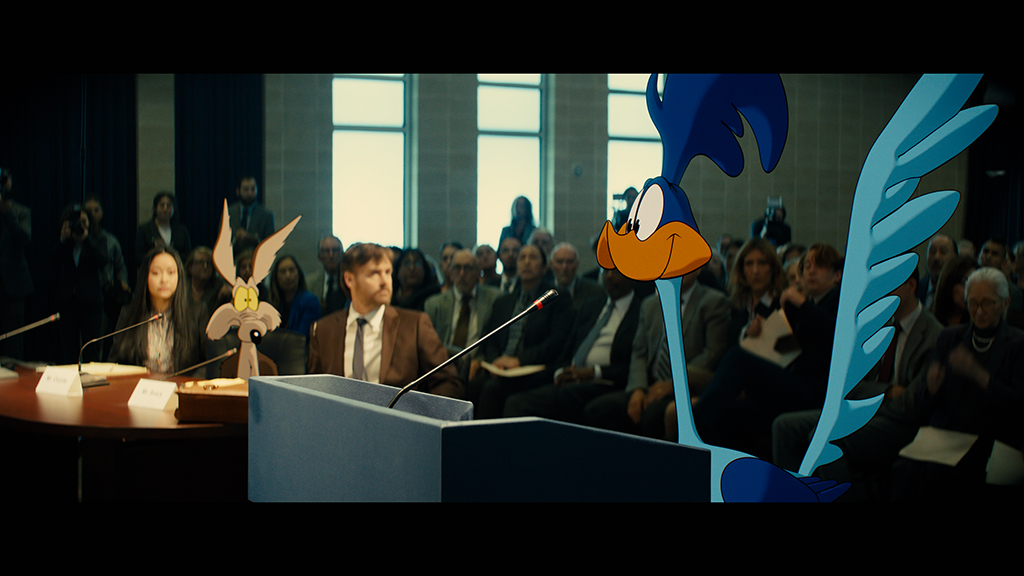
Recreating the look of classic cartoons meant rethinking established VFX practices, especially lighting and rigging. “I remember trying to train lighting artists that you don’t need to beautifully light your characters or your scenes with all of these different light sources,” Seaman notes. “It needs to look like the cartoon characters. That was more challenging than we realized at the start.” Rigging has to be more flexible for animated characters than a photorealistic digital double. “By far one of the hardest tasks of the project,” Seaman admits. “We had to cast a wide net to get some really good specialists at making the rigs do the things that Keith’s team needed to do and be fast in a pipeline to animate with iterative feedback. In particular, there were specific rigs for the faces. Of course, we’ve got multiple rigs for multiple characters, and they all have different proportions and face shapes, so the magnitude of that was enormous. But then we come to an even tougher rigging challenge: what we call ‘the gags,’ like when Wile E. hits his face against a windscreen, gets run over by a truck, turns green, or gets blown up by a grenade. We had a specific team just dealing with gags. They would almost re-engineer an entire rig or model or miniature pipeline for that character for those three or four shots.”
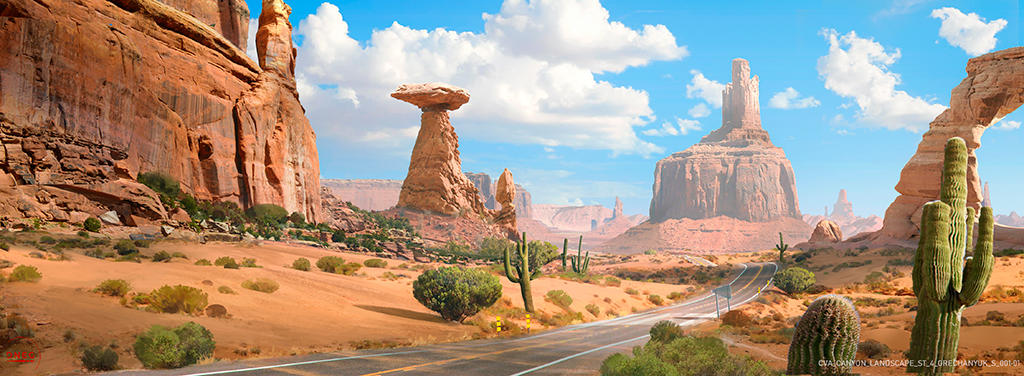
Whereas photorealism is a key consideration in visual effects, animation is all about appeal. “You could have animators debating this for years,” Roberts laughs. “Appeal is what makes the image, character and gag compelling. It’s not necessarily being cute. You can have an evil character, and his appeal is how evil he looks. It is a matter of taste to a certain degree, but with Chuck Jones and Wile E. Coyote, he’d set out a certain set of visual rules that we followed to make it look authentic.” A certain amount of appeal comes from familiarity. “Certainly, things like the desert scene, which looks like it has a photographic nature,” Seaman says. “However, you realize it’s never somewhere that really ever exists in real life. The brief called for a traditional Wile E. Coyote, Monument Valley-style desert. But what worked really well for us is that we got a photoreal environment that looked familiar to everybody, and that’s a comforting space we ended up in on that scene.”
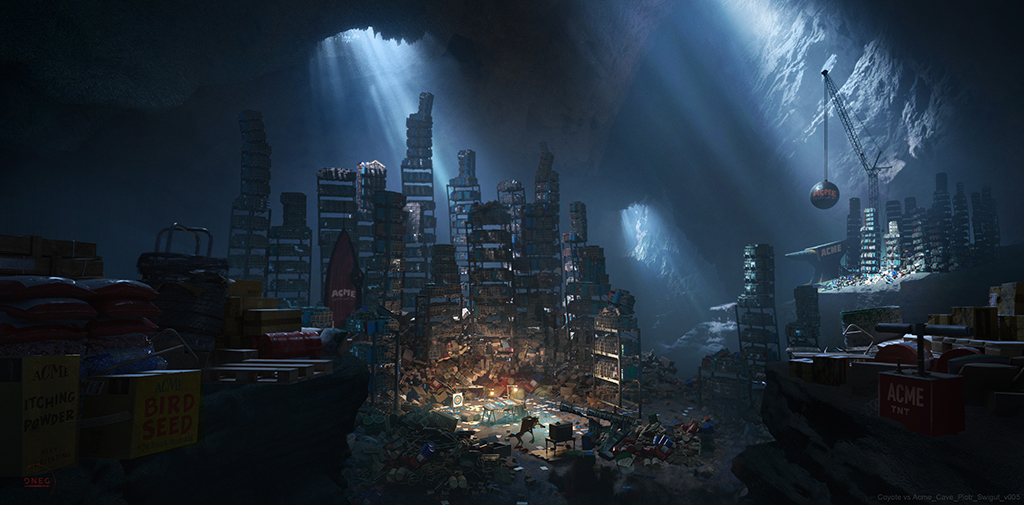
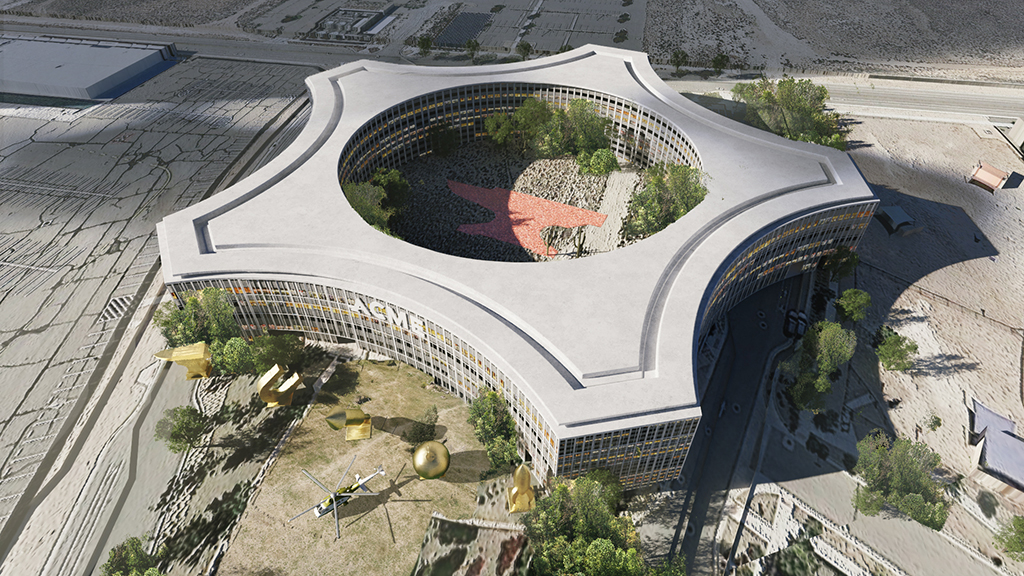
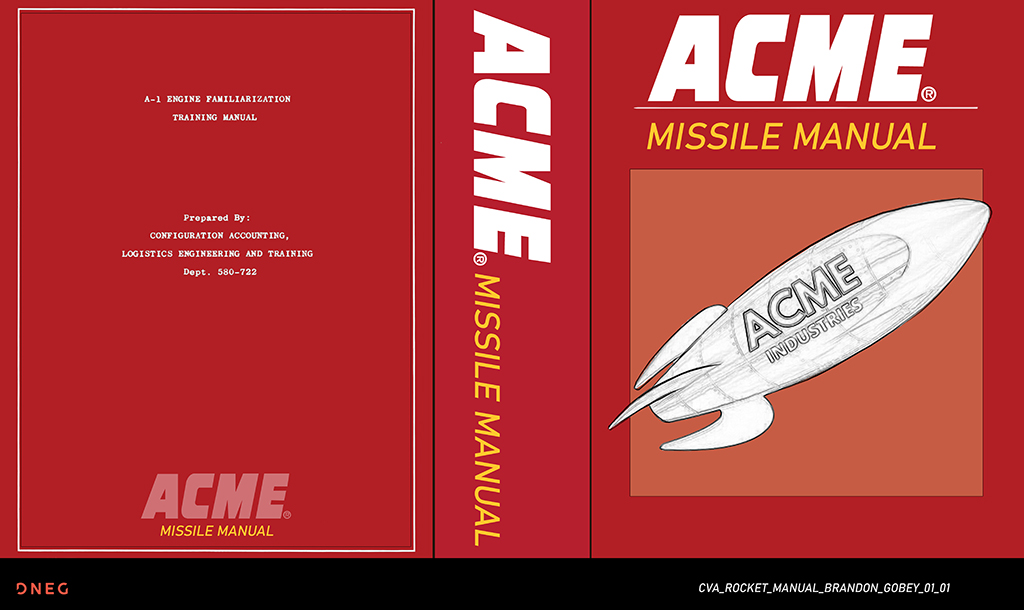
Some environments were entirely CG, like the cavern inhabited by Wile E. Coyote. “That was another conundrum of what is photographically real: a toon prop or ACME product?” Seaman says. “That went through a series of composition layouts to even try and figure out what was the funniest. Is it funny that he’s trying to wrestle in a real-life filing cabinet? Then there’s a toon hammer ready to be picked up or a real-life TV [playing] a bad broadcast. Hopefully, everything was designed to make it look effortless on screen. But everything had a vast amount of creative discussion to make it look right.” Much of Wile E.’s backstory is revealed through props. “You want to be able to understand more about his personality without the movie having to explain it to you,” Seaman observes. “And by doing that, you can see he’s gone through years of struggle. He’s got rocket ships, roller skates and open boxes. Everything is designed [for audiences] to sympathize with the character and also understand he’s been doing it for a long time.”
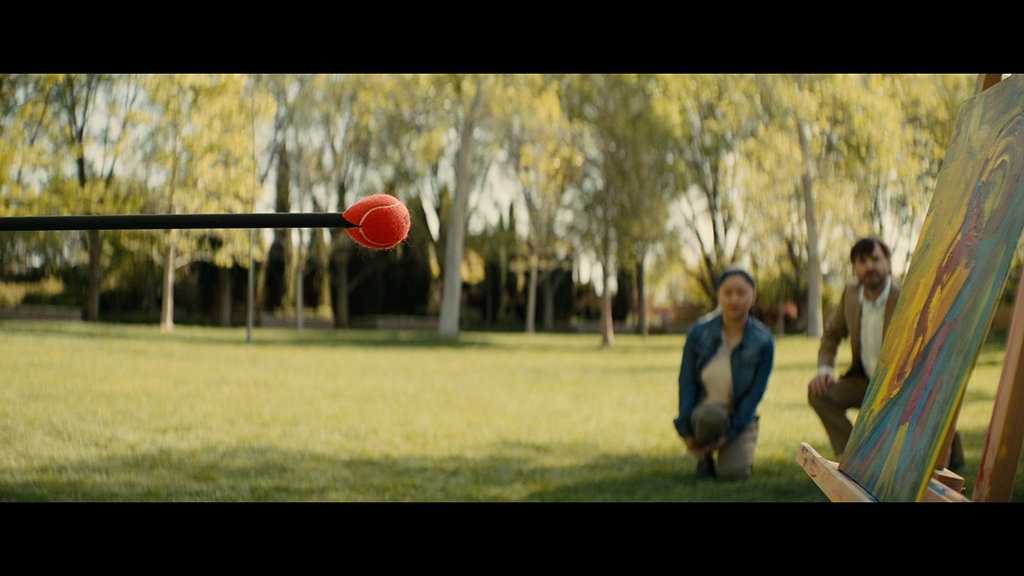
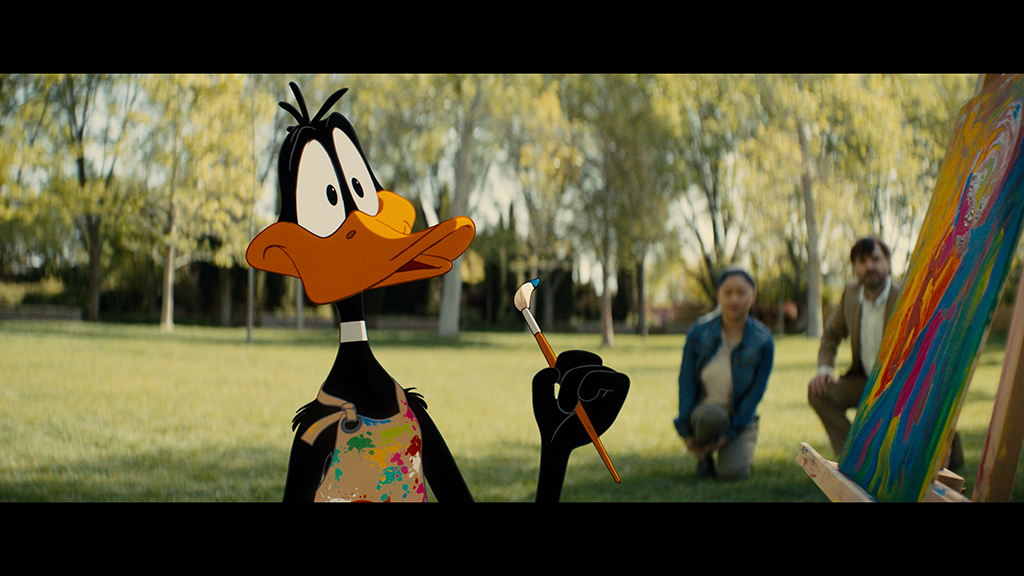
Previs was done extensively beforehand. However, several gags needed further development. “Quite often they would start with a foam stand-up puppet and frame for that,” Roberts reveals. “They would have the stand-ins of the human actors and get all of the framing correct. It was anamorphic, so the framing was quite cinematic. They would then pull out the puppet. They would put David Barclay [Puppeteer] in if there was a human to interact with, like a conversation to be had. Then it was up to Dave Green and George Murphy to figure out which plate to use. Quite often, it was a plate with the puppeteer.”
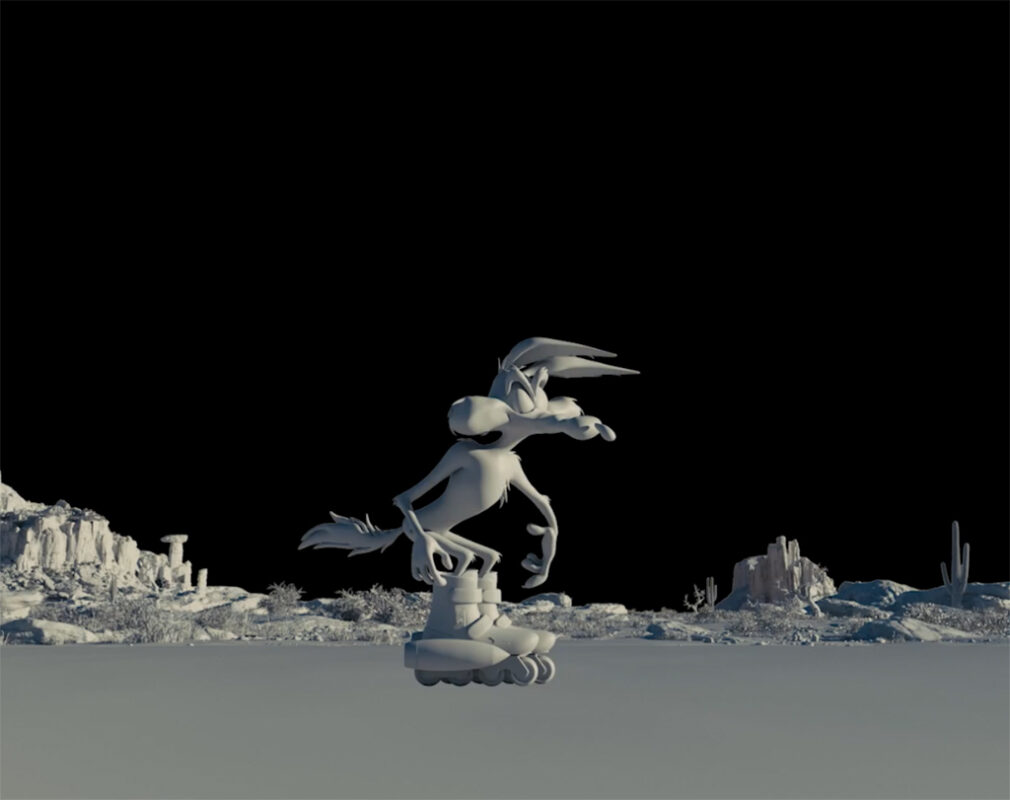
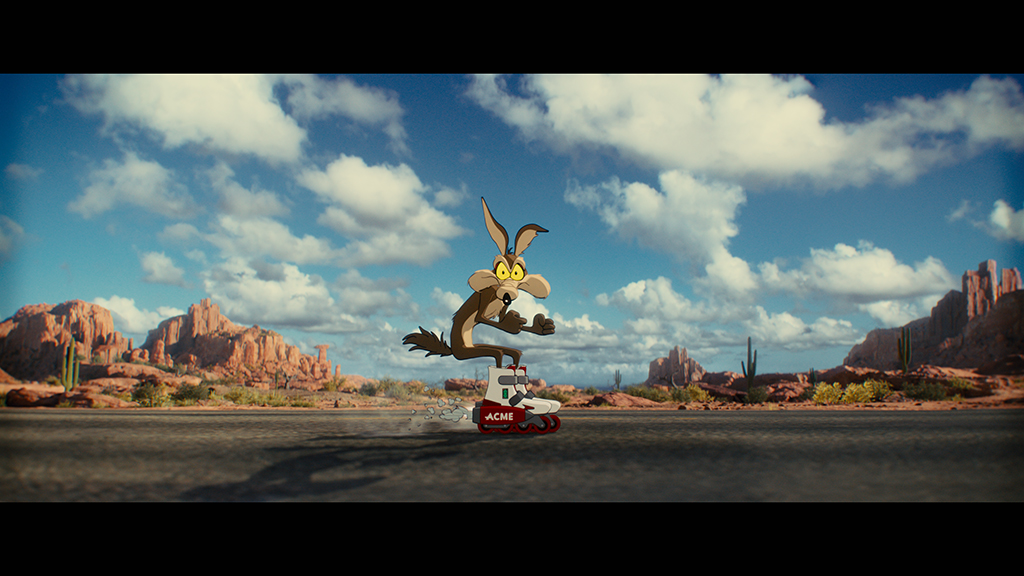
“When Wile E. is outside the courthouse riding on the back of the rocket, it hits Will Forte’s car, and the actual car explodes, flips up, lands and there’s fire everywhere. That was a practical explosion. We did it on the backlot, comped it in, and it looked great.
—Keith Roberts, Animation Director, Coyote vs Acme
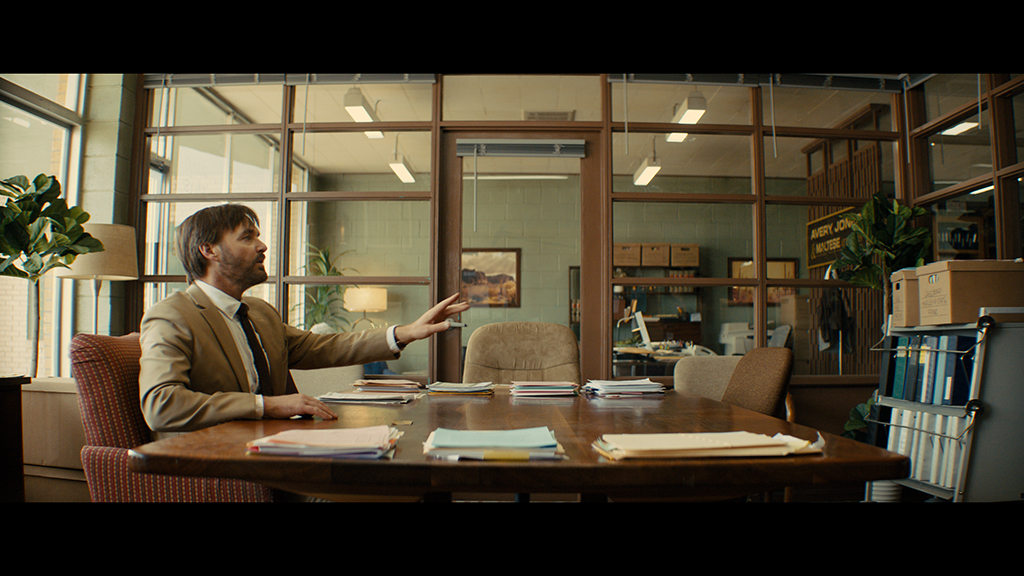
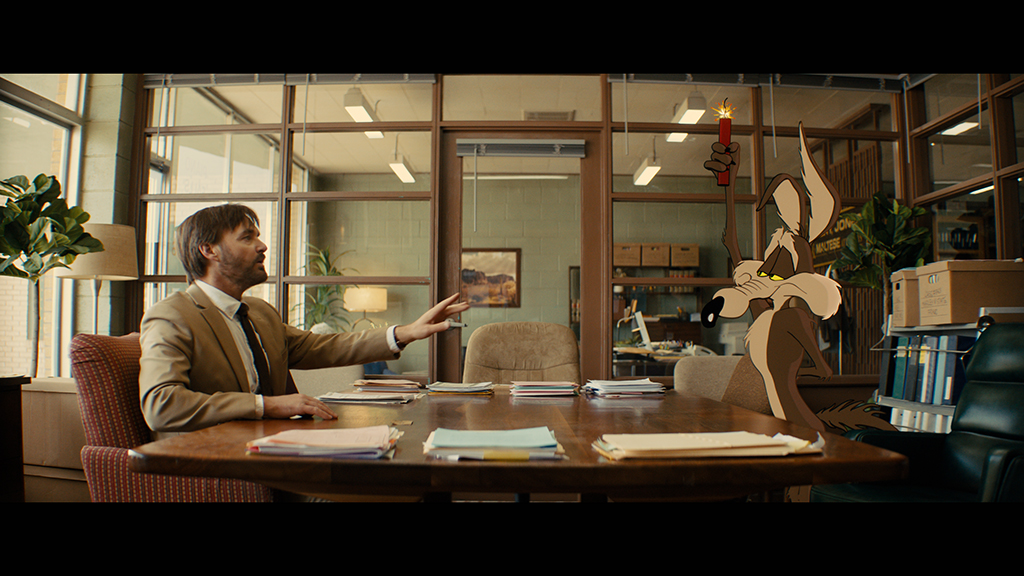
At times, puppets had to be painted out, and greenscreens were removed. “In some cases, we did split comps of an actor’s performance in one plate and a different actor’s performance in another plate, because the eyelines were so tricky to get right,” Seaman says. “There were definitely a few shots here and there where you just look at it and go, ‘We need another shot in between the shots just to sell the gag.’ There were some thought-through shots of environments so we could create our own clean plates and LiDARs to project on. There were a whole host of tools in our toolkit to do things like that.”
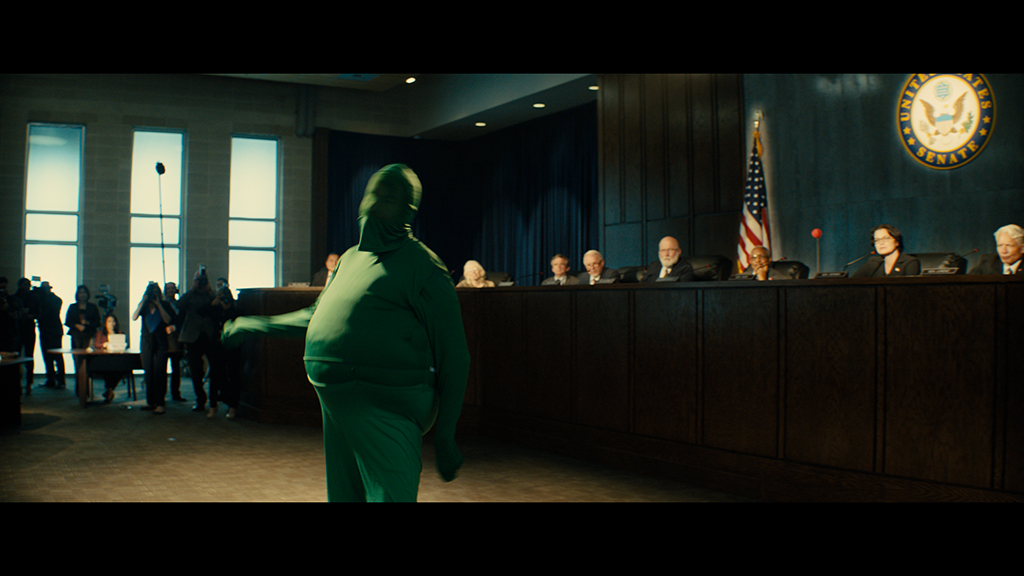
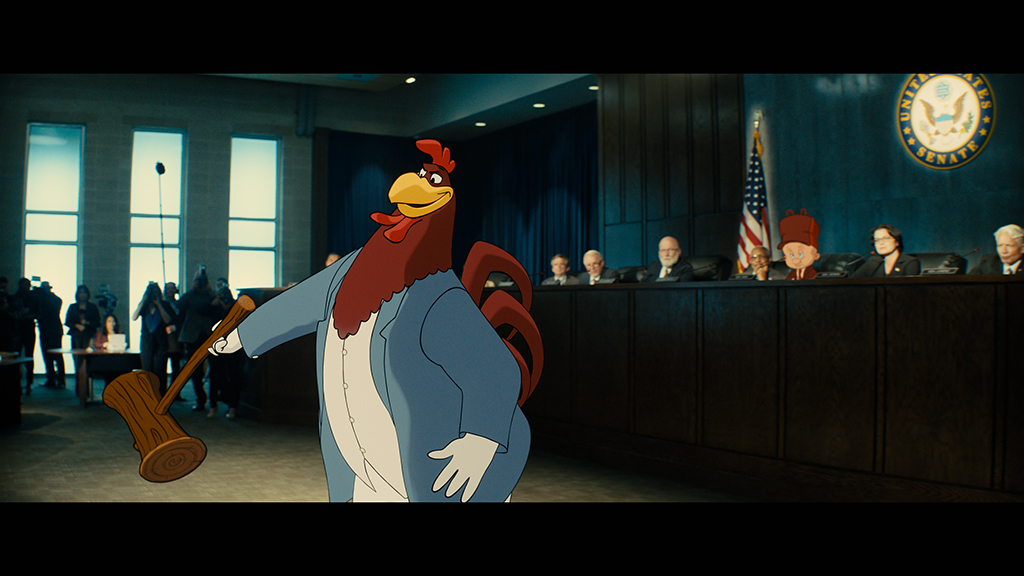
Foghorn Leghorn proved to be a hard character to light. “He’s absolutely massive, and one of the tough challenges was getting the lighting to sit on the toon characters as well as the practical plates, especially when they were alongside other actors,” Seaman says. “We had to train the artists to pick a keylight and keep it simple. One of the design challenges was when toons wear costumes. We went through various iterations of, ‘Is his jacket photoreal or the costume? Which is funnier?’” A different on-set approach was adopted for Foghorn Leghorn. “Normally for Wile E. Coyote or Road Runner, we would have a puppet and Puppeteer David Barclay. For Foghorn Leghorn, we had a mime artist named Joe Compton in a green suit, and he learned all of the lines. There’s a court scene at the end, and it’s him in a green suit, doing these big broad gestures. He was getting a standing ovation from the extras in the crowd. It was so magnetic, compelling and funny. Joe would come up with his own gags. Dave and Carsten Kurpanek [Editor] cut that together, and we had Andy Brooks sketch over that with Foghorn Leghorn; that’s what we gave the animators to use as a base.”
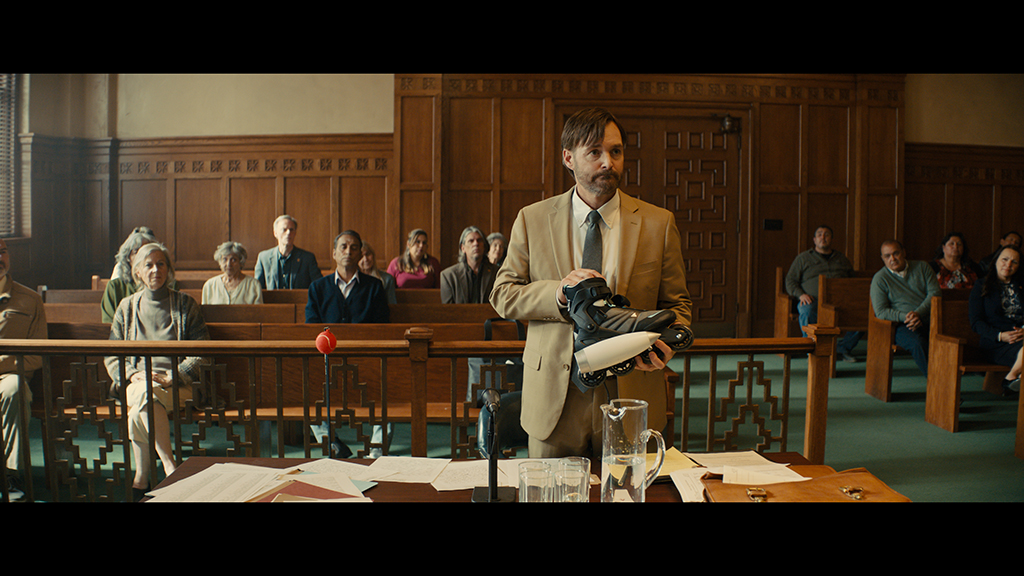
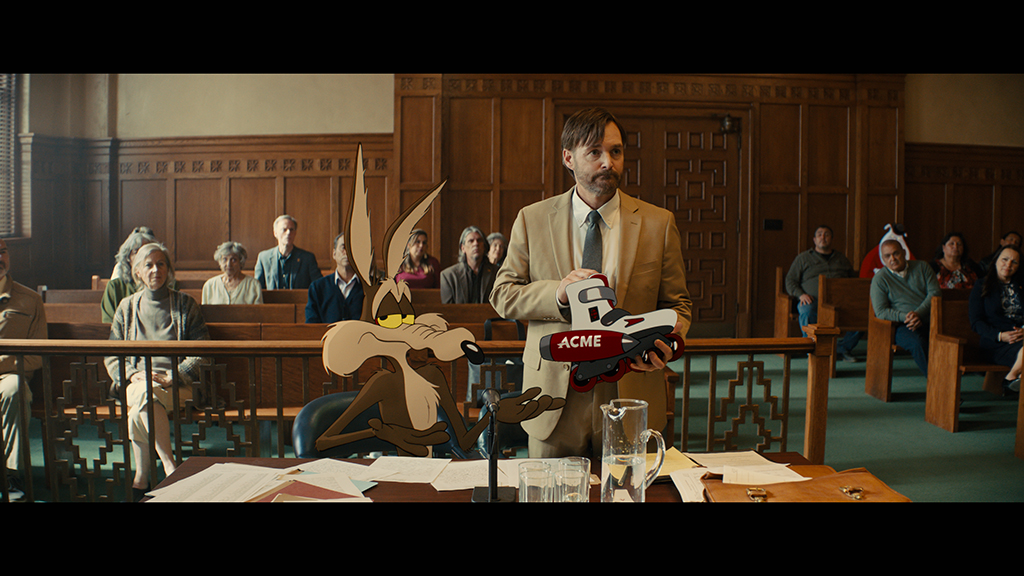
A certain aspect was paramount when orchestrating the pipeline. “We knew the whole project was about the characters and animation, so [we got] everything set up for the animators to be able to test, iterate and try out things with fast rigs and have the ability to change and move cameras around,” Seaman explains. “In the background, we worked out a lighting pipeline that was run in a similar chain of events to visual effects, except it was for toons.”
The characters had to inhabit environments within the desert setting inspired by the original cartoon. “We did an initial pass in Unreal Engine to start working out cameras and blocking ideas,” Seaman says. “We could generate quick images for feedback from Dave Green and George Murphy to choreograph those scenes. Once the animation was more locked, we could pad out the scene. The scene that was difficult for us was the train tunnel, especially when you inject the live-action actors in there and need them to walk down a 3D train tunnel. We went through a challenging design process to figure out what a train tunnel looks like, even down to a 3D wall that looks painted, with light being cast on it in a simplified way.”
In the end, justice prevailed. “When Coyote vs. Acme got shelved, I felt gutted and when I heard it was going to be picked up again, I actually physically cried,” Roberts admits. “At that point, you know it is going to make it out into the world, but you don’t know how it’s going to be accepted. Then for it to be accepted with such open arms and positivity, it feels amazing. It has been worth all the disappointment. The journey I had on the film was a positive one. I’m pulling for it to be a success on streaming as well as in theaters. Everybody I show it to loves it.”