
Talking animals, aliens, fantastical beasts – when we see a creature onscreen, what does it take for us to believe in it? In VFX and animation, this crucial question is a guiding light that keeps creators toeing the line between biomechanical accuracy and artistic license. Achieving this delicate balance can mean the difference between a story falling flat or hitting its intended emotional beats.
INVENTING AN ALIEN
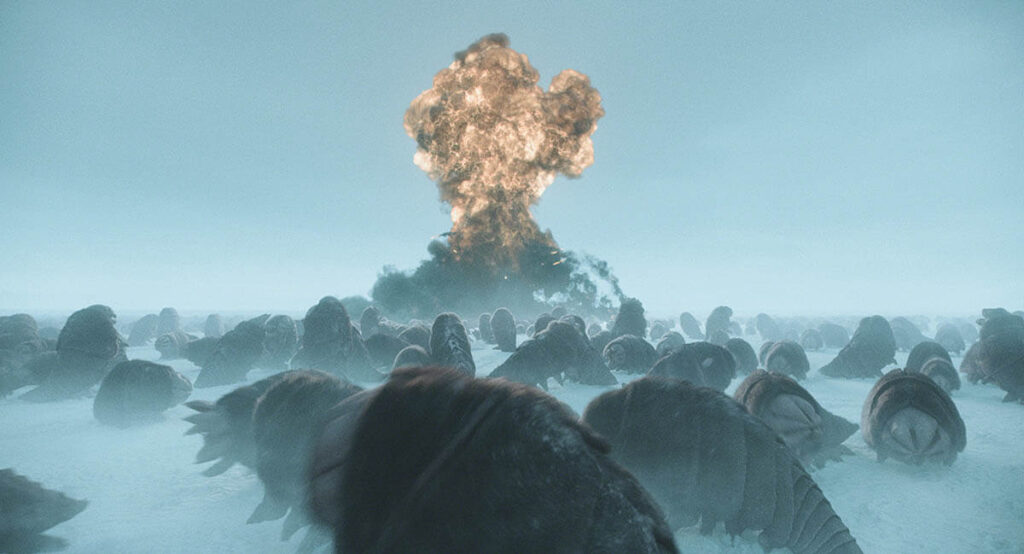
Developing a creature from scratch begins with addressing every detail. “We start with the story, the tone and what the director wants,” says DNEG’s Robyn Luckham, Animation Director on Mickey 17. Tasked with animating the Creepers, alien creatures that inhabit the film’s icy planet of Niflheim, Luckham spoke with director Bong Joon Ho and the film’s lead designer to nail down the Creepers’ every characteristic. “It starts with where they live and how the creatures are formed, based on their environment. Then, we get into character – what characters do they play in the story, and what’s the tone of the story? Is it a serious film or more playful? Are they more playful?”
The Creepers have their own character arc. According to Luckham, at first, they’re ‘repulsive,’ but eventually they ‘win you over.’ To inject them with cute factor a cute factor, Luckham drew inspiration from bear cubs and the Cat Bus in My Neighbor Totoro, as well as walruses, millipedes, horses and dogs. “What creatures are out there in our world that represent something similar,” he asks, “and how can I make a Frankenstein’s monster?”
Luckham also considered their habitat; how they eat, breathe and move, and how they protect themselves. “You have to make sure there’s an alignment between the creature’s design and the environment. There are a lot of assumptions you make because you’re on Earth, and when you’re creating a fantastical creature, you have to reassess. You’re taking a leap when doing an alien,” he continues. “You can make it as fantastic as you want, but you have to justify it because everyone will know if you haven’t. Sometimes, it has to look real, and sometimes it has to be more cinematic.”
After addressing the unknowns, Luckham prepares for the first animation test. The whole process takes over a year. “The Creepers are an evolution – they started as a [2D] picture, but in the film, they’re standing up, they’re rolling, they’re doing all sorts of things. It takes time to get that right.”
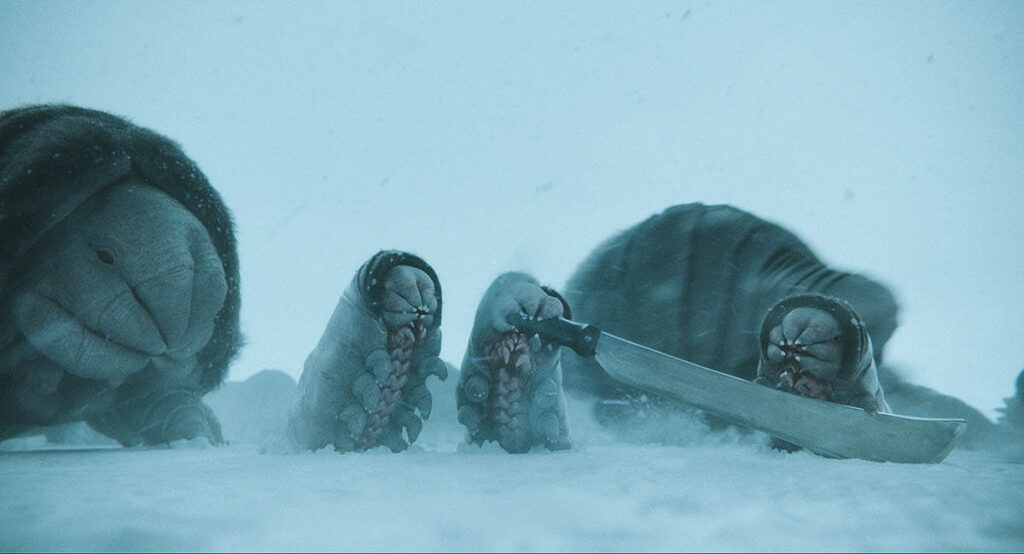
While animators and VFX supervisors often turn to scientists – zoologists, paleontologists, biologists and the like – for guidance, Luckham was afforded no such luxury on Mickey 17. “I would love to talk to scientists on every project, but it depends on the show and the budget.” On a sci-fi film like Mickey 17, the creatures in question are entirely fictional. “It’s a fantasy creature, so having a scientist there – they don’t really have a frame of reference,” Luckham remarks. “I could make the judgments myself.”
Instead of consulting with external academics, the crew employed its own team “of phenomenally trained Creeper supervisors” who were “experts in anatomy and muscle activation,” according to Luckham. These experts ultimately advised on movement – the jiggle of fat or the rippling of skin. “You have to build layer by layer,” he argues.
After rounds and rounds of animation tests and tweaks, the Creepers finally came into their own. Each creature has “a thick outer layer to protect it from all the elements,” Luckham states, “and it has a small mouth with hard ends that it uses to crunch rocks.”
It’s one thing for a creature to exist; it’s another for it to interact. Crucial to the story is the Creepers’ ability to communicate, not only with one another but also with the titular Mickey. “There’s that one little line of dialogue, which is, ‘How are you, Mickey?’ I had to work backwards,” Luckham admits. “All our speech comes from breath: breathe in, speak, breathe out. That goes through our larynx. That’s our logic.”
Occasionally, Luckham would ‘bend the rules’ at Bong Joon Ho’s instruction. “You have to make compromises,” he says, but achieving a sense of reality was his primary goal. “I want to get it as real as possible because every creature we see, we put our emotions into, and we can feel that emotion back. It’s our interpretation. It’s quite unique and quite a privilege to create a brand-new creature,” he adds. “We’re creating a language, creating a physiology from scratch. It was a real challenge, but that’s the work I enjoy.”
ACCESSING THE SOUL
Like many of today’s movies, Mickey 17 is a page-to-screen adaptation of the sci-fi novel Mickey7. While the written word knows no bounds in what imagery it can inspire, films are limited by their reliance on visual perception. Russell Dodgson, VFX Supervisor at Framestore, faced this fact while working on His Dark Materials, HBO’s live-action interpretation of Philip Pullman’s fantasy trilogy. “We had to create a character called a Mulefa, and the way it’s written in the books is an absolute design disaster,” he states. “It’s got a diamond-shaped body, four legs and no spine, and it can roll around on seed pods. [Pullman has] written something fantastical, but he hasn’t necessarily worried about how it translates to the screen. That’s not his concern. He tells you that it’s elegant, but when you see it, it doesn’t look as elegant as described.”
Like Luckham, Dodgson began with the big questions. “What’s pleasing to look at? Which rules do you stick by? Do you give it a more human-like ability to express, or do you honor the true mechanics?” he asks, noting the importance of intention when it comes to creature design. Dodgson contacted a zoologist to advise on the non-human characters in His Dark Materials. “We went through all the analogous creatures that exist, that we could draw from, to build this complete fantasy creature. There’s a very fine line between what rules you can break and what you can’t, relative to an audience’s perception or what they understand about something. You slowly build this picture that works through trial and error.”
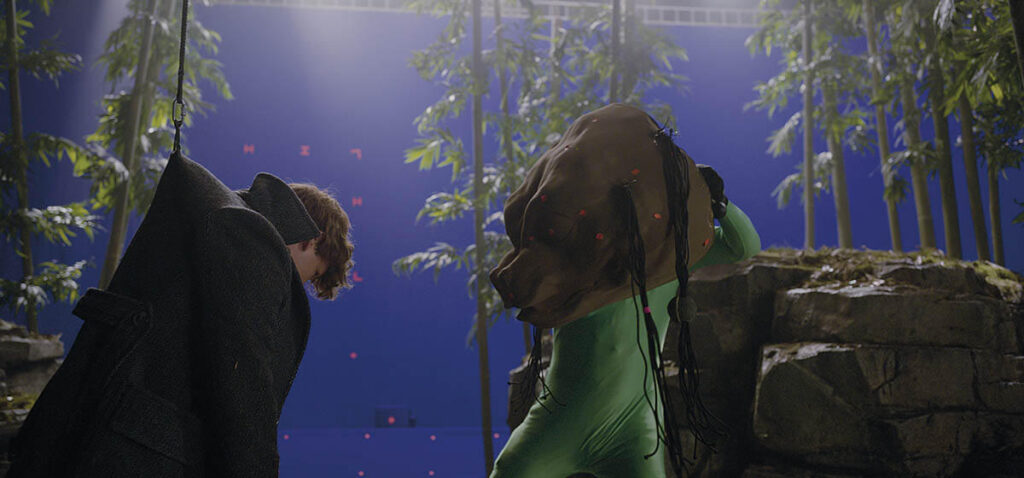
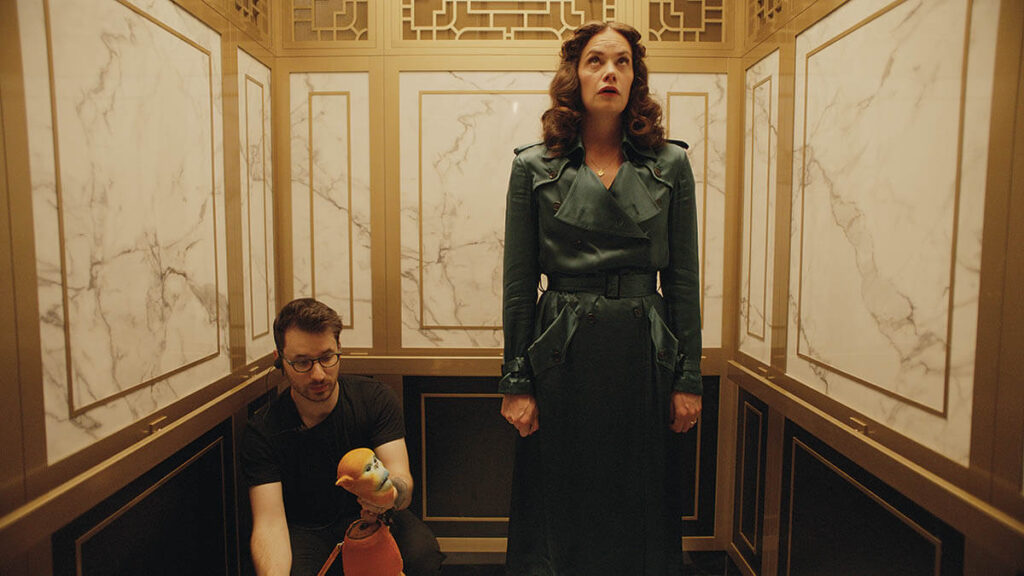
For every human in His Dark Materials, there is an animal companion called a daemon – a living manifestation of the person’s soul. “The whole point is that they have a human consciousness,” explains Dodgson, who called upon a team of puppeteers during production. “As long as you have puppeteers who are sensitive to performance, who understand the rhythm of the real creature and the body language that is going to work with an actor, then what you’ve got on set is something that is physically the right shape, moving in a similar rhythm and tempo [as the animation], but has this human intent.”
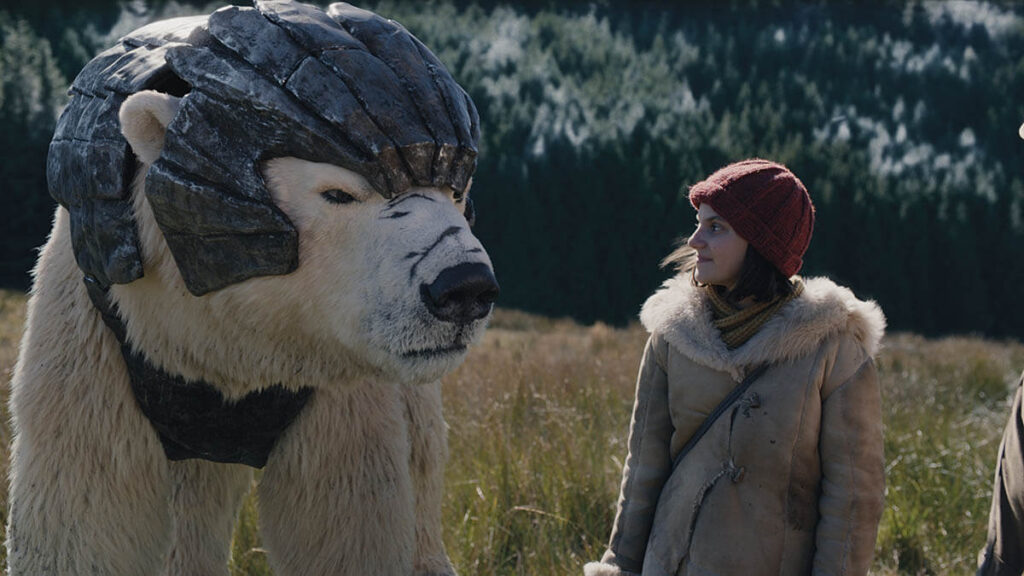
Since the daemons act more civilized than wild beasts, “we had to strip out animal behavior and replace it with human focus and intent,” Dodgson notes. “We had to strike a delicate balance. There’s so much bidirectional language between animals and us. That’s why they’re such a beautiful vessel for connecting with an audience.”

BIRDS, BEARS AND FANTASTIC BEASTS
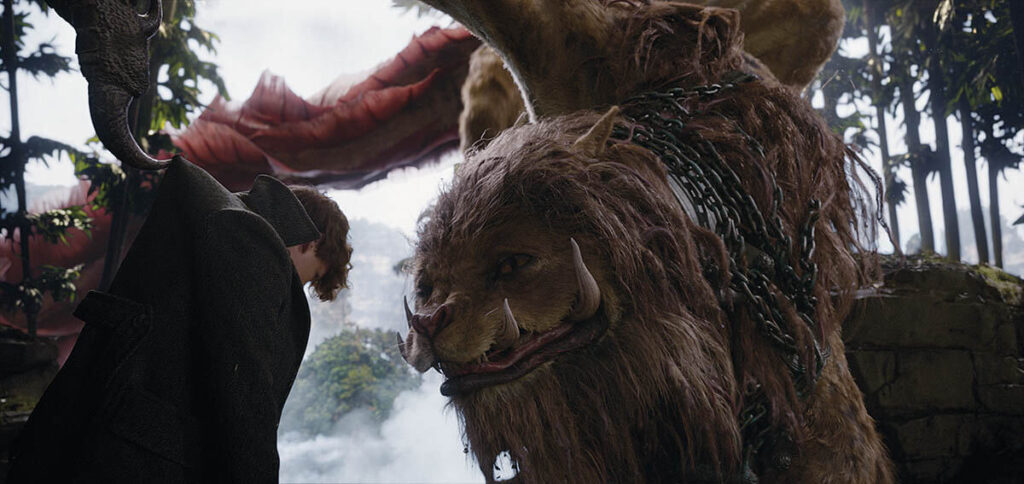
Pablo Grillo, seasoned Animation Director at Framestore, is credited with animating the Paddington, Fantastic Beasts and Harry Potter franchises. Grillo believes that all animals, humans included, share the same essence. “We’re all vertebrates and, going even beyond that, are all made of the same recipe,” he says. “Once you understand that, you can find the throughlines. A lot of differences are arbitrary.”
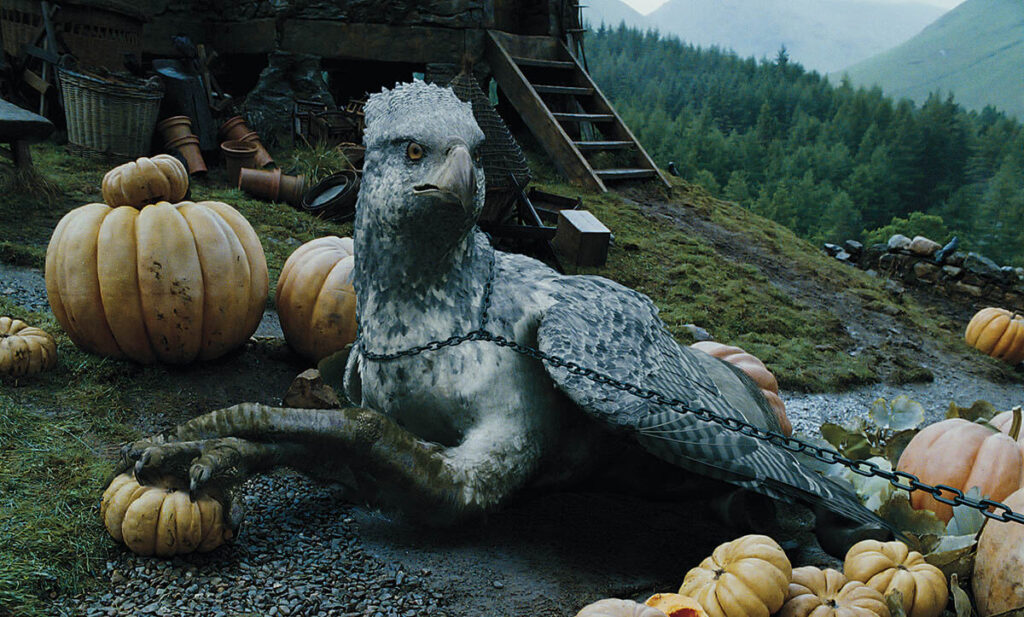
With a background in zoology, Grillo brings an in-depth understanding of animal anatomy, psychology and behavior to his VFX work. “Visual effects animation demands that the material looks completely authentic when it’s put in a real space and against live action. We have to do a huge level of study and be very analytical. That’s what binds the artistic and scientific.” Whatever the project, Grillo stresses the significance of realism and universality as it relates to creature animation. “Finding something familiar to lean on is essential,” he shares. “I always tell other animators to look at animal ‘fail’ videos. I think there’s a lot to be learned there. You experience feelings of optimism, failure and shame. What you’re trying to do is access a truth.” Harry Potter and the Prisoner of Azkaban, for instance, introduces a character called a Hippogriff, a legendary creature that’s both bird and mammal. “I was lucky enough to work on the Hippogriff,” Grillo recalls. “What made it so tangible that it was utterly realistic in its performance was that it looked real. It was naturalistic. It wasn’t trying to do anything outlandish. I always thought that was a successful creature because of its homage to the real world. It felt absolutely compelling.”
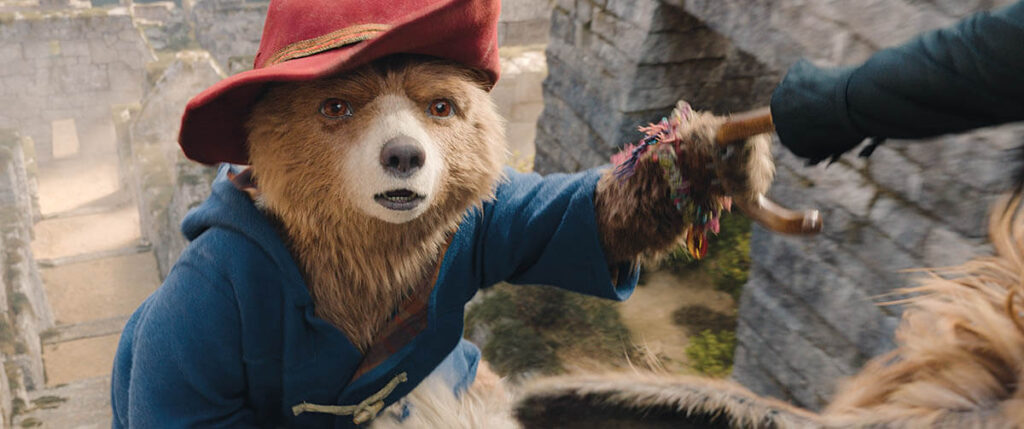
Years later, Grillo joined the Paddington movies, animating the beloved titular bear himself. “Paddington is a young bear, but more importantly, he’s a person that you can believe and invest in. There was a choice in terms of defining his anatomy, to have him keep up with the other actors and walk normally, and for that not to be a distraction,” Grillo says. In this case, he split away from biomechanical accuracy and instead embraced a narrative-driven design. “We had to devise an anatomy where the legs poke out from under the belly; we built a strange hybrid pelvis. It was a creative decision.”
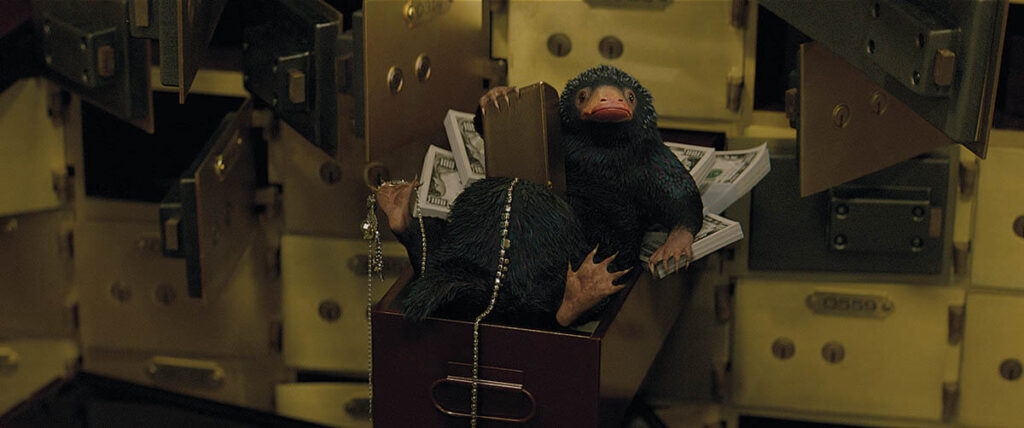
Grillo returned to the Harry Potter cinematic universe for Fantastic Beasts and Where to Find Them, a film that introduces audiences to extraordinary fictional beings. “One of the most enjoyable creations for me was the Niffler because it’s a creature that, on the page, was almost impossible in that it was very small but had to be very fast and voracious,” Grillo describes. “It had to be a humorous creature – a comedy actor as much as an animal – but it had to look real. It had to look sweet. I built a lot of mood boards for the director and offered up a variety of creatures,” he continues. “We honed in on the monotremes, platypuses and echidnas. There’s a primitivism to them that’s already entertaining by itself. If you juxtapose that with a mental state that is incredibly headstrong, you could have something really interesting.”
After playing around with early animations, Grillo eventually settled on a design that was ‘just right.’ He says, “It’s about finding a balance where you don’t take the design too far, but it looks otherworldly and alien. It’s an interesting thing when you’re creating something that doesn’t exist. You go, ‘Well, that looks like an animal I’ve never seen before, but I believe it.’” Once he established the Niffler’s basis, Grillo added the ‘trimmings’ and endowed it with personality. He began with the aggression of a honey badger and mixed and matched other animal traits from there. In the end, he argues, “There are no real rules. You either buy it or you don’t.”
ON COMMON GROUND
Grillo believes digital technology has allowed animators to go much further, approaching the design process more “holistically.” He explains, “You build anatomy; you look at color pictures, and look at the acting and the movement. You don’t commit to anything until you’ve explored these different angles of what a creature can be. By doing so, you also discover what they’re capable of, and through that you get more story. The plasticity of the process allows you to keep moving gently towards that finished product.”
Creature animation is both science and art, both objective and subjective. “A lot of the art is being able to look at things that happen in the natural world and see them as a universal truth,” Dodgson remarks. “It’s through finding a tangible solution that you create a sense of realism that the audience can then believe in,” Grillo states. “That way, they can invest in more important things in the story. It’s an incredible privilege to get invested in these creatures. They open your eyes to the beauty and intricacy of nature. What we do is beautiful, and it’s full of passionate people. I think we’re all scientists at heart.”