Courtesy of Apple & DNEG.

Courtesy of Apple & DNEG.
Exploring the space race through an alternative-history lens, Star City imagines a timeline where Soviet rocket engineer and spacecraft designer Sergei Korolev, who died during surgery in 1966, survives and helps the Soviet Union become the first nation to land a person on the moon. The Apple TV+ sci-fi series is a spinoff of For All Mankind, which centers on the American side of the space race.
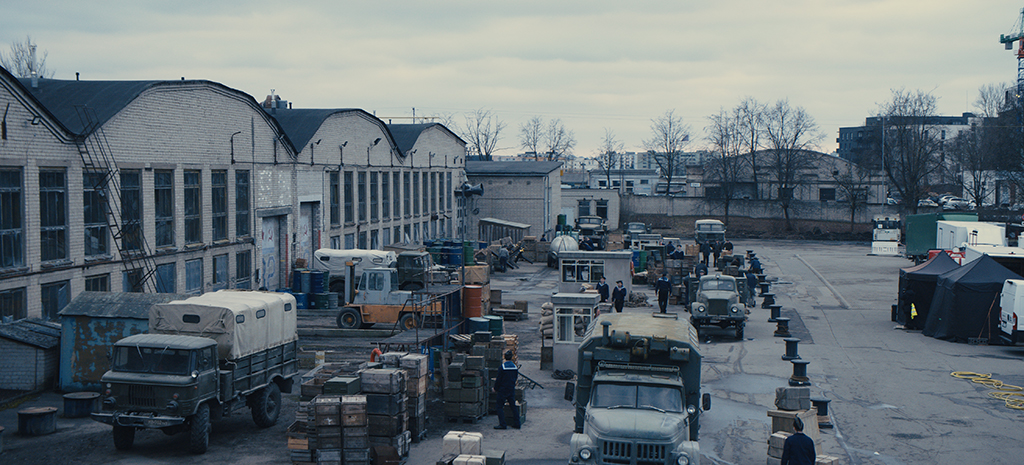
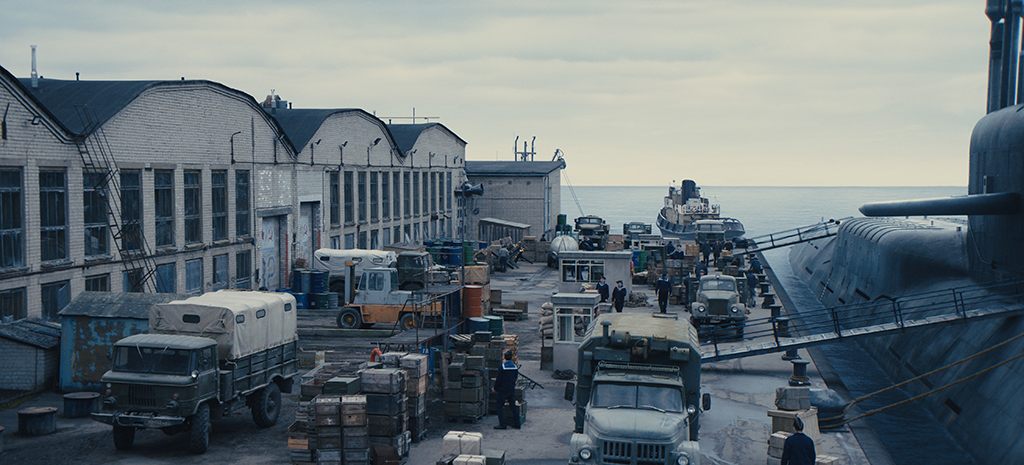
Production Visual Effects Supervisors Jay Redd and Todd Perry tasked DNEG (Mercy) with 131 visual effects spread across 21 sequences. The work included two Soviet moon landings with male and female cosmonauts; the re-entry of two Soyuz spacecraft pursued by a MiG-21 fighter jet; a docking sequence; an orbital view of Earth; and a CG nuclear submarine. Visually, the series draws heavily on the paranoia and conspiracy films of the ‘70s, with shadows everywhere and a grainy quality.
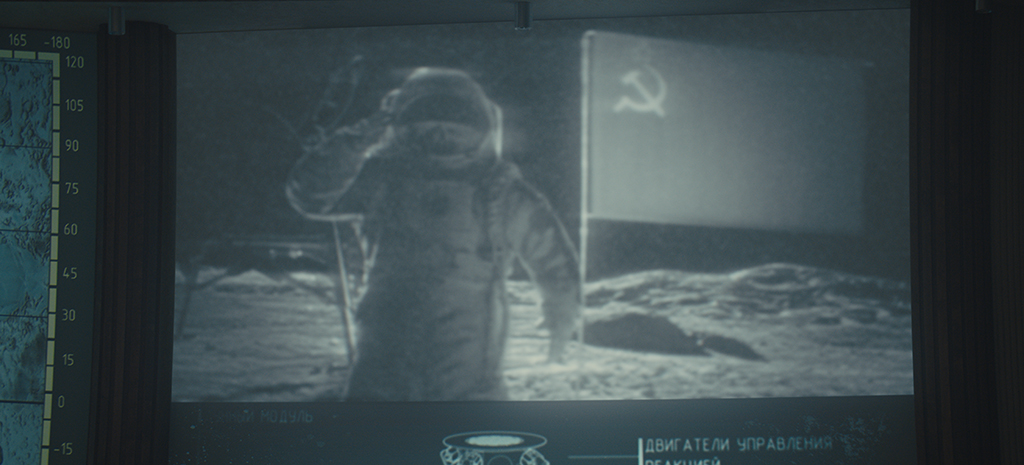
“In the For All Mankind universe – which Star City is a part of – it is all about being accurate to the period and building an alternative timeline that feels real despite being fake,” states Chris Keller, Visual Effects Supervisor at DNEG. “In the case of Star City, it oozes with this KGB spy drama; that started on the production, and they shot on vintage Soviet glass, so a lot of the lenses that we used were from that period and part of the world. We worked hard to match that aesthetic.”
Extensive R&D went into recreating the optical artifacts. “You start with lens distortion, vignetting, chromatic aberrations, and then we went one step further on this show and retooled a defocus node that was found online, which replicates all of these hypercomplex artifacts like astigmatism, cat-eye, barn doors and chromatic aberrations in the bokeh kernel; that gave everything the chef’s kiss. Production shot a lot of optical lens flares that we used quite heavily as well.”
Star City expands on the first Soviet moon landing depicted in For All Mankind. “Production did not have the visual effects files from For All Mankind Season 1 anymore, but they did have the plate photography,” Keller says. “Some shots of Alexei Leonov walking on the moon are exactly as they appeared in Episode 101 of For All Mankind, but we also show a couple of other angles. We used the plate photography of the actor from back in 2019 to rotomate him and recreate the entire first moon landing in full CG using our assets. Some elements, like the lunar lander and landscape, had subtle differences, but overall, we tried to stay close to the original, including all of the broadcast effects you see on screen.”
Visor reflections are notoriously difficult to achieve. “All visors were done in full CG even when we had plate photography,” Keller reveals. “Even if you are looking at a close-up, you always had to render the entire environment 360 degrees because the visor is basically a convex mirror ball. Most of the time, when you are looking at a visor reflection, it’s actually cheated. The layout of the reflected environment is either shifted up or down because the horizon line would cut awkwardly through Anastasia’s face, giving her a mustache, or go [across] her eyes and interfere with the actor’s performance. We were often fading it out in the middle to get a read on the performance.”
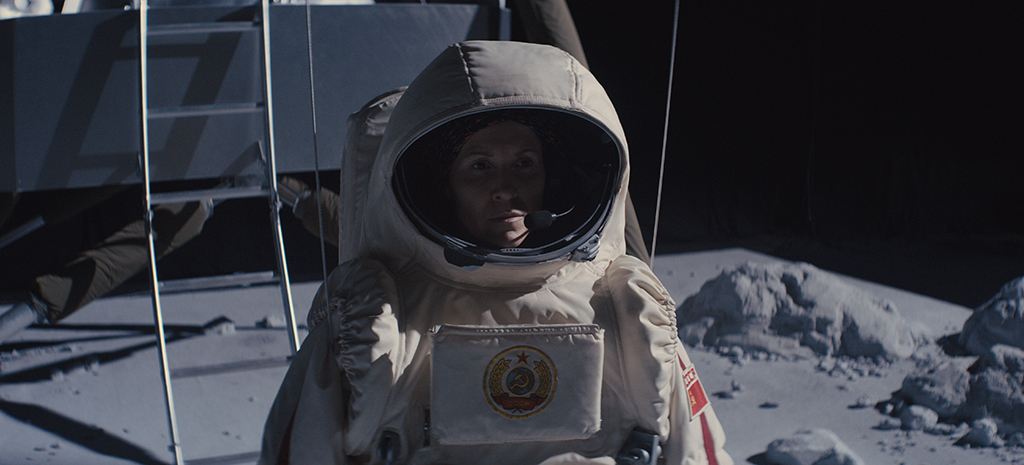
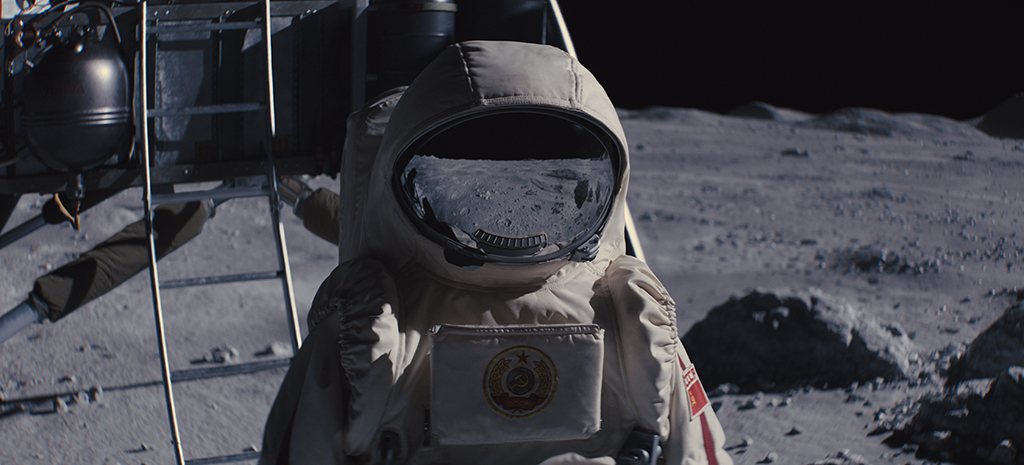
For both lunar landings, the team reused the same environment. “We did a lot of research on the south pole of the moon,” Keller says. “We knew there were going to be long shadows, which were important for art direction and [lighting]. The great thing about anything space-related is NASA has so much publicly available data. We looked at height maps and measurements of subsurface characteristics, including the composition of the regolith and its reflective [properties]. That gave us a realistic starting point for our modeling and the look development of the surface. We built a library of boulders, scattered rocks, craters and ridges to be able to fly them in on a shot-by-shot basis for better shot composition.”
In space, lighting is generally harsh and unforgiving. “You always want to try to backlight, especially on the lunar surface,” Keller notes. “Because if you frontlight it, it becomes this flat gray mush that looks unappealing.” DNEG deliberately omitted atmospherics. “Instead, we portrayed the moon as an incredibly harsh and desolate environment, which is where the long shadows come in. Photorealism was high up on our list. Actually, you never see stars. The sky was this perfect black, which is exactly what would happen in real life. I spent days, maybe weeks, combing through the NASA Apollo archives, looking at tens of thousands of photos, and compiling the best ones to capture how bleak and lonely the lunar surface is and how lost you feel. That was a big part of the story point for Anastasia in Episode 102.”
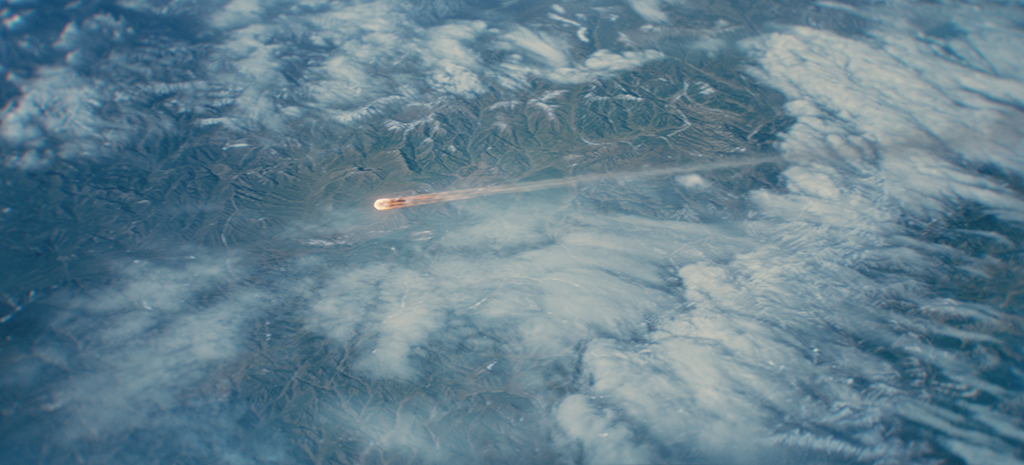
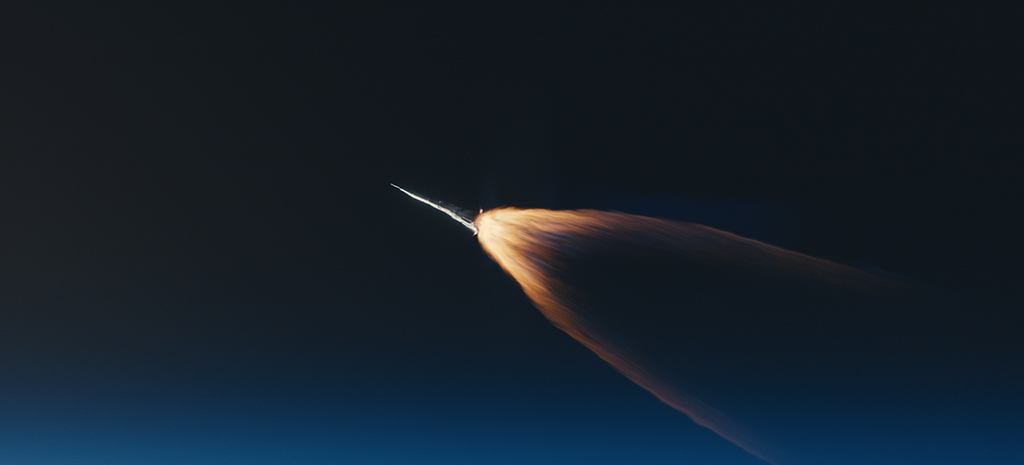
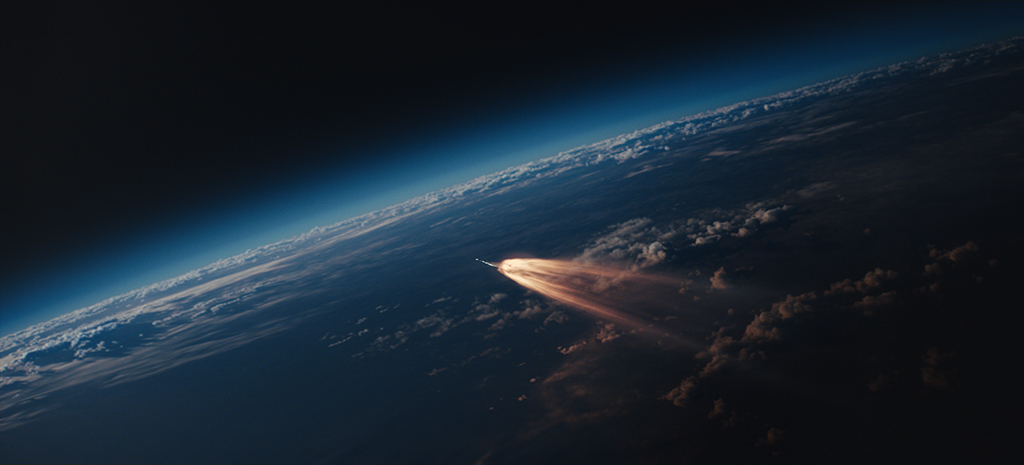
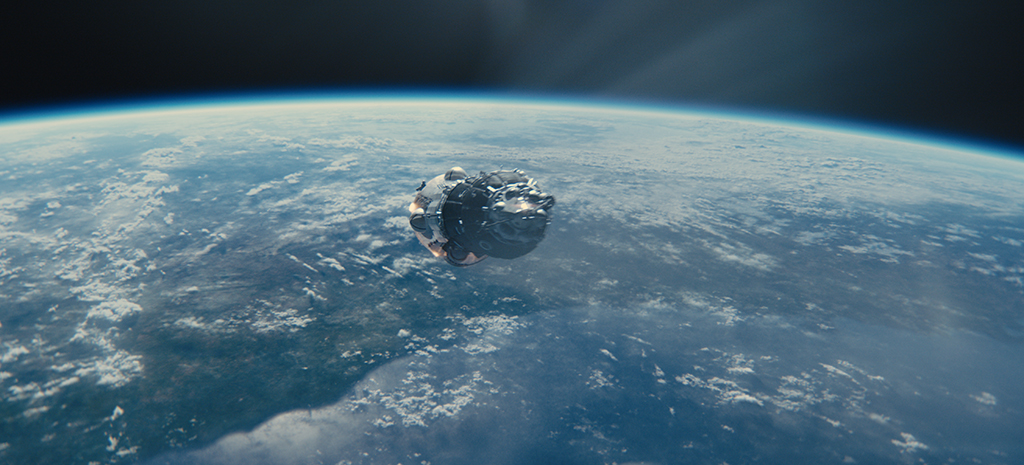
The re-entry sequence features the Soyuz spacecraft, the Salyut-1 space station, Earth, plasma effects and destruction simulations. “It starts with making sure that the assets are up to scratch, which was a lot of work,” Keller explains. “We knew that the various spacecraft were getting close to the camera and would both have to hold up in these long, serene orbital shots, which in some ways is harder than the high-octane action shot that has effects and simulations involved.”
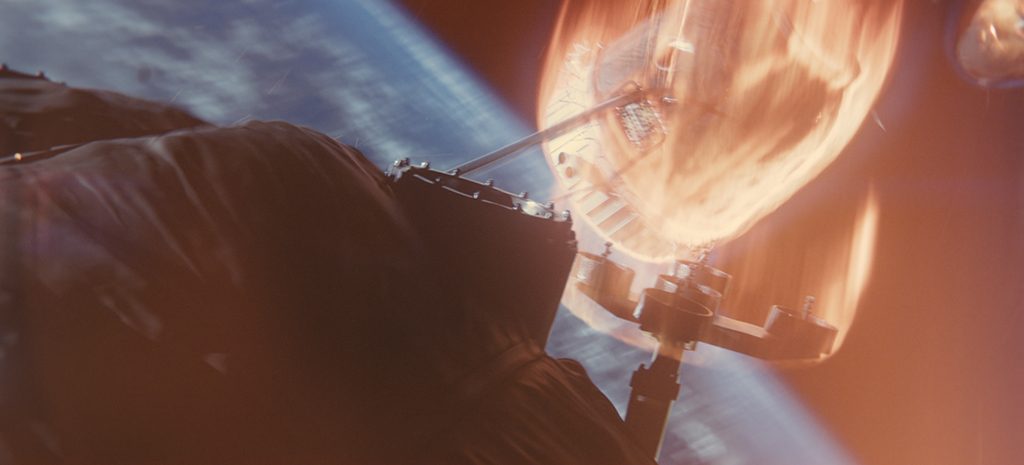
The historical basis of the show complicated the asset builds. “The Soviets tended to keep their cards close to their chest, so there is very little high-quality photography. We had to go into the farthest corners of the web and grab any picture we could find. That took a long time for the Salyut-1 and Soyuz. We got into modeling and texturing real things – like panel lines, welding, rivets and subtle dirt – all those little details show up in space lighting, which is one harsh directional light.”
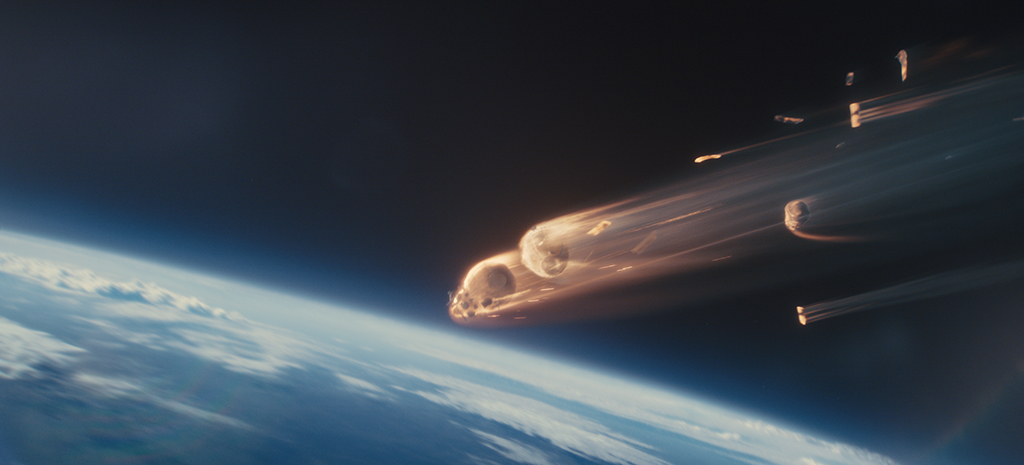
Because real-life photography was limited, NASA-produced animatics provided the key reference for the plasma effect. “Those helped us to understand how a heat sheath forms around the descent module,” Keller says. “I cut together all kinds of reference reels for any given effect, but also looked at existing movies and shows for inspiration, such as Gravity and Life, and of course, the franchise we’re working on. The plasma effect itself consisted of many layers of different types of fire, leading edge, long and short sparks, and smoke that were mixed and matched to taste.”
“Some shots of Alexei Leonov walking on the moon are exactly as they appeared in Episode 101 of For All Mankind, but we also show a couple of other angles. We used the plate photography of the actor from 2019 to rotomate him and recreate the entire first moon landing in full CG using our assets. Some elements, like the lunar lander and landscape, had subtle differences, but overall, we tried to stay close to the original, including all of the broadcast effects you see on screen.”
– Chris Keller, Visual Effects Supervisor, DNEG
The fire builds gradually as the capsule enters the thin, upper atmosphere. “You get initial bursts of sparks as you hit air pockets that become entire flames. As you start diving into thicker atmosphere, air resistance becomes increasingly strong, at which point the entire capsule is engulfed in flames. Everything burns off, and you end up with an oxidized metal capsule as you get into the stratosphere.”
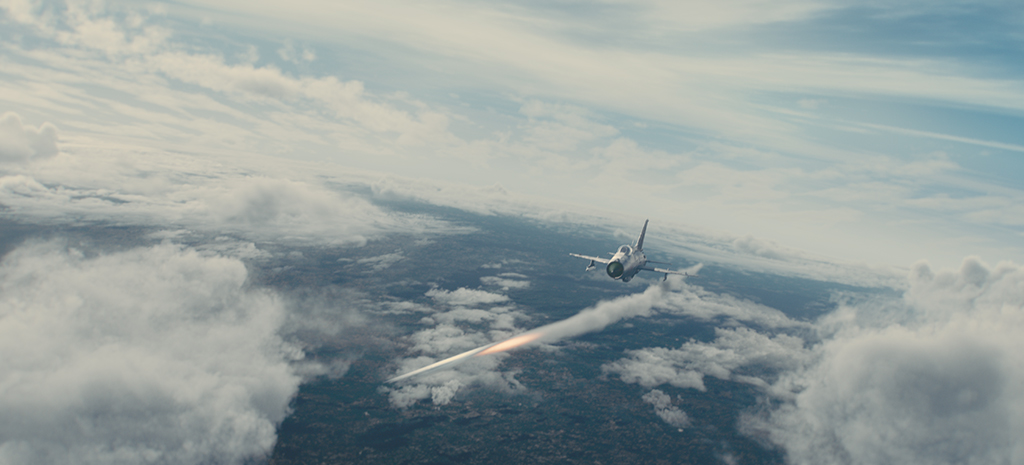
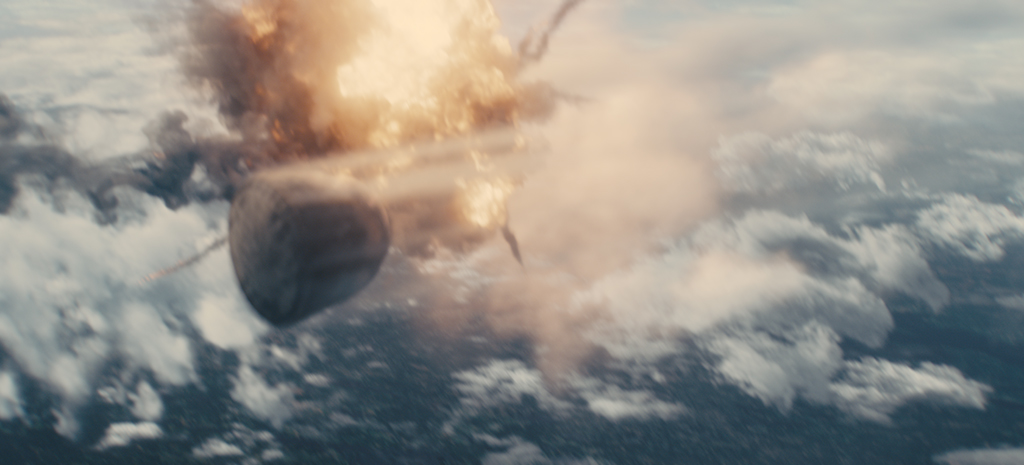
A CG MiG-21 fighter jet fires heat-seeking missiles at two descending Soyuz spacecraft, triggering a mid-air explosion. “The difference between the re-entry in Episode 108 and 102 is we’re actually diving into the clouds,” Keller states. “We built a library of 3D volumetric clouds for these later shots just before the fighter jet shows up. The fighter jet itself was based on a real one, which was difficult to integrate. It’s basically a chrome tin-can material that’s hard to control and shape, and it fires heat-seeking air missiles to shoot down the descent module. Unfortunately, we have many recent references for heat-seeking air missiles from various conflicts around the world. The descent module was knocked off course by an explosion, which happened within proximity. We still had to create the descent module in various states, like fully intact and wrapped in Kevlar, and detail the surface under the Kevlar as it burned off. Then we had to create multiple variations of charring and burning.”
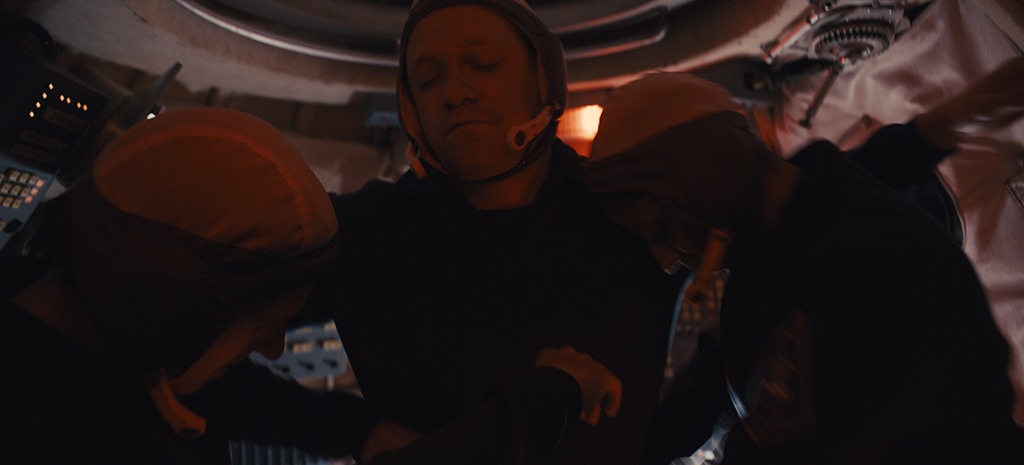
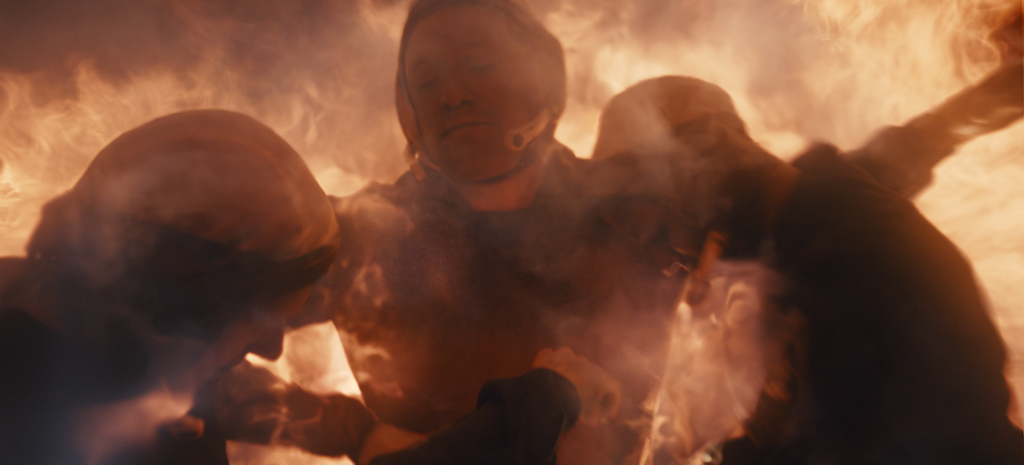
The explosion shot went through several iterations to make the impact read clearly. “The explosion, descent module and camera are all traveling together. Weight starts with the camera, making sure it has the right amount of buffeting and shake. There is a lot of artistic balancing going on to make sure everything feels correct, but you also get a good read on the action.”
DNEG departed from its usual pipeline to create the volumetric clouds. “I knew we were going to see Earth a lot from a distance, under different lighting conditions and various parts of the planet,” Keller recalls. “It was always going to be a CG Earth, but even a CG Earth is trivial to render these days. We have some high-resolution maps of the land and water, but I was concerned about the clouds because I knew that cloud patterns were going to be instrumental in shot design.”
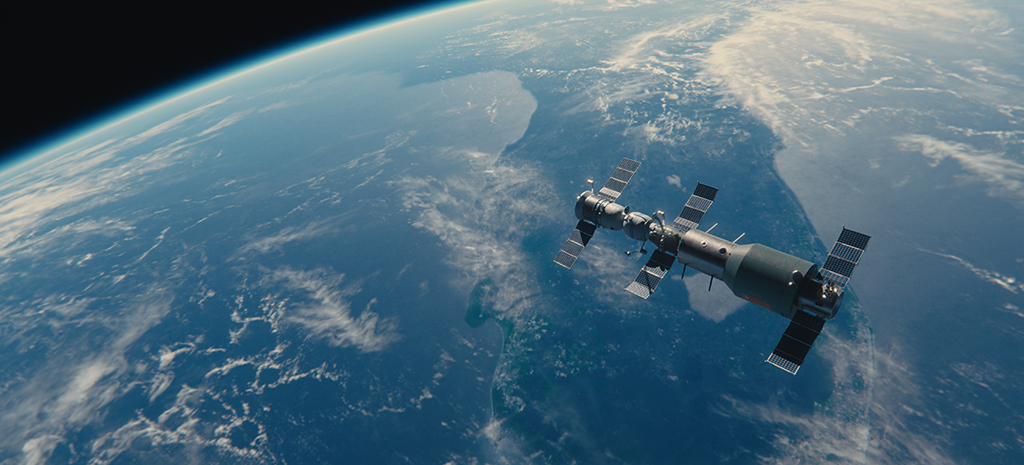
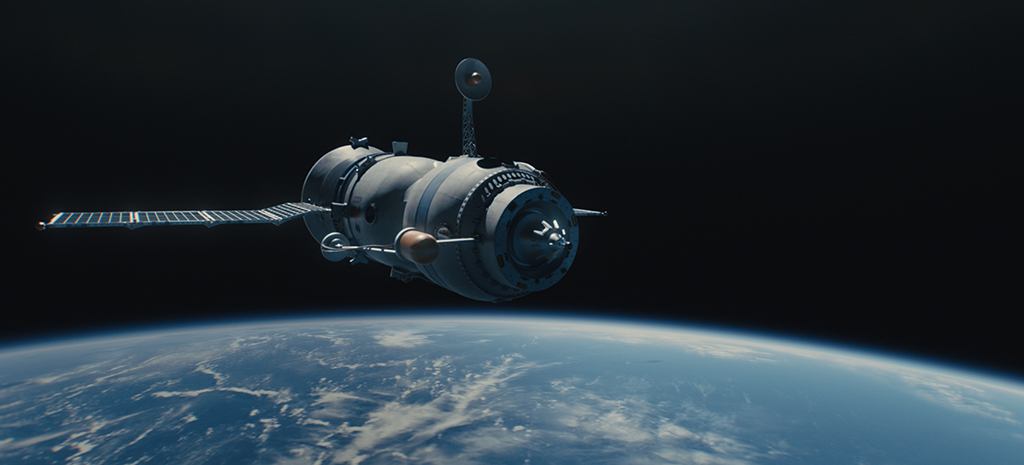
A traditional matte-painting approach presented challenges. “Combining footage from different sources with various resolutions and painting lighting can create a patchwork world that doesn’t quite look real. We went with a novel hybrid approach, where we built a library of extracted cloud textures, like big weather systems, keyed off views of Earth. Instead of going into matte painting with those, we positioned the textures on the 3D Earth for each shot and then used them to drive a volumetric shader in Terragen. All of these different source images came together with the same shader settings, rendered at the same time with the same lighting, to produce a cohesive image. That is probably what I’m most proud of in the entire production: our views of Earth, especially in Episode 107, where we have the orbital docking sequence. If you look at the Earth there, the fidelity of the clouds and the photorealism is amazing.”
“We went with a novel hybrid approach, where we built a library of extracted cloud textures, like big weather systems, keyed off views of Earth. Instead of going into matte painting with those, we positioned the textures on the 3D Earth for each shot and then used them to drive a volumetric shader in Terragen… That is probably what I’m most proud of in the entire production: our views of Earth, especially in Episode 107, where we have the orbital docking sequence. If you look at the Earth there, the fidelity of the clouds and the photorealism is amazing.”
– Chris Keller, Visual Effects Supervisor, DNEG
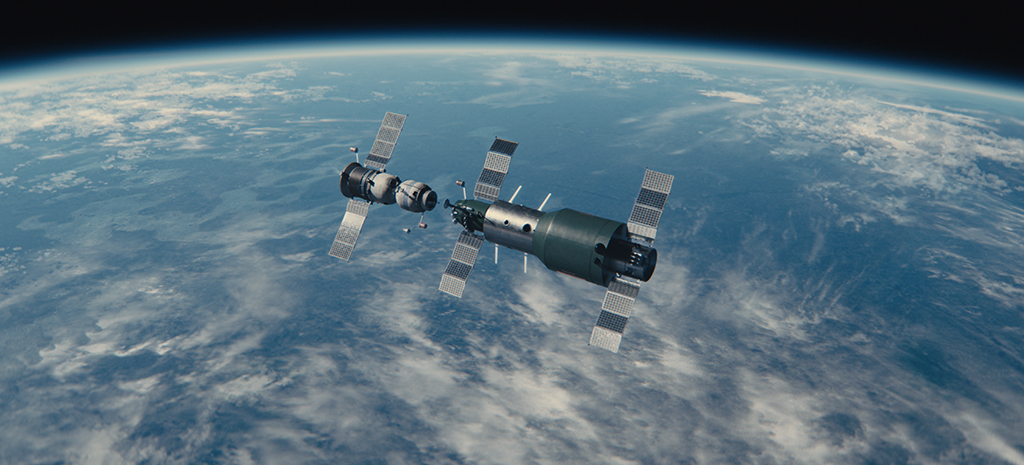
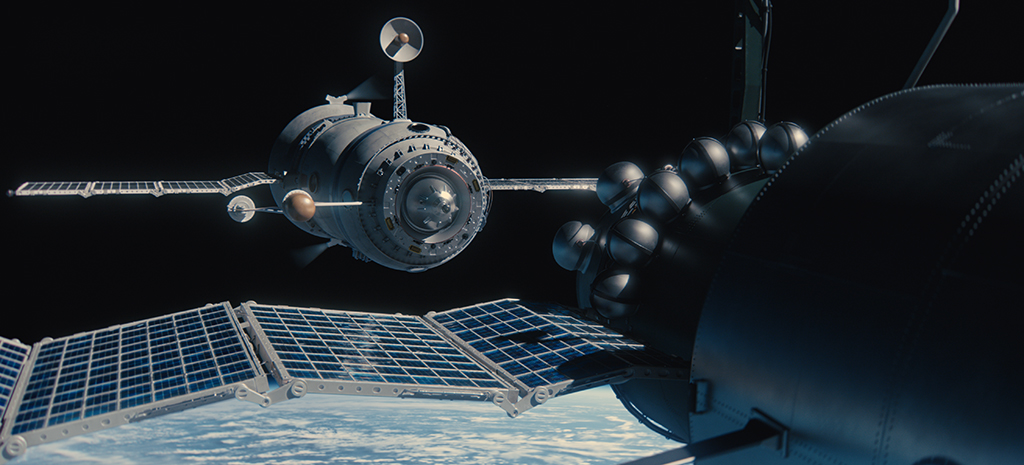
The Soyuz docking with Salyut-1 in Episode 107 is a standout moment. “It’s very 2001: A Space Odyssey,” Keller notes. “It’s a slow space ballet sequence. It has our Terragen Earth in the background with beautiful cloud formations. The camera is still and serene; the assets shine; you see all these little panel lines in the sun, and the RCS thrusters fire with smoke effects in space. It’s an uneventful scene of two spacecraft docking, but a lot of creative effort went into that. There is no camera shake. The edits are slow, and the shots are long, and they let them breathe. I feel like we hit a nice photographic standard. That’s my personal favorite as that’s where everything came together. And the moon landing is also something to be proud of, for sure!”