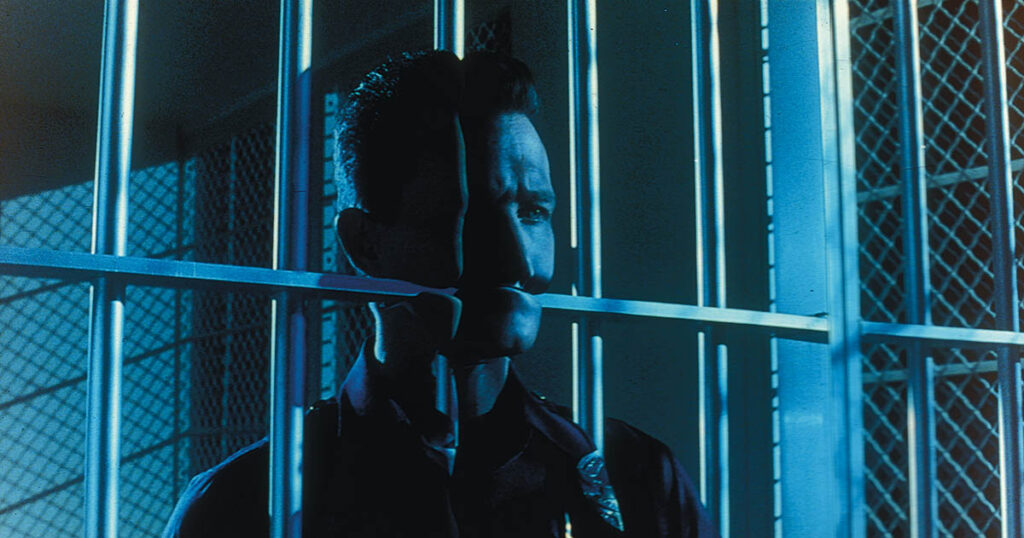

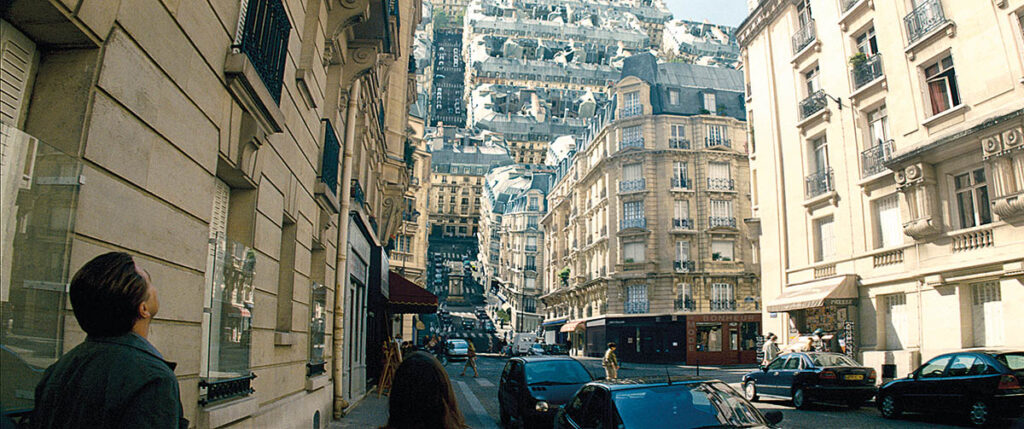
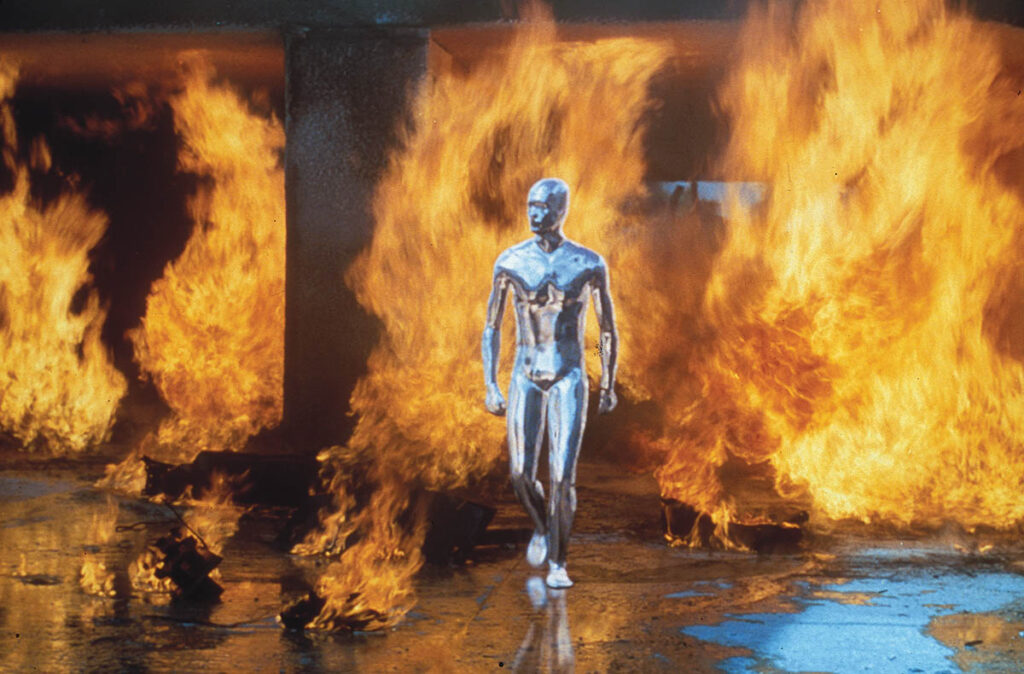
For many people, the watershed cinematic moment for CGI was the Gallimimus stampede in Jurassic Park; however, the real breakthrough occurred two years earlier when James Cameron decided to build upon the alien water tentacle that mimicked the face of Mary Elizabeth Mastrantonio in The Abyss to produce the T-1000, a shapeshifting liquid metal assassin from the future that serves as the antagonist in Terminator 2: Judgment Day. The digital innovation did not stop there. Christopher Nolan envisioned a dreamscape in Inception where Paris folds in on itself, and Ang Lee cast a Bengal tiger as a principal cast member in Life of Pi. All three of these accomplishments remain the gold standard despite the constant evolution of technology, fueled by filmmakers’ storytelling ambitions and audiences’ expectations.
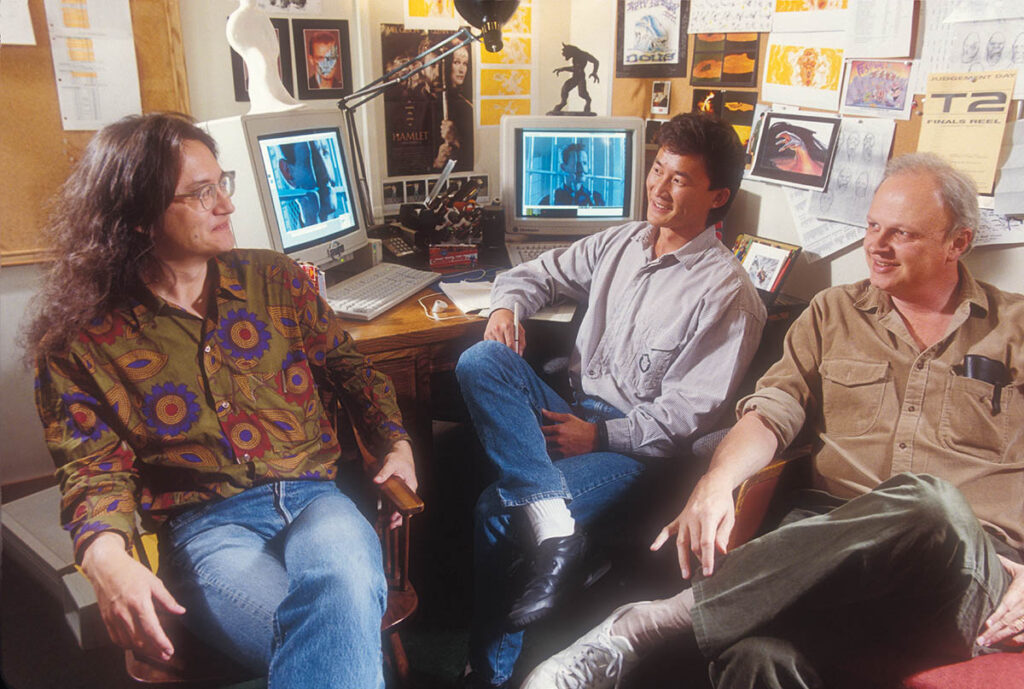
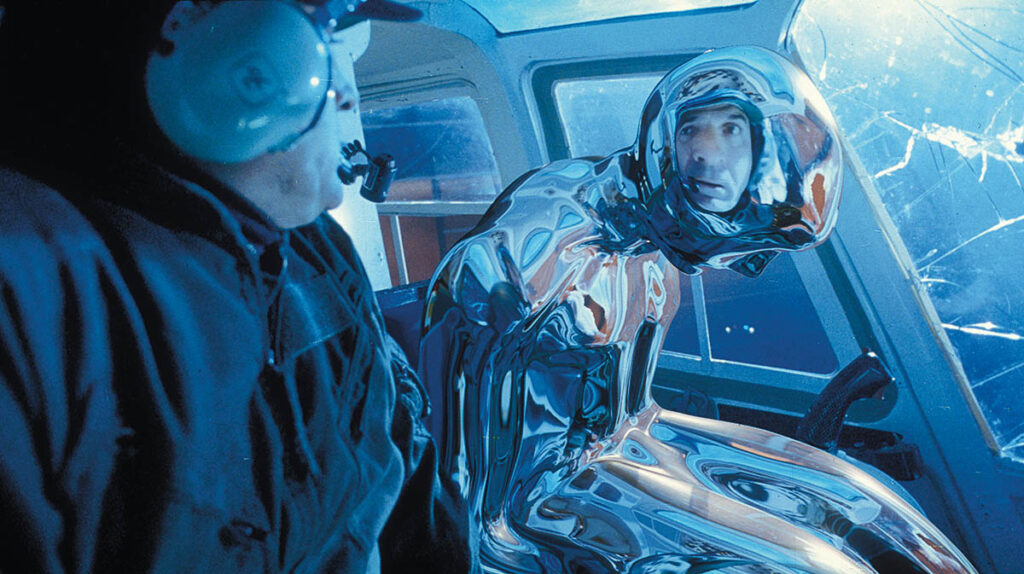
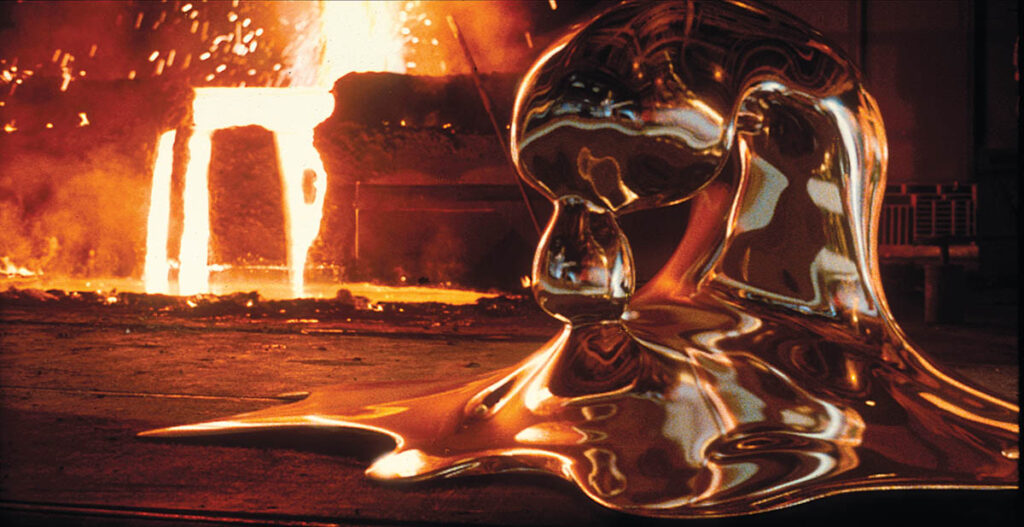
Douglas Smythe, a CG supervisor at ILM, served as a computer graphics shot supervisor for ILM on Terminator 2: Judgment Day. “Technically, the T-1000 wasn’t metal,” Smythe notes. “It was a poly alloy, which is the name somebody made up so that it didn’t have to match any particular metal or chrome. We needed a little bit of diffuse for shaping, otherwise you couldn’t read anything. But as far as the underlying technology at the time, you’ve got the diffuse and specular components, and you colorize and balance them in different ways. If you do it this way, it looks like plastic, or if you make it transparent, it looks like glass, or if it ripples, it looks like water, or if you remove the diffuse, it looks like chrome.” Specific teams rather than pipelines were formed. “We would get a modeler, animation, lighting and technical type of person, and they would figure out how to do a shot. We didn’t have a shot pipeline. We had a morph team and a 3D character team, which is when the T-1000 is in a humanoid form, but all metal. There were also the amorphous blob and Terminator death teams.”
Computer graphic technology had to be invented to produce the desired shots. “All the people who worked on Star Wars and Terminator 2 had a similar challenge : ‘We have to make a shot that looks like this storyboard and this idea, but we don’t have the tools right now in front of us that let us do that. Let’s figure out how to take the pieces we have and make the shot happen,’” Smythe observes. “We had an early version of Alias for modeling and animation, and back in those days, we were using bicubic patches for things. It wasn’t NURBS and certainly not subdivision meshes yet. How to stitch them together so you get a continuous surface, as opposed to having gaps, seams and holes, and solving the problem of having three or five or six patches coming together at a corner, which is necessary for human shapes to do – we hired a mathematician to figure that problem out.”
“[Paris folding onto itself and settling in place] was one of those sequences that could quite easily have ended up looking a bit fake, so the biggest challenge and worry was to do it justice and make it look as real as the rest of the film. We were all quite proud of the sequence as a whole. It became a signature part of the movie and really captured people’s imagination.”
—Andrew Lockley, Visual Effects Supervisor, Inception
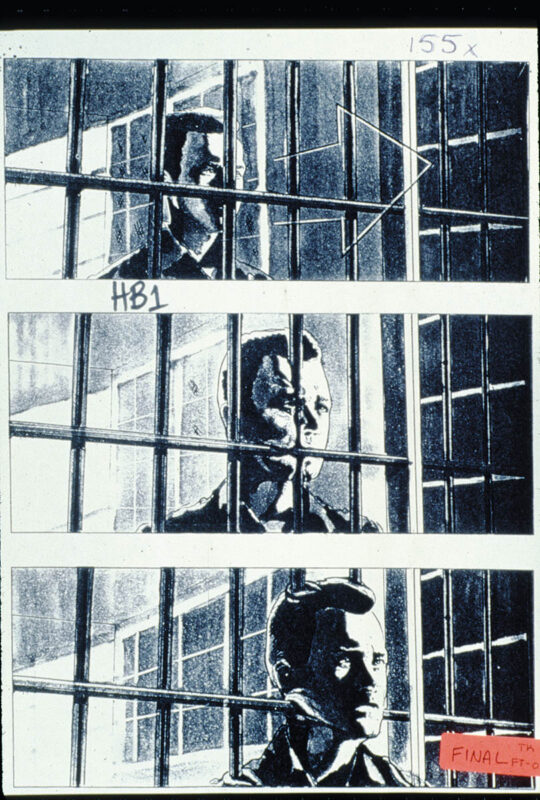
Every individual shape of the T-1000 was modeled by hand. “When the face splits out into the whole salad bowl shape and folds back in together,” Smythe explains, “that was a combination of hand modeling and me with graph paper, figuring out the coordinates so the shape moves from here to here.” A classic moment is when the morphing T-1000 is held back by a gun that gets caught between the jail bars. “We had our cyber scan of Robert Patrick and the mesh, and pushed it through the bars with absolutely nothing happening to let us get the timing. ‘Okay, at this frame, it hits the side of his nose, or it hits the side of his cheek, so at that point it has to bend in.’ The dynamics of creating a CG character have essentially remained the same. “You start with some concept art and ideas of what it’s supposed to look like, then you refine until it gets to the level that is what you need. Hopefully, you start running with it in shots as soon as possible, rather than perfecting it. You realize that there’s this situation that you forgot to take into account or didn’t know about because you hadn’t gotten turnovers for that sequence yet.”
Before becoming the Production Visual Effects Supervisor and Creative Director at beloFX, Paul Franklin co-founded DNEG. He was a member of Christopher Nolan’s inner circle, which led him to orchestrate Paris folding in on itself in Inception. “I spent a lot of time thinking about the characters in the script,” Franklin states. “In particular, Ariadne and how her background as a student of architecture might influence the way she looks at the world and, in turn, how she might work within the dreamscape that she creates in the Paris scene. The tone of the scene is deliberately playful; that seemed important to me. On the one hand she’s playing with the rules of the dream world, but because of her knowledge of architecture she approaches it with the logic and rigor of an engineer. Another key idea for me was one Chris and I had both experienced in 2004 in Chicago during the filming of Batman Begins. We had been able to get the city to raise the drawbridges across the Chicago River. If you stood in the street near one of the bridges as it rose, it looked like the world was folding on a mechanical hinge, taking the road surface, sidewalks and street lamps with it. I proposed that we turn Paris into a series of linked drawbridge sections with joints at every intersection that lift and fold the city into a box shape. The uniform footprint of the Parisian city blocks lent itself admirably to this idea. That became the basis of our approach.”
Presently a lighting TD at DNEG Animation, Alison Wortman was DNEG’s CG Supervisor on Inception, who did the layout for the shot, which Nolan approved on first viewing. “In the previs, we began by looking at the shoot location in Google Street View, which allowed me to scout the street layout and understand the views that would be available to the shooting crew,” Wortman states. “This also helped me start to plan how the street might fold up, for example, identifying where the intersections could make crease points. On the shoot, we took extensive reference photography of the location to help the team at DNEG build up a photorealistic version of the previs I had blocked out. This included shooting bracketed HDR photography of each facade of every building around the main shooting intersection, and if I remember rightly, a decent amount [an additional block worth] in each direction spreading out from the main intersection. We took the photos at ground level from a tripod. We shot high-resolution images using a panoramic head to create tiles that could then be stitched together into a large, high-res image from which the team could extract texture information. We repeated each tripod location but took the photos from a scissor lift to capture more orthographic shots of the facades. All of this photography was sent back to the team in London, and they used it to build textures and inform the details of the model builds going on back at DNEG.”
Andrew Lockley is a Visual Effects Supervisor at DNEG, the role he held when working on Inception. “For the shot where the city settles into place we went around with the lighting a lot,” Lockley reveals. “We were struggling to get the buildings to look completely real, and we weren’t sure if it was because the buildings looked weird upside down or if we were missing something in the lighting that was making them look flat and painted. We just couldn’t get it looking right. In the end, we decided to break the rules and invented a light source that cast sunlight onto the building as they came down into position. We placed it at quite an awkward angle, rather than making it too pretty, so it felt accidental. It didn’t make sense logically, but it gave them great scale and shape, and it just worked. It’s the version that ended up in the movie.” Maintaining a sense of realism was hard. “It was one of those sequences that could quite easily have ended up looking a bit fake, so the biggest challenge and worry was to do it justice and make it look as real as the rest of the film,” Lockley notes. “We were all quite proud of the sequence as a whole. It became a signature part of the movie and really captured people’s imagination. It’s amazing to be involved in something that has so many iconic moments.”
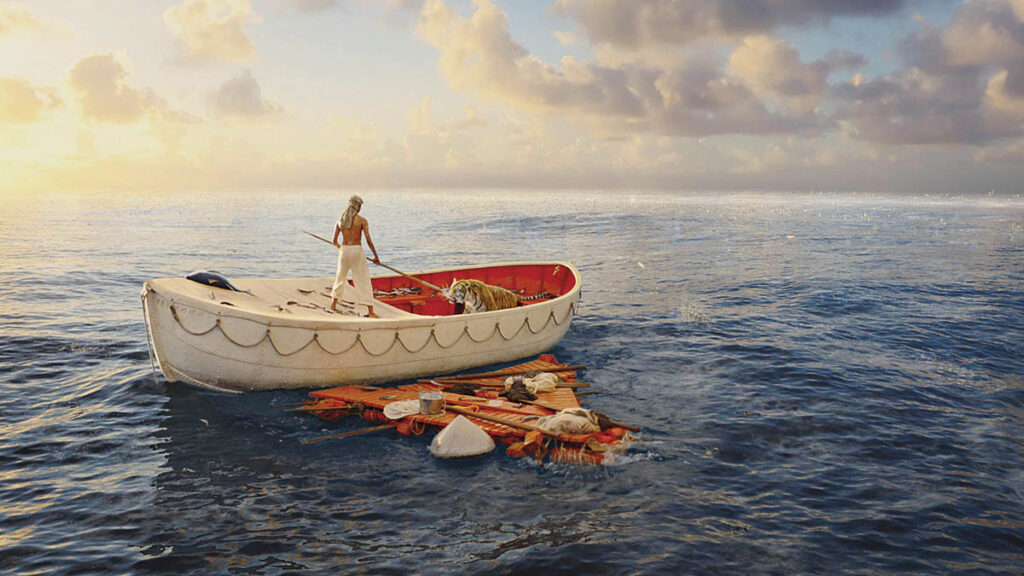
Hired to be the Production Visual Effects Supervisor on Life of Pi, Bill Westenhofer has remained on the client side. “There were two technical advancements that were attributed to the 15% to 20% of the improvement [of the creature pipeline],” Westenhofer remarks. “One is something called ray tracing. When lighting the hairs themselves in the past, it was so computationally expensive that you had to do a number of lights and big shadows. Now, computers are fast enough that we can render light bouncing off the boat, hit the tiger, bounce back, and get that whole thing working. There is another little thing called subsurface scattering, especially with clumps of white fur: light comes in one side, and the hair is not completely opaque, so it bounces around, and you get some glow coming out the other side. Those kinds of things add to the realism. Ultimately, what raised the bar on this one was having access to real tigers.”
Every trick in the book was utilized to get the proper interaction between Richard Parker and Pi Patel (Suraj Sharma). “With Suraj, you could tell him the tiger is going to be here, and even if we didn’t supply him with anything you could see in his eyes that he was imagining it,” Westenhofer states. “With that said, we would do things. Quite often, my Animation Director, Erik-Jan de Boer, would put on a blue suit, hop into the boat and be the tiger when he’s fighting over the pole and the fish. It’s Erik who is catching the end of the stick and grabbing and shaking it to give some resistance. When Suraj pulls the tiger into his lap, we molded the tiger’s head and shoulders out from our model, using sand bags inside to give it the right weight and pull. We replaced that with a digital version, which had hairs.”
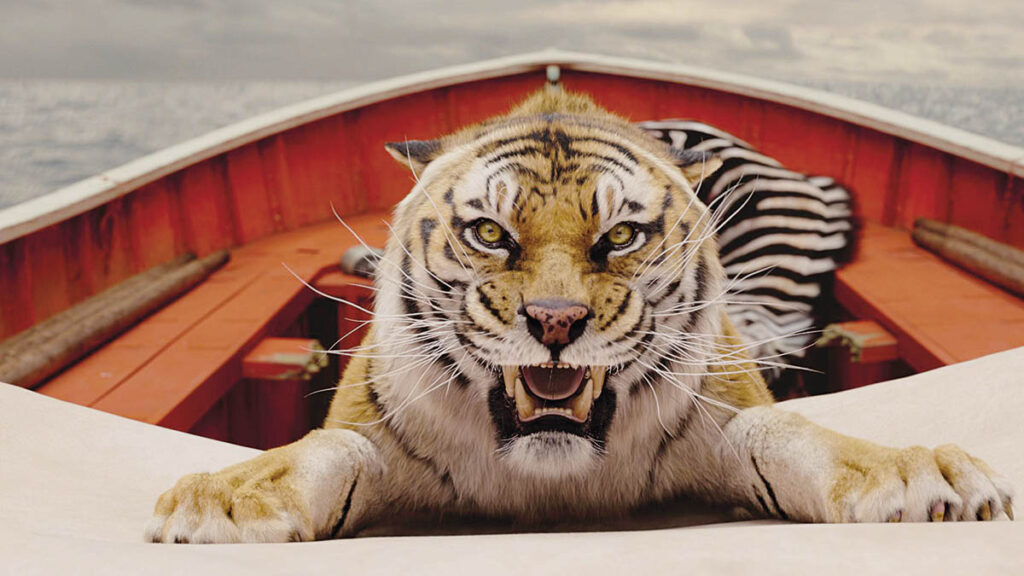
Freelance Visual Effects Supervisor Erik-Jan de Boer was an animation supervisor at Rhythm & Hues. “Our tiger had to be completely believable as a predatory animal for Ang Lee to be able to sell the relationship between Richard Parker and Pi, from fear to respect, dependency, and ultimately compassion,” de Boer remarks. “We would need to be able to see our own emotions reflected in his eyes. Early in our schedule, we rotoscoped reference footage for side-by-side studies to assist the character build, rigging and lighting development. These are not purely technical exercises; the animator needs to be very skilled and understand how the animal moves, its weight, timing, and how to design the motion effectively through the rigging controls. Rotoscoping gave us very realistic motion, but the performance was never appropriate for the movie, as it is next to impossible to direct these animals. This is also the main reason why any form of motion capture was out of the question. We created all our performances from rest using keyframe animation in Rhythm & Hues’ proprietary animation package, Voodoo. Keyframing meant that the believability of each performance depended on the talent and perseverance of each individual artist.”
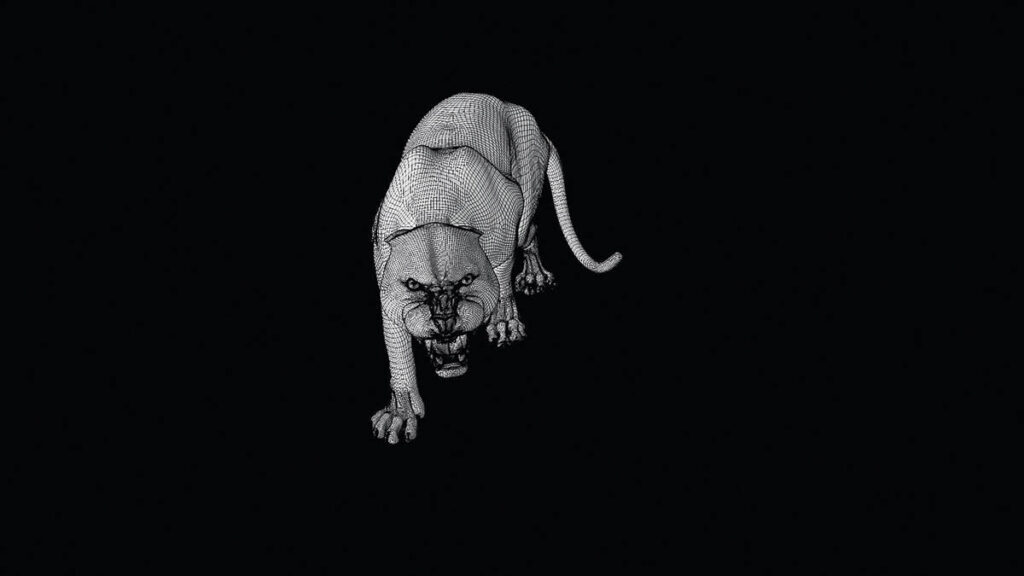
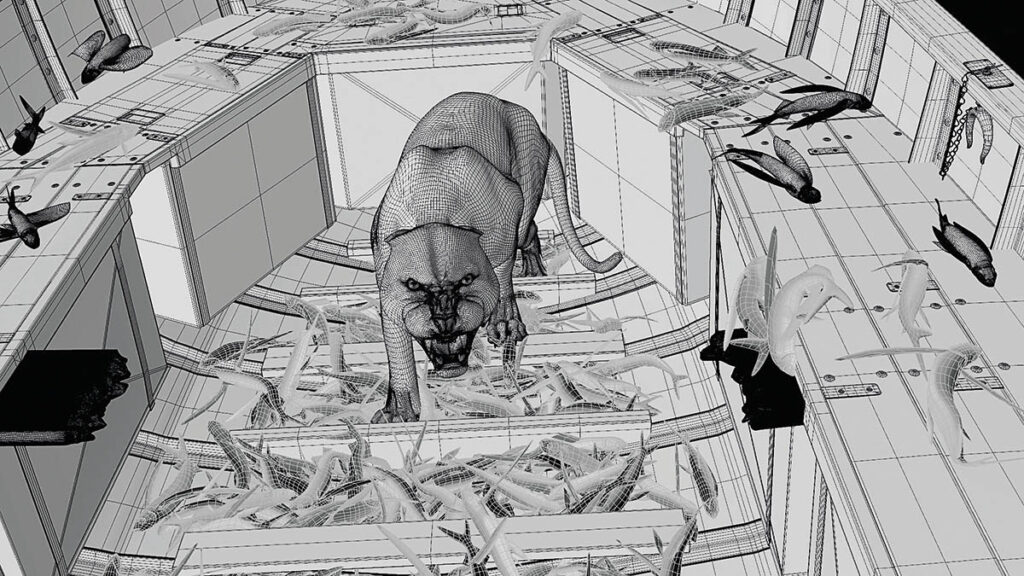
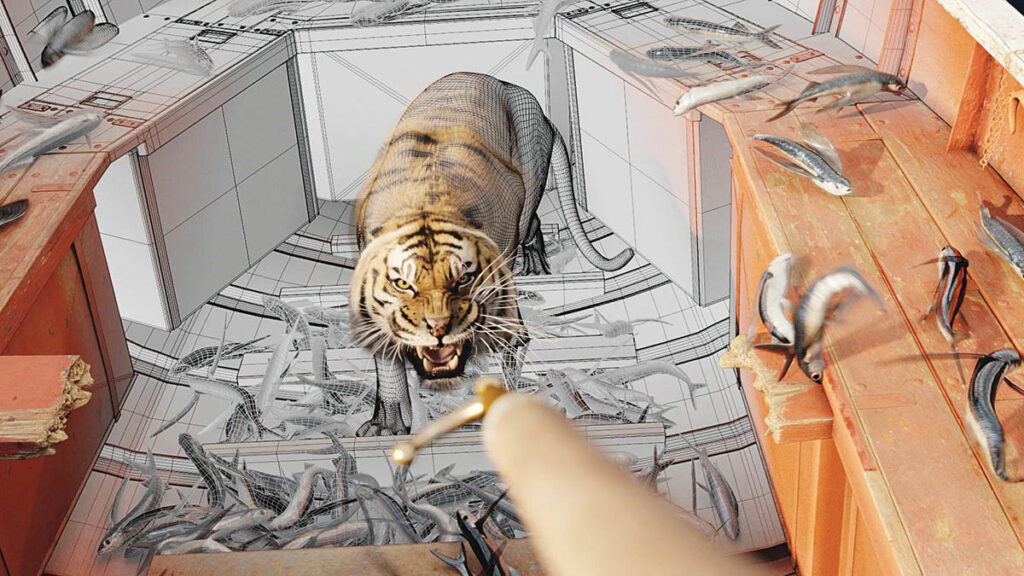
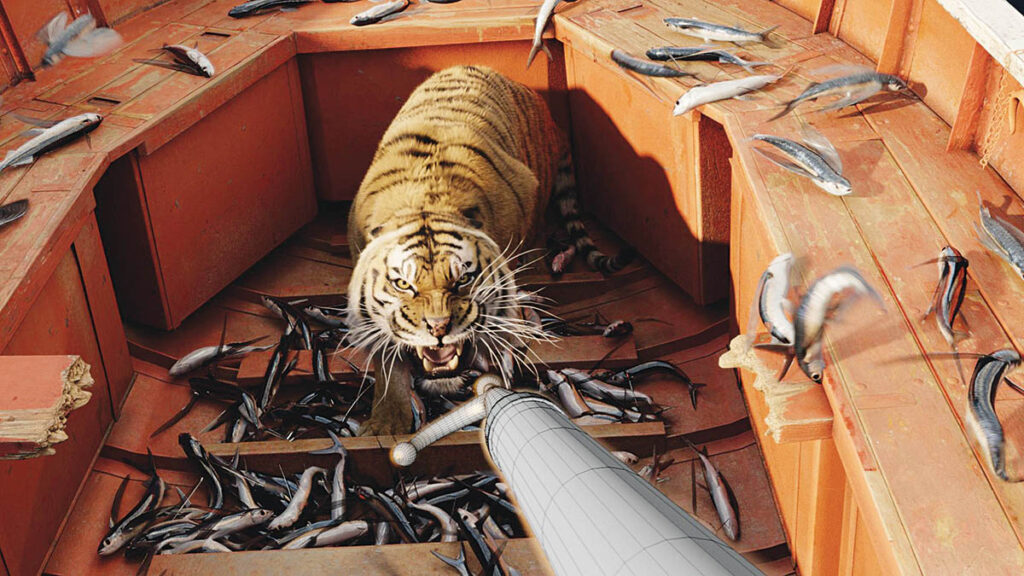
Paws can be quite expressive. “Not just the obvious pro- or retracted state of the claws, but also the change in shape between relaxed, load-bearing and placements on uneven surfaces,” de Boer observes. “We did additional research and development on our extremities and greatly improved the modeling, mechanics and control structures of the paws. When Richard Parker confronts Pi for the first time and Pi throws him the rat, there is a moment where it had to become clear that the cat is uncomfortable on the tarp. We are close-up on both paws with a right claw stuck in the cloth. Richard Parker pulls away and the claw releases, muscles flex, tendons groove the skin, and the darker interior fur flashes in and out with the claws. The paw digits articulate, and the shape changes are clearly legible. There is texture and detail in the motion. This fidelity really allowed us to bring a level of realism and a sense of real weight and connection to the contacts that we had not achieved before.”
Freelance Visual Effects Supervisor Jason Bayever was a digital effects supervisor at Rhythm & Hues. “Believe it or not, Alvin and the Chipmunks had a heavy influence on Richard Parker,” Bayever reveals. “Alvin and the Chipmunks essentially had the same face rig as Richard Parker. This enabled our modeling department and everybody leading up to this to have a consistent list of blend shapes. It meant that our animators didn’t have to learn a new face shape and a new process for each character. If they wanted a certain shape, that shape was always there. We could also build motion libraries for those shapes. Theoretically, we could have taken Alvin’s lip syncing a song and applied it directly to Richard Parker. It was an unbelievable system for rigging.”
Other layers had to be built for Richard Parker. “One thing that’s very cool about wild animals is their disconnected scapula,” Bayever observes. “Our scapula is connected, so you can only move it a little bit. When lions, tigers or any of those big cats walk, their scapula moves up and down, which enables them to be powerful and run quickly. They are almost 500 pounds of pure muscle inside a sack of skin, so they can move around within it, unlike us. There’s a lot of what we call ‘skin slide.’ They built a sophisticated system of multiple layers of simulation. I believe there were three simulations: under skin, muscles and over skin on top of that. That was just the rigging side of it. We did a lot of side-by-side comparisons of King [a real tiger used as reference], and then our simulation. Erik-Jan de Boer’s team would animate the tiger doing the exact same thing that King was doing in the real footage. We would keep simulating and building processes until the two of them matched.” A prequel franchise has elevated the CG creature pipeline. “There is no question that the Planet of the Apes movies have taken furry creatures and character elements to a whole new level.”