Motion Control – these two words strike fear in the hearts of ADs and lines on the foreheads of directors. While developments in camera tracking software have reduced the need for motion control on live-action sets, judicious use of motion control can make difficult shots easy and impossible ones possible.
What is Motion Control?
A motion control camera rig uses computer-controlled motors for accurate reproduction of camera movement with respect to time. Motion control rigs range from motorized pan/tilt heads to cranes with eight or more motorized axes of movement. A motion control programmer ope ates the rig with its highly specialized computer – choreographing camera moves that can then be edited in order to smooth out bumps, change timing or adjust framing. In addition to moving the camera, the computer can be used to control lighting effects and movement of models or props. Different types of rigs have different capabilities, strengths and weaknesses.
Four basic uses for motion control are:
Performance Choreography
Sometimes a shot calls for a camera move that requires either a faster motion or more abrupt acceleration or deceleration that can be achieved with human-powered camera equipment. These shots can often be achieved with motion control rigs because of their powerful motorized axes. The ability to program the various axes separately and to edit the moves on the computer to smooth out problems allows the Director and DP to fine-tune the shot until they are satisfied.
Multiple-Pass Photography
Obvious examples of multiple-pass live action motion control are twin shots where one actor plays two or more characters within a shot. Less obvious are soft split shots where actors and animals act in different passes or an actor reacts to a physical effect shot in the second pass. Another use has been shooting clean passes for rig removal. Multiple-pass photography also can be used to duplicate a foreground greenscreen camera move when shooting the background plate or playing back a move to shoot a greenscreen element to be composited into an existing shot.
Scaling
Both temporal and spatial scaling are accomplished by shooting different passes at different speeds. While many people are familiar with the scaling done when combining live-action motion control shots with miniature motion control model work, a less familiar use involves shooting live-action shots of a normal-sized character interacting with a miniature or giant character. Here, a motion control move is scaled up or down and repeated with the other-sized character. The two elements are then composited in post. Software designers have created tools that allow the programmer to scale complex moves by taking into consideration the axes of rig manipulation.
Import/Export of Camera Move Data
The development of camera tracking software packages has greatly simplified and automated the painstaking task of extrapolating camera movement in a shot and applying it to the other elements for the composite. Situations still exist where recording camera positional data against a frame-accurate time base or streaming camera positional data to drive a real or virtual camera’s movement is advisable. It’s important to understand how the data will be used and coordinate formatting and transfer to the visual effects house. A text file full of numerical angle and distance values is mostly useless unless the user knows what they relate to.
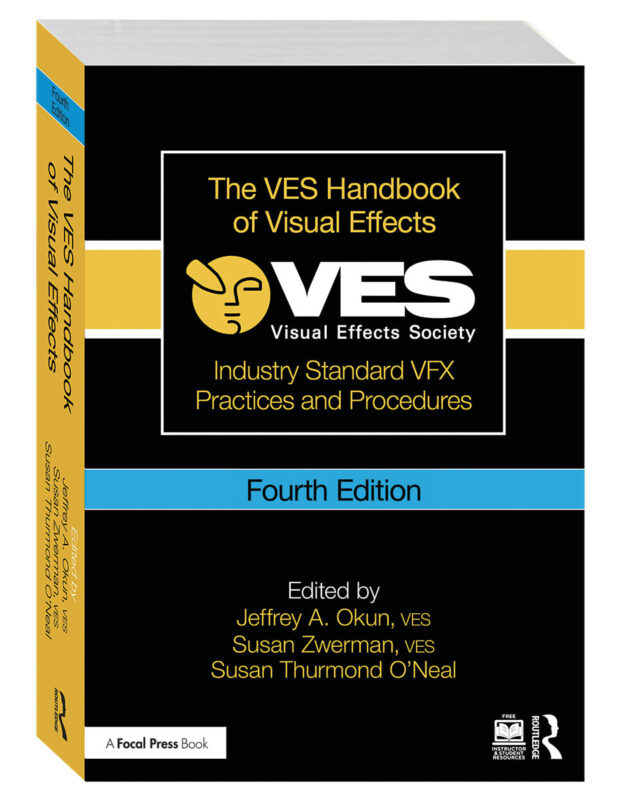
Purchase your copy here:
http://bit.ly/3JnG2yT